
A considered process, built for longevity
Our raised beds are designed with the same care for appearance as they are for longevity. Surface, proportion, and material choice are resolved together, not traded off against one another.
What sets our work apart is not how it looks on day one, but how it continues to perform, weather, and mature over time. That difference comes from a slower, more deliberate process that works with timber, rather than forcing it into shortcuts
Our work is proof that sustainability is not achieved by doing less, but by doing better at every stage of the process. Through careful craftsmanship and responsible design decisions, we create raised beds that retain both their structural integrity and visual presence long after others begin to fail.
The principles behind sustainable wood craftsmanship
Every decision we make begins with purpose. A process or material chosen for speed, cost-cutting, or surface appeal alone has no place in our work.
Sustainable wood craftsmanship is not a single technique or finish. It is a way of thinking that guides every choice, from timber selection and seasoning through to how each board is worked, finished, and assembled.
These principles shape how we source materials, how we prepare them, and how each raised bed is built to perform in real gardens over time, not just at installation.
Locally sourced timber
We work with responsibly sourced Western Red Cedar and Douglas Fir from trusted local suppliers wherever possible. These timbers are chosen not only for their durability and character, but for how reliably they perform when prepared correctly.
Working close to the source allows us to understand how the timber has grown, how it has been handled, and how it is likely to behave over time. This knowledge is essential when building raised beds intended to live outdoors year-round, where seasonal movement and exposure are part of the design brief, not an afterthought.
By sourcing locally, we retain control at the very start of the process, ensuring every board enters seasoning and preparation with known properties rather than assumptions.
Timber choice and provenance
We work with two carefully selected timbers: Western Red Cedar and Douglas Fir. Each is chosen not for fashion or convenience, but for how it behaves over time when exposed to real garden conditions.
Western Red Cedar is naturally stable, lightweight, and rich in protective oils. Its fine, even grain responds exceptionally well to the Yakisugi process, producing a surface with clarity, depth, and long-term resilience. It forms the backbone of our work and is our preferred choice where longevity, refinement, and visual balance are paramount.
Douglas Fir is a denser, more resinous timber with a bolder grain structure. It behaves differently under flame, producing greater variation and a more expressive surface. While slower and more demanding to work, it offers an alternative character for projects where a more rugged or architectural presence is desired. We include it deliberately, not as a lesser option, but as a different material language.
All timber is sourced from trusted UK suppliers with clear provenance. Western Red Cedar is responsibly imported and milled to specification, while Douglas Fir is grown and processed within the UK. Working close to source allows us to select boards for suitability rather than speed, maintain consistency across projects, and ensure that every decision is made with long-term performance in mind.
This approach gives us control from the very beginning. Timber choice is never an afterthought. It is the foundation on which every raised bed is designed, seasoned, and built.
What follows is not a finish applied to timber, but a transformation revealed through it.

Seasoning that protects your investment
We work with timber that is cut to order rather than pulled from stored stock. As a result, every project begins with a deliberate seasoning phase before any shaping, charring, or assembly takes place.
Freshly milled timber carries internal moisture and tension that must be allowed to equalise naturally. Rushing this stage leads to movement later. Splitting, twisting, and stress failures often appear months after installation, once the timber is exposed to real weather cycles. We design around this reality rather than attempting to control it after the fact.
Before any further work begins, boards are stacked, spaced, and left to season under controlled outdoor conditions. Airflow, time, and patience allow the timber to stabilise gradually, releasing internal stresses and reducing the risk of future distortion. Depending on the species and thickness, this stage alone can take several weeks.
This approach serves two purposes. Structurally, it produces timber that behaves predictably once installed. Visually, it allows the grain to settle before surface treatment, ensuring the character revealed later through Yakisugi is honest and enduring rather than forced.
Seasoning is not a delay in our process. It is the first stage of construction. Everything that follows depends on it.
Once the timber has reached its natural balance, it is ready for the controlled transformation that defines our work.
How an 18th-century Japanese method is protecting Dorset wood today
We did not arrive at Yakisugi by tradition or trend.
We were looking for a way to protect timber without coatings that sit on the surface, trap moisture, or fail over time. We wanted a finish that worked with the material rather than against it, and that could offer genuine longevity without chemicals.
That search led us to Yakisugi.


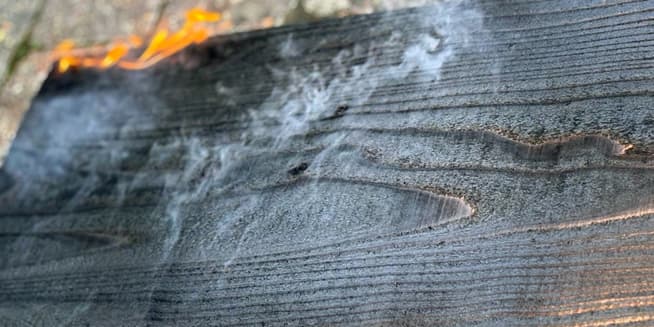
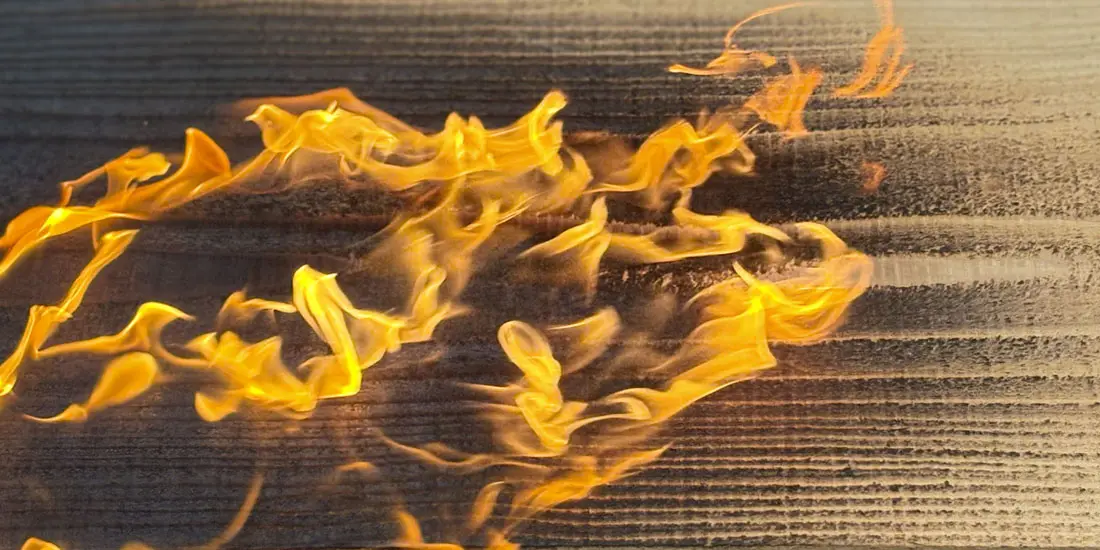
Yakisugi is a surface treatment that uses controlled flame to modify the outer layer of the wood. Rather than sealing the timber beneath a film, the process alters the surface itself, changing how the wood responds to moisture, UV exposure, and biological decay.
We use Yakisugi because it aligns with our wider approach to durability. The process strengthens the outer fibres of the timber, reduces moisture absorption, and creates a naturally resilient surface while preserving the structure beneath. When applied correctly, it protects without compromising breathability or long-term stability.
The method demands judgement. Heat must be carefully controlled, and every board responds slightly differently depending on grain, density, and species. Yakisugi is not applied for appearance alone. It is a material decision that requires restraint, experience, and respect for the timber being transformed.
If you would like a deeper explanation of how Yakisugi works and why we use it, we explore the process in more detail in our article on the science and thinking behind Yakisugi.
Here in Dorset, we apply the technique with intention rather than imitation. The goal is not to recreate a historical aesthetic, but to use a proven method to solve a modern problem: how to protect timber naturally, at scale, and for the long term.
Yakisugi is not the end of our process. It is the point at which protection and character begin to converge.
Refining the char, the Pika-Pika technique
After charring, the timber is intentionally left to cool and settle before any further work begins. At this stage, the surface is fully protected, but it is not yet resolved.
Rather than leaving the char intact, we carefully refine it using a controlled brushing process known as Pika-Pika. This removes loose carbon from the surface while preserving the hardened outer fibres created during charring.

The purpose of this step is not cosmetic. Refining the char stabilises the surface, prevents carbon transfer, and reveals the underlying grain structure without compromising the protective layer beneath. It is here that the timber begins to express its natural character, shaped by flame but not obscured by it.
This stage requires judgement. Brush too lightly and the surface remains unstable. Brush too aggressively and the benefits of charring are diminished. Each board is assessed individually, allowing the refinement to respond to grain, density, and species rather than following a fixed formula.
Pika-Pika is the point where restraint matters most. It is where protection becomes usable, and where durability begins to take on form.
Protecting beauty, naturally
Once the char has been refined, the timber is ready for its final protection.
We arrived at this stage through careful testing rather than assumption. The goal was not simply to protect the surface, but to preserve the appearance of the timber while supporting the long-term performance of everything that comes before it.

We use a carefully selected system of natural, zero-VOC oils that bond with the timber, rather than forming a surface film. This allows the wood to breathe and move naturally, while providing durable resistance to moisture, UV exposure, and biological growth. The protection becomes part of the material rather than a layer applied on top.
Time is a critical part of this decision. The oil system is applied with sufficient curing intervals to allow each coat to fully integrate with the timber. Once complete, the surface does not rely on seasonal reapplication to remain effective. Instead, it is designed to hold its character and protection over multiple years, allowing the timber to age gradually rather than degrade.
The result is a surface that resists water, retains colour stability, and discourages fungal growth, all without compromising breathability or texture. Beauty is preserved not through regular intervention, but through a finish chosen to endure.
This final stage is not about fixing the timber in place. It is about giving it the conditions it needs to mature gracefully, supported rather than constrained.
Where others stop, our process begins
Most companies stop when the timber arrives. For us, that’s only the beginning. Each board is dried, charred, brushed, and oiled to reveal its natural strength and beauty, using processes designed to protect, not disguise. The result is a raised bed that stands apart, one shaped by craftsmanship, guided by sustainability, and built to last.
Functional art for your garden.