Raised bed calculator explained: inside The Deflection Doctor
We built The Deflection Doctor because we went looking for a raised bed calculator we could actually use ourselves and could not find one. We wanted something that would do more than tell us how much soil a bed might hold. We wanted to know what that fill would weigh when wet, whether the structure was likely to deflect under load, and what could be changed before build to make the design more stable. That tool did not seem to exist, so we built it.
That experience also raised a wider question. If we were searching for a calculator that could answer those questions and coming up short, how many other people were doing exactly the same? How many gardeners, homeowners, and makers were being left with volume calculators that stopped too early, or engineering tools that asked far more of them and still did not tell them what to change next? That gap is what led to the raised bed calculator we now call The Deflection Doctor.
The aim was not to produce another tool that simply returns a number. It was to build something that could help people make a better decision before they spend money, cut timber, and fill a bed. This article explains how that calculator works, the assumptions behind it, and why we designed it to diagnose likely structural risk and prescribe changes rather than leave users guessing.
Key takeaway: The Deflection Doctor was built because most raised bed calculators stop at soil volume and most beam calculators ask too much while still leaving users to work out the fix for themselves. This tool sits between those extremes by estimating saturated weight, structural deflection risk, and suggested design changes before you build.
Why existing raised bed calculators were not enough
The first problem was not that raised bed calculators did not exist. It was that the ones we found solved a narrower problem than the one we were trying to solve. Most were built to answer a quantity question: how much soil, compost, or topsoil will this bed hold? That is useful, but it is only one part of a much bigger decision.
Soil calculators stop at quantity
A basic raised bed soil calculator is usually interested in volume. Enter the length, width, and height, and it returns litres, cubic metres, or the number of bags you might need. For buying fill, that is helpful. For understanding whether the structure itself is likely to behave well once filled, it is not enough.
The missing step is weight. Dry volume is one thing. Wet fill is another. Once soil becomes saturated, the load on the walls changes significantly, and that is where a raised bed stops being just a container and starts becoming a structure under pressure. A calculator that stops at volume can tell you how much material to buy, but it cannot tell you much about what that material may do to the bed once it is holding real weight.
That matters because many raised beds are built with a rough sense that they will probably be fine. Timber looks thick enough. The span does not feel excessive. The dimensions seem normal. But none of that is the same as checking what the wall is likely to experience under wet load.
What we needed sat somewhere between these two familiar but incomplete types of tool.
| Feature | Basic volume calculator | Beam calculator | The Deflection Doctor |
|---|---|---|---|
| Soil volume | ✅ Yes | ❌ No | ✅ Yes |
| Saturated weight | ❌ No | ❌ No | ✅ Yes |
| Structural assessment | ❌ No | ✅ Yes | ✅ Yes |
| Suggested fixes | ❌ No | ❌ No | ✅ Yes |
Beam calculators can be powerful, but they are not practical for most users
At the other extreme, proper beam deflection calculators do exist. They can be powerful, but they are often built for people who already understand structural inputs and know exactly what numbers to enter. They tend to ask for far more information, and even then they usually stop at the structural output itself. You may get a result, but not much help interpreting it or improving it.
That creates a different kind of gap. A simple soil calculator stops too early because it never becomes structural. A beam calculator can become highly technical, but still leave the user with a pass-fail style answer and no obvious route forward. For most gardeners, homeowners, and small makers, neither approach is ideal.
What we wanted sat between those extremes: a tool simple enough to use quickly, but smart enough to say something meaningful about structural behaviour before build.
How two extra inputs turned a soil calculator into a decision tool
A basic soil calculator usually needs only dimensions. That is enough to estimate volume, but not enough to say much about how the structure itself is likely to behave. The Deflection Doctor asks for just two more meaningful inputs than a simple volume tool, and those two additions change the question completely.
A simple soil calculator tells you how much fill you need
Length, width, and height are enough to work out volume. That is useful if the only question is how much compost, soil, or blended fill to buy. But volume alone does not tell you what load the wall may need to resist, how the board is likely to behave under that load, or whether the design is asking too much of the timber.
That is why so many raised bed calculators stop at the point where the structural question is only just beginning.
Timber species and board thickness turn that into a structural question
Once you add timber species and board thickness, the problem changes. It is no longer only about how much material sits inside the bed. It becomes a question of how a particular board is likely to respond when that fill becomes heavy and wet.
Species matters because wood is not one generic material. Different timbers have different stiffness characteristics, and ignoring that would flatten important real-world differences into a fake average. Thickness matters because structural behaviour depends heavily on section size. Without board thickness, you can estimate weight, but you cannot sensibly estimate likely deflection. That is the point where the calculator moves from quantity into engineering.
Length still matters, but in a different way. In this calculator, the entered length is treated as the longest unsupported span, because that is usually where deflection risk becomes most meaningful. In other words, the structural question comes from a combination of entered dimensions, species, and thickness, not dimensions alone.
Why five inputs was the sweet spot
We could have asked for more. In fact, a much more detailed structural model could ask for far more. But public calculators become less useful very quickly when the number of inputs rises and users are pushed into guessing technical values they do not really know.
Five inputs was the point where this tool still felt quick, usable, and realistic for ordinary users, while also giving the model enough information to say something meaningfully structural. Go much further, and the calculator starts drifting away from practical pre-build guidance and toward a slower, more technical tool that many people would abandon or fill in inaccurately.
That trade-off was deliberate. The aim was not to model everything. It was to capture the few extra variables that change the result most while keeping the calculator simple enough to use properly.
We did not want a calculator that only returned numbers. We wanted one that asked just enough to help people make a better decision.
Just as importantly, the calculator treats length as the longest unsupported span. That means users are not only entering a dimension. They are also defining the structural condition the wall must cope with. A 4 metre bed with a support at every metre is not behaving like a 4 metre unsupported wall. In that case, the meaningful length for the calculator is 1 metre, because that is the longest distance between supports.
By asking for species and thickness, the tool can also move beyond a generic idea of timber and start treating the board as a real structural element with its own stiffness characteristics. That is where the calculator stops being a volume tool and starts becoming something closer to an engineering judgement made usable for ordinary people like us.
What the calculator assumes, and why
Any public-facing structural calculator has to make assumptions. The real question is not whether they exist, but whether they are visible, reasonable, and suited to the problem being solved. We wanted The Deflection Doctor to be transparent about that. It is not trying to model every possible site condition, fixing detail, timber grade, or long-term ageing pattern. It is built around a simplified baseline that makes the results quick enough to use, clear enough to interpret, and grounded enough to be useful before build.
Why we use saturated soil weight and 20% moisture
The calculator uses a saturated soil density of 1,920 kg per cubic metre because a raised bed does not face its greatest structural demand when the fill is dry and light. It faces it when the soil is wet, heavy, and putting the greatest load on the wall. That is the condition most likely to reveal whether a design is asking too much of its span, thickness, or timber choice.
We also chose 20% moisture content for the timber assumption because this is an outdoor garden structure, not a piece of indoor joinery. Timber in service outside is not living in idealised laboratory conditions, and using overly dry assumptions would make the result feel more optimistic than we thought was responsible. The aim here was not to predict every seasonal fluctuation in moisture, but to use a practical condition that better reflects how timber often behaves in the real world.
Why MOE and MOR both matter
To estimate likely deflection, the calculator needs to treat the board as more than just a piece of wood with a name. That is where stiffness matters. Species matters because different timbers resist bending differently, and that difference becomes meaningful once a wall is carrying real wet load across a real unsupported span.
This is where Modulus of Elasticity, or MOE, comes in. In simple terms, it is a measure of how resistant a material is to elastic bending under load. That matters here because the first structural question for most raised beds is not whether a board will snap immediately, but how much it is likely to move. Bowing is often the first visible sign that a design is being pushed too far, so stiffness sits near the centre of the model.
But the calculator does not stop there. It also uses Modulus of Rupture, or MOR, to help flag when a design may be moving beyond a deflection concern and into a more serious bending-stress range. That is why severe results can trigger a warning that, under this simplified baseline, bending stress may also be approaching or exceeding the rupture range for the selected timber. In other words, MOE helps the tool estimate likely movement, while MOR helps it recognise when the structural concern may be becoming more serious.
Why braces, restraint, and long-term creep are not treated as simple universal inputs
This is also where the model deliberately stops. In real life, raised beds can be affected by many more things than the calculator asks for: intermediate supports, brace design, fixing strategy, post spacing, connection strength, soil friction, long-term creep, repeated wetting and drying, and variations in timber quality, to name only a few.
Some of those factors can reduce risk significantly. Some can create a false sense of security if they are poorly detailed. That is exactly why we did not want to bolt them on as simplistic tick-box inputs. A brace is not automatically a fix. A support only matters if it is properly placed and properly doing its job. Long-term creep is real, but modelling it meaningfully would require more information than most users could confidently provide.
So this section is really about restraint as much as modelling. The Deflection Doctor makes clear assumptions rather than pretending to universal precision. It is built to answer an important pre-build question quickly and honestly, not to imitate a full structural analysis package with guessed inputs.
Why diagnosis alone was not enough
A warning on its own is only half useful. It might tell someone that a design is marginal, but it still leaves them with the harder question: what should change? Reduce the length? Use thicker boards? Choose a stiffer species? Lower the height? Add a support? Without that next step, many calculators still leave the user hanging at the very moment they most need help.
Most tools leave you with a number or a warning
That is one of the biggest weaknesses in this space. A calculator may give a volume figure, a load figure, or even a structural result, but the user is often left to interpret it alone. For a confident engineer, that may be manageable. For an ordinary user trying to plan a raised bed, it usually is not.
A bare result also creates a second problem. Even when a warning is understood, it does not automatically lead to a better design. Users can end up knowing there is a risk without knowing which variable matters most, which change is likely to help most, or whether a small adjustment would solve the issue at all.
The Deflection Doctor suggests changes
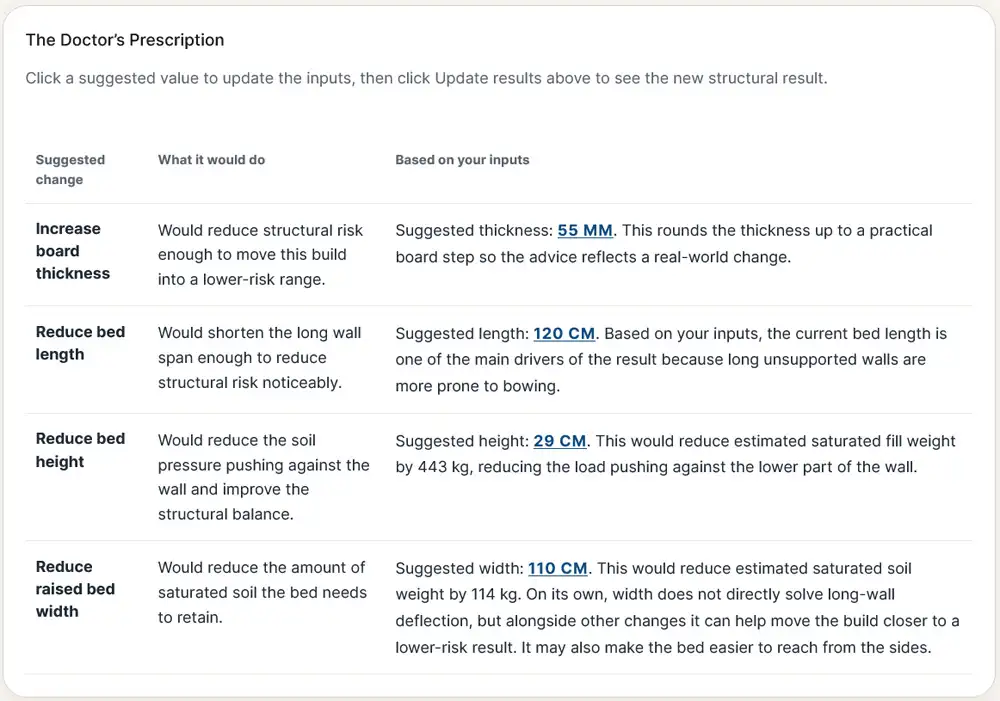
That is why The Deflection Doctor was built to prescribe, not just diagnose. Identifying a weak design is useful, but only if the tool also helps the user see a route toward a better one. If a design looks weak under the calculator’s simplified baseline, the tool does not stop at the warning. It suggests practical changes that can move the result back toward a more stable range.
A warning is only half useful if the user is left to guess the fix.
That matters because not all fixes are equal. Sometimes the answer may be to reduce the longest unsupported span. Sometimes it may be to increase board thickness. Sometimes it may be to rethink the dimensions altogether. The point is not to leave the user staring at a problem with no route forward. It is to give them a clearer path toward a better design.
Why that can save time and money before build
This is where the calculator starts saving people real time and money. Guesswork costs money. It can mean buying timber for a bed that was never structurally convincing, filling it, watching it move, and then having to reinforce, rebuild, or live with the result. It also costs time, because design mistakes are always easier to correct before timber is cut and soil is inside the bed.
The Deflection Doctor cannot remove every possible cause of failure, and it does not pretend otherwise. Ground conditions, moisture behaviour, detailing, build quality, and long-term durability still matter. But deflection should not be one of the avoidable mistakes discovered after the bed is built. If the calculator helps users reach a more stable design before they spend money and commit to the build, it has already done something most tools in this space never attempt.
Why the tool was designed to feel accessible
The subject behind this calculator is structural enough to become dry very quickly. Wet soil weight, board stiffness, unsupported span, and rupture range all matter, but they are not naturally inviting topics for most gardeners, homeowners, or DIY builders. We did not want the tool to feel like a mini engineering exam. We wanted it to stay usable, memorable, and easy to engage with, even while dealing with real structural questions.
Why we gave it a name with personality
The name The Deflection Doctor was part of that. It adds a little character to a subject that could otherwise feel cold and technical, but it also describes what the tool actually does. It diagnoses a likely problem, then tries to prescribe a remedy. In that sense, the name is not decorative branding. It reflects the tool’s real job.
That mattered because the calculator was always meant to sit between two extremes: the oversimplified volume tool and the intimidating structural calculator. The name helps make that middle ground feel more approachable without pretending the underlying question is trivial.
Why we use vehicle comparisons to make weight feel real

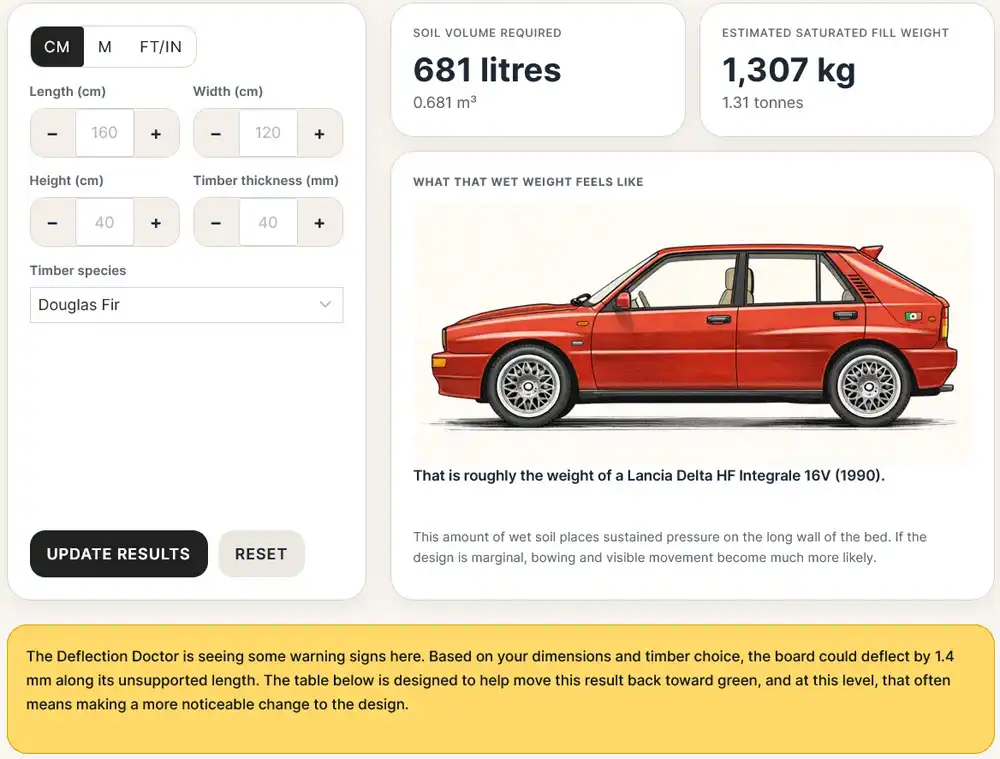
Weight is one of the most important outputs in the calculator, but it is also one of the hardest to picture. A result in kilograms or tonnes may be precise, yet still not mean much to someone trying to imagine what that load actually feels like in the real world. That is why the calculator pairs saturated fill weight with vehicle comparisons.
Seeing that a bed may weigh roughly the same as a Fiat 500 or a Lancia Delta does something a bare number often cannot. It turns an abstract load into something immediate. The point is not novelty. It is clarity. A familiar object gives the user a faster and more intuitive sense of what the long wall may be resisting once the bed is full and wet.
Why the print summary only appears at 1 mm deflection or less
The printable summary follows the same logic. It is not available for every result, because not every result deserves to be treated as something worth keeping and building from. The button only appears when predicted deflection is 1 mm or less under the calculator’s simplified baseline.
That threshold is deliberate. The summary is not a build sheet or a guarantee. It is a clean record of the dimensions entered, the estimated soil volume, the saturated fill weight, the structural verdict, the assumptions used, and a QR code that reopens the same design. Restricting that feature to stronger results is part of the calculator’s trust boundary. It is the tool’s way of distinguishing between a design that still needs revision and one that has reached a stable enough range to be worth saving.
The physics and engineering under the bonnet
Everything above explains why the calculator exists and why it was designed the way it was. This section is for readers who want the shorter technical version of what it is actually doing. The Deflection Doctor is still a simplified model, but it is not guesswork. It combines volume, saturated load, timber properties, section size, and unsupported span into a practical deflection-risk check that can also flag when bending stress may be approaching a more serious range.
The Deflection Doctor is a simplified model, but it is not guesswork
The baseline assumptions it starts from
For structural assessment, the calculator uses a saturated soil density of 1,920 kg per cubic metre. Timber is assessed at 20% moisture content to reflect a more realistic outdoor service condition than overly dry laboratory values. The entered length is treated as the longest unsupported span, because that is the distance over which bowing risk becomes most meaningful.
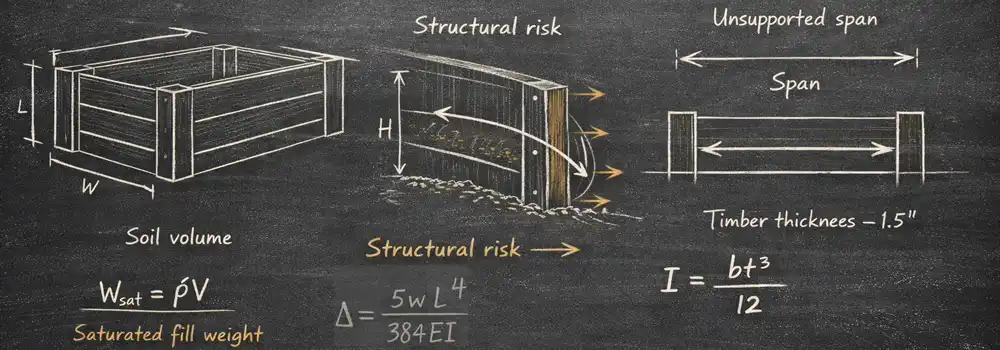
The model also applies a K value of 0.35 as part of its simplified baseline. Here, K is a load-shape factor. It reflects that the pressure acting on a raised bed wall is not treated as a simple even load, but as a more realistic pressure pattern that changes through the height of the fill. That lets the calculator turn a messy real-world condition into a usable structural approximation.
How stiffness and section size enter the model
Species matters because different timbers have different Modulus of Elasticity values. That is what allows the calculator to treat Douglas Fir, Western Red Cedar, and other timbers as structurally distinct rather than as one generic wood category. In simple terms, MOE tells the model how resistant the board is to elastic bending under load.
Thickness matters because section size has a major effect on stiffness. The calculator uses the second moment of area for a rectangular section:
I = bt³ / 12
That is why thickness changes the result so strongly. It is not just more material. Because thickness is cubed in the calculation, even a modest increase in board depth can produce a much larger jump in stiffness than many people expect.
How the calculator estimates movement and stress
Once the saturated load, span, species, and section properties are known, the calculator uses a standard beam-deflection form to estimate likely movement under the simplified baseline:
Δ = 5wL⁴ / 384EI
Here, w is the load per unit length acting along the board. That is the core of the deflection estimate and the point where the calculator moves beyond volume into likely structural behaviour.
The tool also checks bending stress against Modulus of Rupture values for the selected timber. That does not turn it into a full failure-analysis package, but it does allow the calculator to warn when a result may be moving beyond a deflection concern and into a range where bending stress may also be approaching or exceeding the rupture limit under the simplified baseline.
Why this section stays brief
A full structural model could go much further. It could ask about post spacing, brace geometry, fixing strength, timber grade, creep, cyclic wetting and drying, soil interaction, and many other variables. But that would be a different kind of tool altogether. The Deflection Doctor is designed to stay usable while still being engineering-led.
So this is the right level to understand it: real structural logic, real timber properties, real equations, but held inside a simplified and declared baseline built for pre-build decisions rather than formal structural certification.
A raised bed calculator should not leave you guessing
That was the whole point of building The Deflection Doctor. We could find tools that told us how much soil a bed might hold, and we could find more technical calculators that demanded far more input, but we could not find one that gave ordinary users a practical route from idea to better decision. So we built the tool we had been looking for.
What makes it useful is not just that it calculates. It estimates saturated weight, treats the long wall as a structural span, accounts for timber species and thickness, and then goes one step further by suggesting what to change when the result looks weak. That is what turns it from a quantity tool into a decision tool.
It also reflects a simple belief: people should be able to understand a structural risk before they spend money on timber, soil, and build time. Not every raised bed problem can be solved by a calculator, and this one does not pretend otherwise. Ground conditions, detailing, build quality, durability, and maintenance still matter. But deflection should not be one of the avoidable mistakes discovered after a bed is built and filled.
Now that you know what sits behind it, the next best step is to try the raised bed calculator for yourself. Change the dimensions, thickness, or timber species and see how the result moves. That is where The Deflection Doctor becomes most useful: not just in explaining risk, but in helping you design your way toward a more stable bed before you build.