Raised bed myths: moisture and durability advice that sounds right but fails
Raised bed durability myths often sound sensible because they focus on visible protection. Add a liner, choose a durable species, check whether the timber feels dry, and it is easy to assume the main risks have been managed. But wood does not fail because it looks exposed. It fails because moisture moves, lingers, and returns in ways that surface logic often misses.
That is why so much durability advice sounds right while still producing disappointing results. It treats protection as a barrier problem, when durability is really a moisture-behaviour problem. What matters is not just whether timber gets wet, but where it gets wet most often, how long that moisture stays there, and whether the wood is able to dry properly between wet periods.
This is where many common assumptions break down. A raised bed can look tidy, feel dry at the surface, and still hold the conditions that decay needs in its most vulnerable zones. Durable timber can resist exposure better than many alternatives, but it is not immune to poor detailing or repeated wetting. And some of the habits people trust most can trap moisture more effectively than they prevent it.
This article looks at the moisture and durability advice that sounds convincing but fails under closer inspection. The aim is not to dismiss protection, but to understand what real protection actually depends on.
Key takeaway: Raised bed durability is not determined by whether timber gets wet at all, but by where moisture concentrates, how long it stays, and whether the wood can recover between wet periods. Many common “protective” habits fail because they focus on barriers, labels, or surface dryness while ignoring trapped moisture, vulnerable details, and the zones where decay usually begins.
Why moisture and durability myths sound right even when they fail
Most moisture and durability myths survive because they begin with something broadly true. Timber does need protection. Durable species do perform better than weak ones. A dry surface is usually better than a wet one. The problem is that these ideas are often applied too loosely, without asking where moisture is actually entering, where it is being held, and whether the timber is able to dry properly between wet periods.
That is where surface logic starts to break down. A detail can look protective while quietly trapping moisture. A durable timber can still decay if the same vulnerable zone stays wet often enough for long enough. A board can feel dry on the face while remaining persistently damp deeper in the section or around the end grain. In other words, the myths do not spread because they are completely false. They spread because they simplify real moisture behaviour into neat, visible rules.
Raised beds make that simplification especially tempting. People tend to think in terms of inside versus outside, wet versus dry, protected versus exposed. But durability depends on more than that. It depends on repeated wetting, splashback, wicking, trapped interfaces, vulnerable edges, recovery time, and the difference between visible condition and actual moisture history. Once those factors are ignored, advice can sound sensible while directing attention away from the places where timber usually begins to fail.
This is where the myths begin to separate from how timber actually behaves. The table below summarises the most common moisture and durability assumptions, why they sound convincing, where they break down, and what better judgement looks like once moisture movement, drying, and vulnerable zones are taken seriously.
| Myth | Why it sounds plausible | Why it fails | Better judgement | Why the better answer works |
|---|---|---|---|---|
| Plastic liners prevent wood rot | A barrier seems like the simplest way to keep moisture away from timber. | Plastic can trap moisture against the timber and reduce drying at the interface rather than solving the real wetting pattern. | Judge protection by moisture behaviour, not by whether a barrier has been added. | Durability improves when wet zones can dry and recover, not when moisture is merely hidden behind a layer. |
| Capping rails are purely decorative | They sit at the top and are often noticed first as a visual finishing detail. | Top edges and end grain are exposed to repeated wetting, so a cap can reduce direct water entry into vulnerable areas. | See capping as potential protective detailing, not just ornament. | Good top detailing helps shed water away from exposed edges and slows repeated moisture uptake. |
| End grain does not matter | Most attention goes to the wide board faces because they look more exposed. | End grain takes up moisture more readily because the timber fibres are exposed at the cut ends, often at the most vulnerable points in the assembly. | Treat end grain as a priority durability zone. | Protecting the fastest uptake points helps reduce moisture persistence where failure often begins first. |
| Cedar is effectively rot-proof | Cedar is naturally durable, so it is easy to overstate what that protection means in service. | Natural durability improves resistance to decay, but it does not make timber immune to repeated wetting, trapped moisture, or poor recovery. | Use durable timber as one part of a system, not as a substitute for sound detailing. | Resistance helps most when the design also limits persistent wetness and allows the wood to dry properly. |
| “Dry rot” happens because wood gets old, not because it stays wet | The name encourages people to think age alone causes decay. | Decay depends on moisture conditions, not simply the passage of time. | Think in terms of wetness history and moisture persistence, not age alone. | Timber lasts when the conditions needed for fungal activity are interrupted often enough. |
| If the timber feels dry today, the durability problem has passed | A dry touch suggests the wood has stabilised and the risk is over. | Surface dryness can hide deeper or more localised dampness in vulnerable zones that dry more slowly than the face. | Judge durability by repeated exposure and recovery, not by a single dry moment. | Decay risk depends on how often moisture returns and how long vulnerable areas stay wet over time. |
| The inside face of a raised bed matters more than the outside base zone | The soil side feels like the obvious source of moisture and pressure. | Outside base zones often face repeated splashback, ground wetting, and slower drying, even when the inside face gets most of the attention. | Assess durability by looking at the whole moisture pattern, especially near the base and lower outer zones. | Timber often fails first where wetting is repeated and recovery is weakest, not where attention is naturally drawn. |
| Surface appearance tells you whether a bed is structurally and durably sound | Visible condition feels like the quickest way to judge health. | Surface appearance can lag behind internal wetness, hidden decay, or local structural weakness. | Use visible condition as one clue, not as the whole diagnosis. | Real durability judgement depends on moisture history, vulnerable details, and where deterioration is most likely to begin. |
Myths about what protects timber
Many protection myths begin with the same assumption: if water can be blocked, timber will be safe. That sounds sensible because it treats durability as a problem of exposure alone. But timber does not respond simply to whether water is present or absent. It responds to where moisture enters, how often it returns, how long it remains, and whether the wood can dry properly between wet periods.
That is why apparently protective measures can fail so badly. A detail may reduce direct exposure in one place while increasing trapped moisture in another. A material may look sealed while quietly holding dampness against the timber for longer. And a raised bed can appear protected in theory while still creating the exact wet conditions decay depends on in practice.
Real protection is not just about keeping water out at a surface level. It is about managing moisture behaviour across the whole assembly, especially at interfaces, exposed edges, and other priority durability zones. Once that becomes the frame, several familiar assumptions start to collapse.
Myth: Plastic liners prevent wood rot
A plastic liner sounds like an obvious form of protection. If wet soil sits against the inside face of a raised bed, then adding a barrier between soil and timber appears to solve the problem neatly. It fits the common belief that wood rots because moisture touches it, so preventing contact must prevent decay.
That logic is appealing, but too simple. Timber durability is not determined by whether moisture is blocked at one visible boundary. It depends on how moisture behaves over time across the whole board, especially whether damp zones are able to dry and recover between wet periods. A plastic liner can change where water sits and how long it stays there, but that is not the same as removing risk.
The scientific problem is reduced drying potential. When plastic sits directly against timber, it can limit moisture release at that interface rather than improve durability overall. Any dampness entering from above, from imperfect edges, from end grain, from fixings, or from the wider wet conditions around the bed may then have fewer opportunities to dissipate. Instead of timber drying more freely across its exposed surfaces, part of the board is now placed against a low-breathability layer that can slow recovery.
A liner does not remove the moisture problem. It often changes where the moisture sits and how slowly it dries.
This matters because decay is driven by persistent moisture, not by occasional contact with water alone. Wood can get wet and dry again without automatically failing. The real risk appears when vulnerable zones stay damp often enough, for long enough, that fungal activity can continue. A liner does not cancel that risk. In some situations, it can worsen it by slowing the drying cycle the timber depends on.
It also protects the part people notice most easily, not always the part most likely to fail first. The broad inside face feels like the obvious danger zone because it touches the soil, but many durability problems begin elsewhere: at exposed top edges, at end grain, around fixings, and near the lower outside zone where splashback and ground wetting are repeated. In other words, the liner can act as visual reassurance while leaving several higher-risk ingress and persistence points largely unchanged.
The better judgement is to stop thinking in terms of barrier equals protection. Protection should be judged by whether the timber can shed water, avoid persistent traps, and dry properly after wet periods. Breathability, detailing, end-grain awareness, and reduced moisture persistence matter more than placing a sheet of plastic against one face and assuming the problem is solved.
A liner may sometimes be used for other reasons, but it should never be mistaken for a universal anti-rot measure. If the moisture behaviour of the whole system is poor, plastic does not rescue it. It simply changes the route by which the problem appears.
Myth: Capping rails are purely decorative
A capping rail is often treated as a finishing touch. It changes the profile of the bed, gives the top edge a neater appearance, and can make the whole structure look more deliberate. That makes it easy to talk about capping as if it were mainly visual.
The real issue is not whether it looks decorative. It is whether it improves or worsens moisture behaviour at one of the most exposed parts of the bed.
The top edge already matters because it is a primary wetting zone. Rain lands there directly, and if the surface is flat or poorly detailed, water is more likely to sit than shed cleanly. That repeated top-down wetting makes the upper edge part of the durability system whether people think of it that way or not.
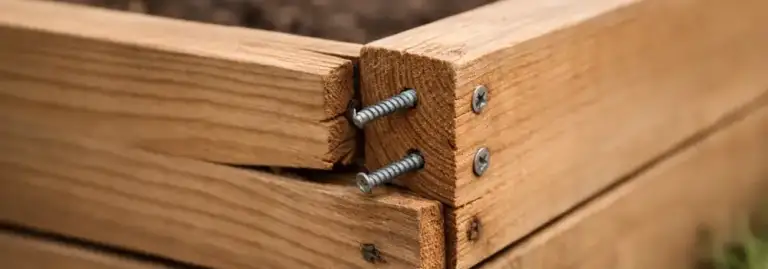
This is where many capping rails make things worse rather than better. In typical garden builds, the cap is fixed from above with vertical screws driven down into the top of the board. That creates direct ingress points in exactly the surface most exposed to rainfall. If the screw head is small, recessed, or sits slightly below the timber surface, it can also leave a shallow depression where water collects. Instead of helping the board shed water, the detail can hold moisture around the fixing and give it a route into the timber below.
That is a serious durability problem because the top edge is not an occasional splash zone. It is a repeated wetting zone that needs to dry well if the board is to last. Once water is encouraged to sit around a fixing point and move into the fibres below, recovery becomes slower and local moisture persistence becomes more likely. In practice, that means the detail can accelerate failure in the very place it appears to be protecting.

This is why the myth fails in both directions. A capping rail is not purely decorative, because the top edge is too important for that to be true. But neither is a capping rail automatically a durability upgrade. If it is top-mounted in a way that punctures the board from above and creates water-holding points, poor detailing can be worse than no detailing at all. This is one example of why raised beds often fail through detailing decisions that look sensible at first glance.
Better judgement starts with the top edge as a priority durability zone. Any detail added there should help water shed quickly, avoid exposed ingress points, and reduce moisture persistence rather than increase it. If a capping rail does the opposite, its visual appeal is irrelevant. It is not protecting the bed. It is accelerating one of its most vulnerable failure routes.
Myth: End grain does not matter
End grain is easy to underrate because it usually occupies less visible surface area than the face of a board. When people look at a raised bed, they tend to focus on the broad sides, the soil contact, or the outside appearance. The cut ends can seem secondary by comparison, as if they are just small edges within a much larger timber structure.
From a durability point of view, that is a serious mistake. End grain does not behave like the board face. It is the cut end of the timber fibres, which means moisture can enter more readily there than through the long face of the board. Put simply, the face of a board is more like the side of a bundle of straws, while the end grain is the open ends. That does not mean every cut end will immediately fail, but it does mean the route into the wood is much more direct.
That difference matters because raised beds repeatedly expose vulnerable zones to wetting. Rain from above, water sitting on the top edge, splashback near the base, dampness around joints, and moisture around fixings all create opportunities for uptake. When any of that exposure reaches end grain, the timber is often less able to resist rapid local absorption than people assume. The result is not just that the end gets wet. It is that moisture can move deeper into a high-risk part of the component more quickly, while drying may lag behind the surface.
The science is straightforward, even if the consequences are often overlooked. Timber is made of long fibres. When the wood is cut across those fibres, the end grain leaves those pathways more directly exposed. On the board face, moisture is meeting the sides of those fibres. At the cut end, it is meeting the open route into them. In material terms, this is known as capillary action: water is drawn into narrow exposed pathways more readily than it is through the side of the board. That is why end grain can behave more like an intake point than the face. It is also one reason raised bed longevity depends so heavily on design and detailing, not just timber thickness or species.
End grain may be one of the smallest visible parts of the bed, but it is one of the fastest routes by which water enters the timber.
This is one reason badly detailed corners, board ends, and top-mounted fixings can cause such disproportionate damage. They do not simply expose timber in a general sense. They expose one of its fastest uptake points. That makes end grain a priority durability zone, especially where it coincides with repeated wetting or slow recovery.
This also explains why the previous myth about capping rails matters so much. A badly detailed top rail does not just put fixings into a wet zone. It can channel repeated wetting into the cut ends and upper edges where the wood is least forgiving. In that sense, poor top detailing is not merely sitting above the board. It is feeding one of the fastest moisture-entry routes in the whole assembly.
This is why end grain should never be treated as a minor finishing issue. In many cases, it matters more than a much larger stretch of board face. A broad timber surface may look more exposed, but if it sheds water reasonably well and dries effectively, it can remain sound for a long time. A much smaller area of exposed end grain under repeated wetting can become a more serious durability threat.
The better judgement is to stop thinking about timber risk in terms of surface area alone. Durability depends far more on how a surface behaves than on how large it looks. End grain matters because it combines fast uptake with frequent exposure at exactly the kinds of locations where poor detailing tends to concentrate moisture.
So the myth fails for a simple reason: not all timber surfaces are equal. End grain is one of the least forgiving parts of the whole assembly. Ignore it, and you ignore one of the clearest routes by which water enters, persists, and begins to shorten the life of the bed.
Myths about durable timber and decay
This section corrects a different kind of misunderstanding. The previous myths were mainly about protective details: liners, capping, and exposed end grain. These next myths are about what people assume durable timber can withstand, why decay begins, and how easily surface impressions can distort the real picture.
That matters because durability is often misunderstood twice over. First, people overestimate what a good species can tolerate. Then they misread decay itself, treating it as an age problem, a surface problem, or something that should be obvious the moment it appears. In reality, timber durability depends on the relationship between material resistance and moisture conditions over time.
A durable species can buy time, but it cannot cancel persistent wetness. Decay can begin long before it looks dramatic. And a dry surface today does not necessarily mean the underlying moisture problem has passed. Once those distinctions are clear, several common assumptions become much easier to dismantle.
Myth: Cedar is effectively rot-proof
Cedar has a strong reputation for durability, and that reputation is deserved. It performs better than many common softwoods in wet outdoor conditions, which is why it is so often associated with long-lasting garden structures. Once people hear that, though, the claim often drifts from “naturally durable” to something much less accurate: that cedar is effectively rot-proof and can be trusted to look after itself.
That is where the myth begins. Durable timber is not immune timber. Cedar resists decay better because of its natural chemistry, not because moisture no longer matters once cedar is chosen. Its durability comes from natural extractives within the wood, compounds that make it less hospitable to decay organisms than many other timbers, which is one reason Western Red Cedar is so widely valued for long-lasting raised beds. What it does not bring is invulnerability.
That distinction matters because resistance and immunity are not the same thing. A naturally durable species can tolerate tougher conditions and longer exposure before failure begins, but it still operates within a moisture environment. If wetting is repeated, drying is poor, and vulnerable zones stay damp for too long, even durable timber can be pushed into conditions where decay becomes possible. The species helps, but it does not override the physics of moisture persistence.
This is why cedar is best understood as one part of a durability system rather than a substitute for one. Good timber can buy time. It can slow the process. It can give a well-designed bed a wider margin for error than a weaker material would. But it cannot rescue weak detailing, trapped moisture, repeated splashback, exposed end grain, or top-mounted ingress points that keep feeding water into the structure.
The science behind the myth is straightforward. Cedar contains natural extractives that improve biological durability, which is one reason it has such a strong outdoor reputation. But those protective compounds are a form of resistance, not a magic shield. They do not stop wood from taking up moisture, and they do not make prolonged wetness irrelevant. If the conditions favour decay strongly enough for long enough, natural durability can be overcome.
That is where surface thinking causes trouble. People often assume that once cedar has been specified, the real durability decisions are over. In practice, the opposite is true. The more durable the timber, the more wasteful it becomes to pair it with poor moisture management. Choosing cedar but ignoring wetting and drying behaviour is a bit like buying a higher-quality roof covering and then detailing the valleys badly. The material is better, but the failure route is still there.
Better judgement begins by treating cedar as a higher-performance material within a larger system. It should be combined with good detailing, attention to priority durability zones, clean shedding of water, and the ability to recover between wet periods. Used that way, cedar’s natural durability becomes a genuine long-term advantage. Used as a licence to ignore moisture behaviour, it becomes badly misunderstood.
So the myth fails because it confuses strong resistance with total protection. Cedar is durable, but durability is still conditional. The timber gives you more margin, not immunity, and that margin can be lost surprisingly quickly when design, detailing, or moisture behaviour are poor.
Myth: “Dry rot” happens because wood gets old, not because it stays wet
“Dry rot” is one of those phrases that sounds self-explanatory while quietly misleading people. The name encourages the idea that timber can somehow rot because it is old, tired, or naturally breaking down over time, even without meaningful moisture problems. Once that idea settles in, decay starts to sound like an age issue rather than an environmental one.
That is the heart of the myth. Timber does not begin to decay simply because years have passed. Decay depends on conditions. Wood lasts or fails according to whether the environment repeatedly supplies what decay organisms need to remain active. Age matters only in the sense that more time creates more opportunities for those conditions to occur. Time does not cause rot on its own.
The scientific distinction matters here. Rot is a biological process. Fungi do not appear because timber has reached a certain age. They depend on a suitable moisture environment, along with oxygen and favourable temperatures, to colonise and keep breaking wood down. In simple terms, the problem is not that timber gets old. The problem is that it stays wet enough, often enough, for biological activity to continue. That is why raised bed lifespan is always a question of conditions and system behaviour, not age alone.
Wood does not rot because it gets old. It rots because the conditions for decay stay active for too long.
That is why the phrase “dry rot” causes so much confusion. It sounds as though dryness is part of the cause, when in reality decay still depends on moisture. The useful correction is not to argue over terminology for its own sake, but to restore attention to the real mechanism: persistent wetness, not mere age, is what makes decay possible.
This matters because age-based thinking encourages the wrong kind of diagnosis. If people assume a bed has started to rot simply because it is old, they may miss the actual reason one part is failing before another. They may blame years in service when the more important question is where moisture has been lingering, where recovery has been poor, and which durability zones have spent too long in the wrong conditions.
Raised beds make this especially important because their moisture pattern is uneven. A single bed is not one uniform environment. It is a collection of local moisture conditions. One section can remain sound for years while another deteriorates much sooner, not because the timber in one area is “older”, but because the wetting and drying pattern is different. Lower outer zones, top edges, end grain, and poorly detailed joints can all create local environments where decay is more likely to continue.
Better judgement begins by treating rot as a condition-driven process rather than a clock. Ask where moisture is entering, where it is being held, and whether the wood is drying properly between wet periods. Those questions explain far more about durability than age ever can.
So the myth fails because it mistakes elapsed time for the cause of failure. Time may increase exposure to risk, but moisture creates the conditions that make decay possible. If you want to understand why wood fails, the real question is not how old it is. It is how wet it has been, for how long, and in which parts of the structure.
Myth: If the timber feels dry today, the durability problem has passed
This myth feels sensible because touch is immediate and persuasive. If the timber surface feels dry, it is easy to assume the wood has stabilised, recovered, and moved out of danger. That instinct is understandable. In daily life, dryness often signals safety. A dry floor is less risky than a wet one. Dry clothes are ready to wear. A dry surface feels like a resolved problem.
Timber durability does not work that simply. Surface dryness and internal moisture history are not the same thing. A board can feel dry on the face while still holding dampness deeper in the section, around fixings, at the end grain, or in sheltered zones where evaporation is slower. In other words, a dry touch can describe the outer skin of the problem while missing the part that matters most.
The science here is about moisture gradients: the difference between what is happening at the surface and what is happening deeper inside the timber. The outer face usually responds first to sun, wind, and warmer air. Internal moisture, or moisture held in exposed pathways such as end grain and fixing points, can lag behind. So the board may appear to have dried when what has really happened is uneven recovery. The surface has changed faster than the deeper risk.
That distinction matters because decay depends on moisture persistence, not on whether the surface happens to feel dry at one moment. Timber can warm up, dry superficially, and look improved while still carrying repeated wetting deeper inside vulnerable areas. If those zones never recover properly between wet periods, the durability problem has not passed. It has simply become less visible.
This is one reason visible reassurance can be so misleading in raised beds. Lower outer zones may dry slowly after splashback. The area around a screw can hold moisture longer than the board around it. End grain can take in water quickly and release it more slowly. A top edge may feel fine in the afternoon sun, while a more sheltered part of the same component remains damp enough to keep the problem alive.
That is why a single dry moment tells you very little on its own. Durability is shaped by the pattern, not the snapshot. What matters is how often the timber gets wet, which parts stay wet longest, and whether those areas have enough drying potential to recover before the next wetting cycle begins.
Better judgement starts by treating surface dryness as one clue, not a verdict. It is useful to notice, but it is not enough. The more important question is whether the timber is repeatedly returning to wet conditions faster than its vulnerable zones can recover. If that cycle continues, the problem remains even when the surface feels fine.
So the myth fails because it confuses a momentary impression with a real change in condition. A board that feels dry today may still be part of a moisture pattern that is shortening its life. Durability is not decided by a quick touch test. It is decided by repeated exposure, slow recovery, and the parts of the structure where moisture persists longest.
Myths about where durability problems begin
Some of the most persistent durability mistakes come from looking in the wrong place. People tend to focus on the broad inside face of a raised bed because that is where the soil sits, where moisture feels most obvious, and where pressure appears to act most directly. It is the surface that seems busiest, so it naturally attracts the most concern.
That instinct is understandable, but often misleading. Timber rarely fails according to where attention is naturally drawn. It fails according to where wetting is repeated, where water lingers, and where recovery is consistently weak. In raised beds, those conditions are often concentrated in smaller, less obvious zones rather than across the most visually dominant surface.
This is why diagnosis matters so much. A bed can look sound across most of its visible boards while beginning to deteriorate in just a few high-risk areas. Splashback, base wetting, exposed end grain, fixings, and poorly drying corners can all create local moisture environments that matter far more than the broader surfaces people usually inspect first.
The myths in this section are not mainly about species choice or protective details. They are about where failure actually begins, and why surface impressions so often direct attention away from the real problem.
Myth: The inside face of a raised bed matters more than the outside base zone
This myth feels intuitive because the inside face is where the soil sits. It is the surface holding back moisture and pressure, so it seems like the obvious place to worry about decay. If one side of the bed looks as though it ought to be under the greatest strain, it is usually the side in contact with damp growing media.
That logic makes sense at first glance, but it misses how outdoor moisture actually behaves. The inside face may be consistently damp to some degree, yet it is not always the part experiencing the most damaging durability pattern. In many raised beds, the outside base zone is under greater pressure because it combines repeated splashback, ground moisture, poor airflow, dirt accumulation, and slower drying in one concentrated area.
That combination matters because durability is not governed by which surface looks most exposed in theory. It is governed by where moisture persists most stubbornly in practice. The lower outer zone is often hit by rain bouncing up from the ground, dampness rising from below, and local shading or restricted airflow that slows recovery. In material terms, uptake from below is often driven by capillary rise, where moisture moves upward through narrow gaps and porous material rather than simply sitting on the surface.
The outside base zone often becomes the harsher durability environment because repeated splashback and slower drying can concentrate there even when the inside face gets most of the attention.

This is one reason the outside of a bed can deteriorate faster than people expect, even when their attention stays fixed on the soil side. The inner face may be damp, but the outer base can experience a harsher wet-dry cycle: repeated splashback, frequent rewetting, dirt loading, slower evaporation, and less chance to recover cleanly. That cycling matters because fluctuating wetness can be more damaging than people assume. It repeatedly feeds moisture into the fibres, interrupts drying, and can gradually open more small pathways for water to keep returning. It is one reason the environment around a raised bed often affects durability more than people expect.
The geometry of the bed makes this easy to miss. The outside base zone occupies relatively little visual space, and it is close to the ground, where dirt, shadow, mulch, and planting can conceal what is happening. Yet this is exactly where several risk factors often converge: lower board edges, corner posts, fixings, end grain, contact with wet ground, and the first area hit by rebound water in bad weather. A broad inner face may dominate the eye, but a narrow outer strip can dominate the failure pattern.
This is also why site conditions matter so much. A bed in an exposed, fast-drying location will behave very differently from one surrounded by hard surfaces, dense planting, poor drainage, or persistent splashback. The myth survives because people imagine moisture as a simple inside-versus-outside problem. In reality, the relevant question is which local zone spends the most time wet enough, often enough, to struggle to recover.
Better judgement starts by inspecting the bed as a set of different moisture environments rather than one uniform timber box. Look closely at the lower outside edges, the corners, the posts, the area just above the ground, and any places where splashback, dirt, or standing dampness are repeated. Those zones often reveal more about real durability than the broad inner surface ever will.
So the myth fails because it confuses the most obvious moisture source with the most damaging moisture pattern. The inside face matters, but it is often not where the real durability problem begins. In many raised beds, the outside base zone is the harsher environment, the slower-drying zone, and the place where biological failure often starts long before most people think to look.
Myth: Surface appearance tells you whether a bed is structurally and durably sound
This myth survives because visual judgement feels efficient. If a raised bed still looks straight, the boards seem solid, and the timber surface appears dry or tidy, it is easy to assume the structure is fundamentally sound. Most people trust what they can see. A bed with obvious distortion, cracking, or collapse clearly has a problem, so the reverse assumption follows naturally: if those signs are absent, the bed must still be healthy.
That is a dangerous shortcut. Surface appearance can tell you something, but it cannot tell you everything that matters. Timber often deteriorates from local moisture persistence, hidden ingress points, or slow internal weakening long before the whole structure announces the problem clearly at the surface. In other words, visible condition can lag behind real condition.
This matters because durability failure and structural failure do not always appear at the same moment. A raised bed may still look broadly intact while decay has already started in a corner post, around a fixing, at the end grain, or in the outside base zone. The board face may remain visually convincing even while the most important load-bearing or moisture-sensitive details are losing strength. By the time the surface looks obviously wrong, the underlying problem may already be well advanced.
A raised bed can look sound while beginning to fail in its most vulnerable zones.
The science here is about hidden moisture history and uneven deterioration. Timber is not one uniform material responding evenly across every part of the bed. Different zones wet differently, dry differently, and carry different structural roles. A broad board face may weather attractively and remain visually calm, while a much smaller section near the base, a joint, or a fixing point experiences repeated wetting and slower recovery. That means the most important warning signs are often local, not general.
This is why surface appearance can be especially misleading in well-made beds. Good materials and decent workmanship may allow the structure to retain its overall shape for quite a long time, even while one durability zone is quietly deteriorating. Straight lines, attractive grain, and a clean finish do not prove that the high-risk details are still sound. They only prove that failure has not yet become visually dramatic.
The reverse mistake happens too. People sometimes see superficial weathering, colour change, or minor surface checking and assume the timber is failing, when the real structure is still sound. That is the other reason visual judgement is unreliable on its own: some visible changes are cosmetic, while some serious problems remain largely hidden. Looking weathered is not the same as being weak, and looking good is not the same as being healthy.
Raised beds make this especially important because their risk is concentrated in specific places. Corners, posts, end grain, top edges, lower outer zones, and fixing points tell you more than the broad middle of the board. If those areas are not being inspected, the diagnosis is likely to be too optimistic or too simplistic.
Better judgement begins by treating appearance as a clue rather than a conclusion. Look beyond whether the bed appears tidy or aged. Ask where moisture has been entering, where it may have been trapped, which zones carry the most risk, and whether the details most exposed to repeated wetting still feel structurally firm. That is a much more reliable way to understand real durability. That is exactly why surface appearance and real condition are not the same thing in a raised bed.
So the myth fails because appearance is only the surface expression of a deeper process. A raised bed can look sound while beginning to fail in its most vulnerable zones, and it can look weathered without being structurally compromised. Real judgement comes from reading the moisture pattern, the details, and the failure-prone areas, not from trusting the overall impression alone.
What better durability judgement looks like
If moisture and durability myths have one thing in common, it is that they encourage people to look for simple reassurance. A liner feels protective. A durable species feels safe. A dry surface feels recovered. A tidy bed looks sound. The problem is that timber does not respond to reassurance. It responds to conditions.
Better judgement begins when attention shifts from appearance to behaviour. Instead of asking whether the timber looks protected, ask how water is actually moving through the bed. Instead of asking whether the species is durable, ask whether the design allows it to dry and recover. Instead of trusting the broad visible surfaces, inspect the smaller zones where repeated wetting, trapped moisture, and slow drying are most likely to converge.
That changes the whole diagnosis. Durability is no longer a question of labels, isolated details, or surface impressions. It becomes a question of moisture persistence, ingress routes, recovery time, and vulnerable zones. Once that frame is in place, many common myths lose their appeal because they are no longer answering the right question.
This is also why two beds made from the same timber can age very differently. The wood matters, but the moisture environment matters more. Good species, sound detailing, clean water shedding, protection of end grain, reduced splashback, and faster drying all work together. Remove enough of those advantages, and even durable timber can be pushed into failure. Get them broadly right, and the bed has a much stronger chance of lasting well.
So, better durability judgement is not about spotting one magic fix. It is about reading the whole system more truthfully. Look where moisture enters. Look where it lingers. Look where drying is weak. Look where the timber is least forgiving, because those critical zones often determine how the rest of the bed will age. They tell you far more about longevity than a quick touch, a surface glance, or a reassuring material label ever will.
Related reading
- Raised bed myths: structural advice that sounds right but fails
- Raised bed myths: ground preparation that sounds right but fails
- Raised bed myths: soil advice that sounds right but fails
- Raised bed myths: planting advice that sounds right but fails
- Raised bed myths: joint and assembly advice that sounds right but fails
- Raised bed myths: fixing advice that sounds right but fails