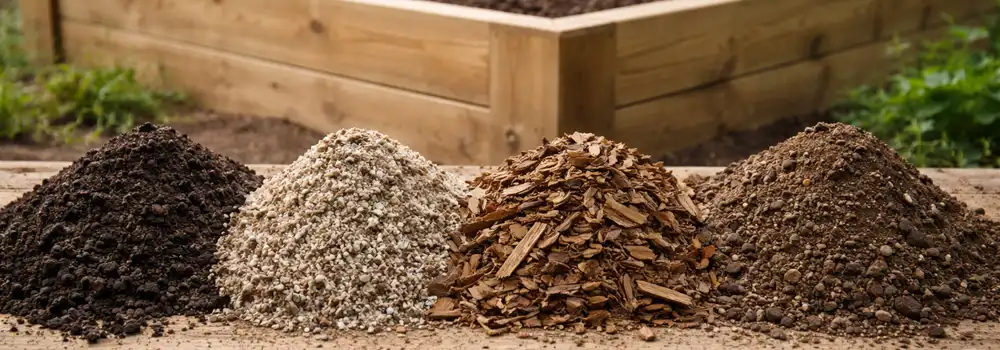
Raised bed myths: soil advice that sounds right but fails
Many raised bed soil myths sound convincing because they borrow the language of good gardening without paying attention to how soil actually functions over time. Rich-looking material is assumed to be healthy. Bagged products are assumed to be suitable. More organic matter is assumed to mean better growing.
The problem is that raised bed soil is not judged well by appearance, labels, or good intentions alone. It has to work physically, chemically, and biologically. That means holding structure, managing water and air, supporting root activity, and staying stable enough to grow well beyond the first few weeks.
This article looks at some of the most common soil and fill myths behind raised beds, explains why they sound plausible, and shows what better judgement looks like instead.
Key takeaway: Good raised-bed soil is not simply the richest, darkest, or most heavily composted material you can find. It has to function as a stable growing system. That means physical structure, chemical balance, and biological activity all need to work together over time, not just look promising at the moment of filling.
Why raised bed soil myths spread so easily
Soil myths spread easily because they attach themselves to ideas that are partly true. Compost is valuable. Organic matter matters. Commercial mixes can be useful. Woody material does decompose. The problem is not that these ideas come from nowhere. It is that they get stretched into universal rules.
Raised beds make this worse because they look self-contained. Once a bed is built and filled, it is easy to imagine that everything important is now inside the box. In reality, raised-bed soil is a living system. It settles, cycles, drains, interacts with the ground below, and changes as microbes, roots, moisture, and weather act on it.
That is why the right question is rarely “Does this ingredient sound good?” It is “How will this material behave physically, chemically, and biologically once the bed is planted and exposed to real growing conditions?”
| Myth | Why it sounds plausible | Why it fails | Better judgement | Why the better answer works |
|---|---|---|---|---|
| Compost alone is the best fill for a raised bed | Compost is fertile, dark, and associated with healthy growing | Compost alone often lacks the stable structure and balance needed for long-term root conditions | Use compost as one part of a balanced growing medium, not the whole system | A more balanced mix supports structure, moisture control, aeration, and steadier nutrient behaviour |
| Potting mix is fine for filling a raised bed | It is sold for plants, drains easily, and looks ready to use | Potting mix is usually designed for containers, not the deeper, broader, slower-changing conditions of a raised bed | Judge fill by long-term soil function, not container convenience | Raised beds need more durable structure and more stable moisture and nutrient behaviour |
| Bagged “raised bed soil” is automatically suitable | The label suggests it has already been matched to the job | Bagged products vary widely and the name alone says little about structure, balance, or performance | Judge the material itself, not the marketing category | Real suitability depends on how the mix behaves after watering, settling, and planting |
| Hügelkultur-style woody filler is always a good way to bulk out a raised bed | It seems economical, organic, and aligned with decomposition-based gardening | Woody filler can create settlement, uneven moisture, voids, and nutrient disruption | Use woody material only where its behaviour is understood and fits the bed depth, crop type, and timescale | Better judgement avoids hidden instability and matches decomposition to the growing system |
| More organic matter is always better | Organic matter improves many soils, so more sounds like a simple upgrade | Too much organic matter can destabilise structure, moisture balance, and nutrient behaviour | Use enough organic matter to support soil function, not so much that it overwhelms it | Balanced soils hold air, water, nutrients, and biological life more reliably over time |
| Rich soil always means healthy growing | Dark, fertile-looking soil is often associated with success | Apparent richness can hide poor aeration, instability, excess salts, or weak structure | Judge health by root-zone function, not by richness alone | Healthy growth depends on balance, not simply abundance |
| You can fix poor soil structure with nutrients or feed | Plants respond quickly to feeding, which makes it seem like the problem has been solved | Nutrients cannot replace pore space, drainage, oxygen, or structural stability | Correct structural problems as structural problems | Roots need a functional physical environment before fertility can work properly |
| Imported soil will always outperform the existing ground interaction | Fresh imported material sounds cleaner, better, and more controlled | Raised-bed soil still interacts with drainage, moisture movement, and biological conditions below it | Judge the bed as part of a wider soil system, not an isolated container | Long-term performance depends on interaction, not just what was delivered on day one |
| The soil in a raised bed eventually “wears out” and needs replacing | Yields can fall and soil can change over time, so replacement sounds like a reset | Most raised-bed soil problems come from imbalance, depletion, compaction, or neglect, not literal expiry | Rebuild function before replacing the whole growing medium | Living soil can often be corrected more intelligently than it can be discarded |
Myths about what makes a good raised-bed fill
Many raised-bed fill myths begin with a partial truth. Compost can be useful. Potting mix can grow plants. Bagged mixes can be convenient. Woody material does break down. The mistake is turning a potentially useful ingredient or method into a general rule.
What matters in a raised bed is not whether a material sounds fertile, organic, or ready to use. It is how that material behaves once the bed is filled, watered, planted, and exposed to time. A good fill has to do more than look promising on day one. It has to hold structure, manage water and air properly, and support biological activity without becoming unstable.
That is why the myths in this section are best judged through three questions. What happens physically to the fill as it settles and wets? What happens chemically as nutrients cycle, accumulate, or get tied up? And what happens biologically as decomposition, microbial demand, and root activity change the material over time?
Myth: Compost alone is the best fill for a raised bed
Compost has a strong reputation because it often improves soil. It adds organic matter, supports microbial life, and can increase fertility. That makes this myth sound sensible. If compost is good for soil, it is easy to assume more of it must be better, or that a raised bed should simply be filled with compost alone.
The problem is that compost is an excellent ingredient, not a complete growing system. A raised bed needs physical structure, chemical balance, and biological stability over time. Compost can support all three, but on its own it often does not hold them in balance.
Compost is an excellent ingredient, not a complete growing system.
Physically, compost alone can settle, slump, or stay wetter than roots prefer as it continues to break down. It also lacks the mineral body of real soil, so it offers less structural grip and less durable texture around the roots. That reduces pore space, which means less air in the root zone and a less stable growing environment. If it dries out hard after repeated wetting and drying, it can also become water-repellent, so water runs off the surface or down the sides instead of soaking in evenly.
Chemically, compost can vary widely in nutrient strength, pH, salt levels, and maturity. A bed filled entirely with compost may begin rich but become unbalanced, especially if nutrients are released faster than young roots can handle or salts build up in the mix. Biologically, its activity is still changing the material after the bed is filled, which means the soil can lose volume and stability as decomposition continues. In practice, that often shows up as the bed level sinking over time rather than holding its original body.
This is where the myth fails. It confuses fertility with long-term soil function. Raised-bed soil does not work well simply because it is rich. It works well when it can hold air, water, nutrients, and biological activity in a stable balance.
Better judgement is to use compost as one part of the fill, not the whole fill. A more balanced growing medium gives roots structural support, steadier moisture behaviour, and a healthier long-term environment than compost alone can usually provide. If you want a fuller explanation of how organic matter, mineral soil, and structural materials work together, see our guide to choosing the right soil mix for raised beds.
Myth: Potting mix is fine for filling a raised bed
Potting mix sounds like an obvious shortcut because it is made for growing plants. It is loose, easy to handle, and often marketed as nutrient-rich and ready to use. That makes it tempting to treat a raised bed as simply a larger version of a pot.
The problem is that a raised bed is not just a big container. Its volume, depth, moisture behaviour, and relationship with the ground below are different. Potting mixes are usually designed for pots that dry relatively quickly, are refreshed more often, and depend on a lightweight medium to avoid becoming dense or waterlogged. What works in a container does not automatically scale well into a larger, longer-lived growing system.
Physically, potting mix is often too light and too unstable to perform well as the main fill in a raised bed. It can dry too quickly in warm conditions, collapse as organic ingredients break down, or lose body over time in a deeper bed. Peat-heavy mixes can be especially difficult to re-wet if they dry out fully, which means water may run past the surface rather than soaking back into the root zone evenly. Uneven settlement can also leave the bed with less consistent rooting conditions than a more soil-like mix.
Chemically, the initial feed in a potting mix may create the impression of fertility, but that is not the same as long-term nutrient balance. Biologically, many potting mixes are built for short- to medium-term container use, not for the slower, more settled ecology of a bed that is expected to behave more like soil over time.
This is where the myth fails. It confuses suitability for pots with suitability for raised beds. A medium that performs well in a container can still be too lightweight, too temporary, and too easily destabilised for a bed that needs more lasting structure.
Better judgement is to assess the fill by how it will behave over time, not by whether it was sold for plants. A raised bed needs a medium with more durable structure, steadier moisture behaviour, and a stronger resemblance to functioning soil than potting mix alone usually provides. It is often also an unnecessarily expensive way to fill a large volume badly.
Myth: Bagged “raised bed soil” is automatically suitable
Bagged “raised bed soil” sounds reassuring because the label appears to remove the need for judgement. If the product is sold for raised beds, it is easy to assume someone else has already worked out the right balance of structure, fertility, and drainage. That makes the purchase feel safe, especially for new gardeners who do not want to get the fill wrong.
The problem is that a product category is not the same as proof of performance. Bagged mixes sold for raised beds vary widely in composition. Some are little more than compost-rich blends, some are dominated by screened green waste or forest products, and some contain far more mineral body than others. Two products can carry the same label while behaving very differently once they are watered, planted, and left to settle.
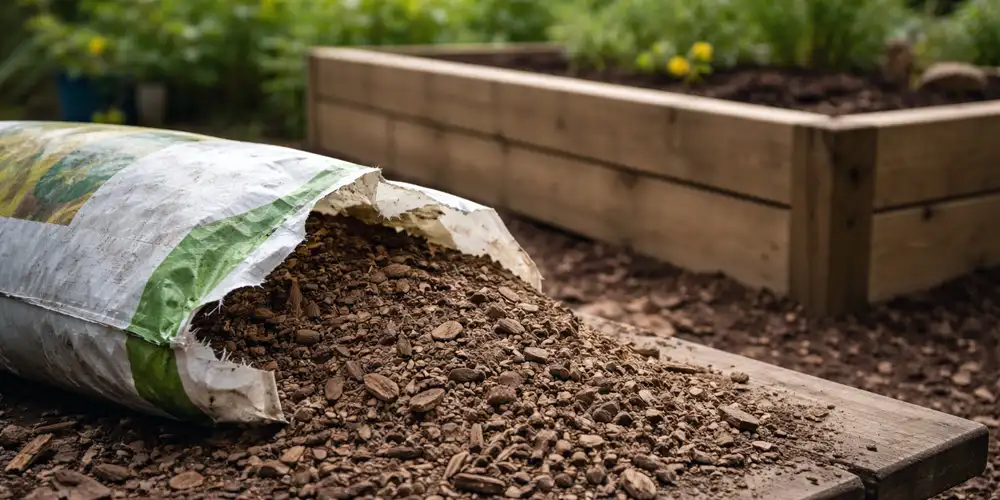
Physically, that means one “raised bed soil” may hold moisture reasonably well while another may slump, dry unevenly, or lose structure quickly. Very light bags can also be a clue that the mix contains too little mineral body to give lasting root-zone support. Chemically, nutrient levels, pH, and salinity can differ more than the label suggests. If a mix contains a high proportion of fresh woody material, it may also trigger nitrogen drawdown as microbes use available nitrogen to break that material down. Biologically, stability matters as much as the ingredient list. A mix that is still changing rapidly can behave less like settled soil and more like unfinished material in transition.
This is where the myth fails. It confuses naming with suitability. A bag label can describe a marketing category, but it cannot guarantee how that fill will perform in a real bed over time.
Better judgement is to assess what the material is likely to do after watering, settling, and planting. A good raised-bed fill needs stable structure, balanced fertility, and enough mineral body to support lasting root-zone function. That is also why it helps to understand the difference between ingredients that sound useful and a mix that actually behaves well in practice, which we explain in more detail in our guide to choosing the right soil mix for raised beds.
Myth: Hügelkultur-style woody filler is always a good way to bulk out a raised bed
Hügelkultur-style filler sounds appealing because it seems to solve several problems at once. It bulks out a bed cheaply, uses natural materials, and fits the broader gardening idea that decaying wood can feed soil over time. That makes it easy for a sound context-specific method to become a much broader rule.
The problem is that woody filler does not behave predictably enough to be treated as an automatic good idea in every raised bed. Its performance depends on the type of wood, how fresh it is, how much of it is used, where it sits in the bed, how deep the bed is, how densely it is packed, and what kind of crops are being grown above it. Once those conditions change, the same method can move from useful to disruptive.
Physically, large woody material can create voids, uneven settlement, and irregular moisture movement as it decomposes. If the spaces between the wood are not fully integrated with soil, roots can encounter dry pockets and lose access to part of the bed’s depth. One area may hold water while another dries too quickly, which makes the root zone less consistent than it appears from above. Chemically, fresh wood can cause nitrogen drawdown because microbes breaking down high-carbon material use available nitrogen in the process, especially where wood sits close to the active growing layer or directly meets the surrounding soil. Biologically, decomposition is active but uneven, so the fill continues changing long after the bed has been planted. That can make the bed sink, shift, or behave differently from one season to the next. In some cases, loose woody fill can also create sheltered habitat for rodents, which is rarely what a vegetable grower intends.
This is where the myth fails. It treats decomposition as automatically helpful, when in practice it has to be judged by timescale, proportion, bed depth, and crop needs. A method that may be useful in a large, deep, long-term bed is not automatically wise in a shallower vegetable bed where consistency matters more.
What matters is not whether the material is organic, but whether the bed remains stable enough to support healthy root conditions over time.
Better judgement is to see woody filler as a situational method, not a default shortcut. If it is used at all, it works best when the material is already well advanced in decomposition and kept well below the main growing zone, so the upper layer can still behave like stable soil. What matters is not whether the material is organic, but whether the bed remains stable enough to support healthy root conditions over time.
Myths about fertility and organic matter
Many raised-bed soil myths become persuasive at the point where healthy soil gets reduced to a simpler idea: richness. Darker soil looks better. More compost feels better. Stronger growth appears to prove that more nutrition must mean better soil.
The problem is that fertility and soil health are not the same thing. A soil can be rich but physically weak, chemically unbalanced, or biologically unstable. It may feed plants quickly while still holding too much water, losing structure, or cycling nutrients too erratically for steady long-term growing.
That is why the myths in this section need to be judged carefully. Organic matter is valuable, but only when it supports function rather than overwhelming it. Nutrients matter, but they cannot repair a root zone that lacks air, structure, or stability. The real question is not how rich the soil looks, but whether it behaves like a healthy growing system.
Fertility is not the same thing as soil health.
Myth: More organic matter is always better
Organic matter has earned its good reputation because it improves many soils. It can help with water retention, support microbial life, and contribute to nutrient supply. That makes it easy for a useful principle to turn into an exaggerated rule. If some organic matter improves soil, it can seem natural to assume that more must improve it even further.
The problem is that organic matter helps soil only when it is in balance with the rest of the system. A raised bed does not become healthier simply by becoming more organic. It becomes healthier when structure, moisture, nutrients, air, and biology remain in workable balance over time.
Physically, too much organic matter can make the growing medium less stable. It may hold too much water, slump as it breaks down, or lose the firmer texture that roots need for anchorage and even growth. When excess moisture pushes out air, parts of the root zone can become anaerobic, which weakens roots and favours the wrong kind of microbial activity. Chemically, excessive organic content can push the bed toward nutrient excess, salt build-up, or unbalanced fertility, especially when rich composts or manure-heavy materials are added repeatedly. Some organic inputs are also disproportionately high in nutrients such as phosphorus or potassium, so repeated additions can distort the balance of the soil rather than improve it. Biologically, a very organic mix may stay in a more active state of decomposition, which means the soil keeps changing instead of settling into a more stable root environment.
This is where the myth fails. It assumes that all benefits of organic matter rise in a straight line, when in reality they begin to trade off against structure and stability if pushed too far. The issue is not whether organic matter is good. It is whether the bed still behaves like functioning soil rather than a rich material that keeps moving.
Better judgement is to use organic matter to support soil performance, not dominate it. A healthy raised-bed mix needs enough organic content to feed biology and improve function, but also enough structure and mineral body to keep the root zone stable. There is no single “best” percentage, because a lettuce bed, a carrot bed, and a lavender bed do not ask the soil to do the same job. More organic matter is not always better. Better-balanced soil is better. For a fuller explanation of how the right mix changes with crop type and growing goal, see our guide to choosing the right soil mix for raised beds.
Myth: Rich soil always means healthy growing
Rich soil is one of the most persuasive gardening ideas because it often looks like success before anything has even been planted. Dark colour, strong smell, soft texture, and fast leafy growth all create the impression that the bed is thriving. That makes it easy to confuse visible abundance with actual soil health.
The problem is that richness is only one part of the picture, and sometimes not the most important part. A soil can look fertile and still behave badly. It may hold too much water, exclude air from the root zone, release nutrients too quickly, or push plants into soft growth that looks vigorous but is less balanced and more vulnerable.
Physically, a rich mix can still be too wet, too loose, or too unstable to support healthy root development over time. Plants may grow quickly but struggle to anchor well, making them more dependent on staking or support than a more balanced soil would require. Chemically, apparent abundance can hide imbalance. Excess nitrogen may produce lush top growth while weakening flowering, fruiting, or root development, which is why a plant can look impressive and still crop poorly. Biologically, a very rich soil may also encourage the kind of soft, sappy growth that attracts sap-sucking pests such as aphids, while the soil itself remains more active and less settled than many crops prefer.
Fast green growth can be a symptom of excess as easily as a sign of balance.
This is where the myth fails. It judges the bed by signs that are easy to notice rather than by the root conditions that actually govern plant health. Fast green growth, dark colour, and quick early performance can all be misleading if the underlying system is too wet, too loose, or too heavily fed.
Better judgement is to ask not whether the soil looks rich, but whether plants are growing in a stable, balanced root environment. Healthy growing depends on air, moisture balance, structure, and appropriate nutrition working together. Richness can contribute to that, but it is not proof of it.
Myth: You can fix poor soil structure with nutrients or feed
Poor plant performance often tempts gardeners toward the fastest visible intervention. If growth is weak, leaves are pale, or crops are disappointing, feed feels like action. And sometimes feeding does improve colour or speed of growth in the short term, which makes it easy to believe the real problem has been solved.
The problem is that nutrients cannot repair a physical failure in the soil. A raised bed can be poorly aerated, compacted, too wet, too loose, or structurally unstable, and none of those conditions are corrected simply by adding fertiliser. Feed may change how the plant responds above ground, but it does not rebuild pore space, restore oxygen, or create the firmer, more stable root environment that healthy growth depends on.
Physically, roots need air as much as they need nutrients. If the soil structure is poor, roots cannot explore properly, water may drain badly or sit too long, and the bed may cycle between saturation and stress. Chemically, adding more feed to a structurally weak bed can worsen imbalance by increasing nutrient concentration without improving uptake conditions. In badly draining soil, salts can also build up around the roots instead of moving through the bed, which can damage the very root system the feed was meant to help. Biologically, poor structure also affects microbial life, because the organisms that support healthy soil depend on the same balance of air, moisture, and stability that roots do.
It mistakes a response for a repair.
This is where the myth fails. Feeding a plant in bad soil can sometimes change the symptoms, but it does not correct the reason the plant was struggling in the first place.
Better judgement is to treat structural problems as structural problems. If the bed is too dense, too wet, too loose, or lacking stable body, that has to be corrected in the soil itself. Nutrients can support a healthy system, but they cannot substitute for one. That is also why it helps to understand how a balanced raised-bed mix should actually behave, which we explore in more detail in our guide to choosing the right soil mix for raised beds.
Myths about how raised-bed soil behaves over time
Some of the most persistent raised-bed soil myths come from treating the bed as if it were sealed off from the world around it. Imported soil is assumed to outperform whatever lies beneath it. Changes over time are assumed to mean the soil has “gone off” or worn out. In both cases, the mistake is the same: the bed is being judged as a static container instead of a changing growing system.
Raised-bed soil does not sit outside the normal rules of soil behaviour. Water still moves through it. Gravity still acts on it. Organic matter still decomposes. Roots still explore, microbes still cycle nutrients, and the ground below still affects drainage, moisture, and biological exchange. Even when a bed is raised above the surrounding ground, it is not isolated from time or context.
That is why the myths in this section need to be judged through interaction and change. A raised bed performs well not because the soil was perfect on day one, but because the system continues to function as it settles, connects, and matures.
Myth: Imported soil will always outperform the existing ground interaction
Imported soil sounds like an upgrade because it appears cleaner, fresher, and more controllable than whatever is already on site. If the existing ground is heavy, compacted, poor, or difficult to work, it is easy to assume that bringing in new material will automatically outperform it. That makes the solution feel simple: replace the problem from above.
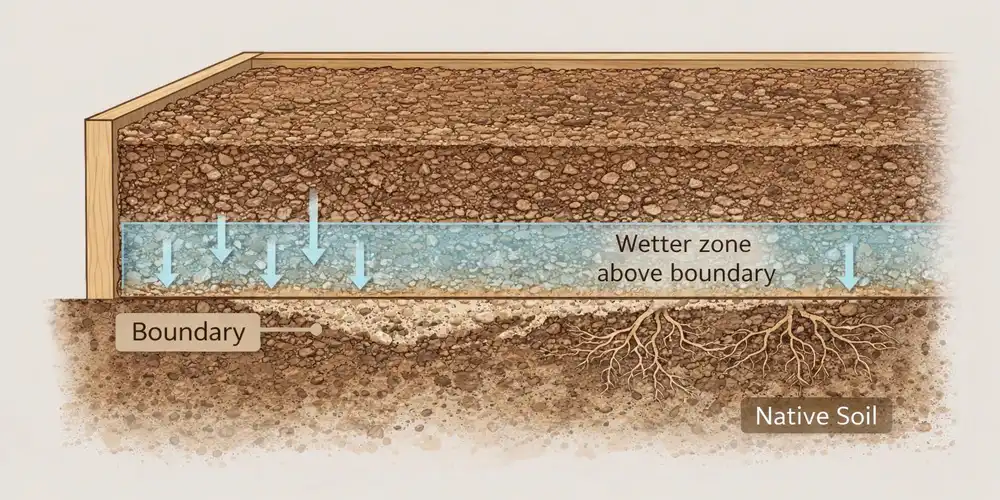
The problem is that raised-bed soil does not stop interacting with the ground beneath it just because it was imported. Water still has to move through the bed and into, or across, the conditions below. Roots still respond to the moisture pattern created at that boundary. Microbes and soil life still work within the wider environment, not inside a sealed box. A raised bed can improve difficult ground, but it does not become independent of it.
Physically, a sharp contrast between imported fill and the existing ground can create poor drainage behaviour rather than solve it. If a loose, open mix sits over heavier or slower-draining soil, water may perch above that boundary instead of moving downward as freely as gardeners expect. That can leave the bed holding more moisture above the interface and create a wetter root zone than the surface suggests. In some settings, the bed may even begin to behave like a sump, collecting and holding more water than the imported soil was meant to manage. Chemically, the imported soil may begin with a better balance, but that does not cancel out the influence of surrounding moisture conditions, leaching patterns, or the slower movement of nutrients through a bed that is not draining as assumed. Biologically, a raised bed still develops in contact with the site it sits on. Its long-term health depends partly on beneficial soil life moving and establishing through that wider ground system, rather than the bed behaving like an isolated fill layer.
A raised bed can improve difficult ground, but it does not become independent of it.
This is where the myth fails. It treats imported soil as a replacement for site conditions when it is really an intervention within them. New soil can improve a raised bed dramatically, but it still has to work with drainage, texture, moisture, and biological conditions already present below.
Better judgement is to ask how the imported fill will interact with the ground, not just whether it looks better in isolation. A good raised-bed soil is not one that arrives perfect in a bag or bulk load. It is one that still functions well once water movement, root behaviour, and settling are shaped by the site beneath it. In practice, that often means thinking about the boundary itself, not just the fill above it.
Myth: The soil in a raised bed eventually “wears out” and needs replacing
This myth is persuasive because raised-bed soil does change over time, and those changes are easy to misread. The level drops, the texture feels different, crops may become less vigorous, and the bed no longer looks as full or as fresh as it did when it was first filled. That makes it tempting to assume the soil has somehow expired.
The problem is that soil is not a static material that stays exactly as it was on day one. A living raised-bed mix settles, decomposes, cycles nutrients, grows roots, supports microbial life, and responds to watering and weather. Change is not proof of failure. Very often, it is simply proof that the soil is active.
Physically, a raised bed often drops in level because organic matter continues breaking down and the fill settles into a denser, more integrated structure. That does not mean the soil has vanished. It means the biology and gravity have been doing their work. Chemically, lower yields or weaker growth do not automatically mean the soil is “used up”. They may reflect nutrient imbalance, repeated cropping without replenishment, or poor uptake caused by moisture or structure problems rather than total exhaustion. Biologically, the soil community continues changing as the bed matures. A different texture or a lower surface level may be a sign of active cycling, not dead material.
Change is not proof of failure. Very often, it is simply proof that the soil is active.
his is where the myth fails. It treats visible change as proof that the whole soil system needs replacing, when in many cases the real issue is that the bed needs rebalancing, topping up, or correcting rather than emptying and starting again.
Better judgement is to ask which function has declined before deciding the soil has worn out. If the level has dropped, the bed may simply need topping up. If yields have fallen, the issue may be nutrient balance, crop rotation, compaction, or moisture management. If the texture has changed, the question is whether the root zone still holds air, water, structure, and biological life in workable balance. Most raised-bed soil does not fail because it reaches an expiry date. It fails when its changing condition is misread and the real problem goes uncorrected. In most cases, good management renews the system more intelligently than replacing it.
What better raised-bed soil judgement looks like
Most raised-bed soil myths survive because they offer a shortcut. They promise that one ingredient, one label, one sign of richness, or one visible change can tell you everything you need to know. But raised-bed soil does not work like that. It behaves as a living system, which means it has to be judged by function, not by appearance or marketing.
Better judgement begins with three questions. Is the soil working physically, with enough structure, pore space, drainage, and moisture balance for roots to live well? Is it working chemically, with nutrients available in useful balance rather than in excess, deficiency, or unstable release? And is it working biologically, with active but not chaotic decomposition, healthy microbial life, and a root zone that can keep maturing rather than collapsing?
That is why the best raised-bed soil is rarely the richest, the lightest, the most organic, or the most heavily branded. It is the soil that stays workable over time. It supports roots without waterlogging them, feeds plants without overwhelming them, and changes without losing function.
In practice, that means judging fill and soil management less by promises and more by behaviour. Does the bed wet evenly? Does it drain and recover properly? Do roots have stability as well as fertility? Does the surface dropping mean failure, or simply active cycling? Those questions lead to much better decisions than any shortcut myth can offer.
A raised bed performs well not when it is filled with the most exciting ingredients, but when its soil remains balanced enough to support healthy growth season after season. That is the real correction behind every myth in this article.
Related reading
- Raised bed myths: structural advice that sounds right but fails
- Raised bed myths: ground preparation that sounds right but fails
- Raised bed myths: moisture and durability advice that sounds right but fails
- Raised bed myths: planting advice that sounds right but fails
- Raised bed myths: joint and assembly advice that sounds right but fails
- Raised bed myths: fixing advice that sounds right but fails