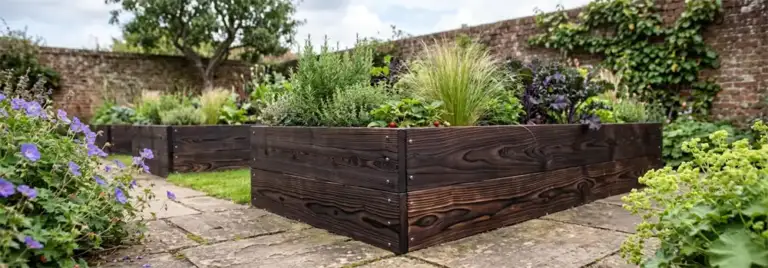
Climate-resilient raised beds for changing UK weather
Climate-resilient raised beds are becoming more important because UK gardens are being asked to cope with sharper weather swings: prolonged winter rain, saturated ground, dry springs and hotter summer days. For a raised bed, this is not an abstract climate argument. It is a practical design problem involving drainage, lateral soil pressure, timber movement, edge drying, ground contact and long-term surface protection.
The question is no longer just whether a raised bed looks good when it arrives. It is whether it will keep performing when saturated soil applies sustained outward pressure for weeks, when dry weather stresses the soil edge, and when lower boards are repeatedly exposed to splashback and damp ground. As we explain in our guide to whether premium raised beds are worth it, long-term value depends on how a bed behaves after the easy first season, not just how it looks on day one.
Key takeaway: A climate-resilient raised bed is not made from one better material or one clever coating. It is designed as a system that manages water, soil weight, heat, drying, timber movement, mechanical fixings and ground contact together.
What makes a raised bed climate-resilient?
A climate-resilient raised bed is one that can cope with more than one kind of weather stress. It must shed excess water without leaving timber trapped in damp ground, resist the pressure of wet soil, avoid drying too sharply in hot weather, and keep its joints and surface protection working through repeated wet-dry cycles.
That means climate resilience is not a single feature. Drainage helps, but drainage alone will not stop a weak frame bowing, a corner post wicking water, or a thin bed edge heating and drying faster than the soil around it. The bed has to be considered as a complete structure: timber, soil, base, fixings, finish and surrounding ground.
| Climate pressure | What it does to a raised bed | Weak design response | Climate-resilient response |
|---|---|---|---|
| Prolonged wet ground | Keeps lower boards, posts and joints damp for longer | Timber sits directly on soil, grass or poorly prepared ground | Prepared base, drainage margin and reduced end-grain water contact |
| Sustained wet soil | Holds the frame under outward pressure for long periods | Designed as a shallow empty box, then used in unknown conditions | Thickness, span, fixings and deflection considered against wet-soil load |
| Dry springs and hotter days | Increase edge drying and stress soil near the bed wall | Thin materials with little thermal or moisture buffering | Substantial timber, suitable soil volume and better moisture planning |
| Rapid wet-dry cycles | Encourage timber movement, joint stress and finish breakdown | Basic timber, light fixings and surface-only treatment | Stable timber, protected surfaces and movement-aware mechanical fixings |
| Splashback and debris | Holds moisture against the most vulnerable lower areas | Soil, lawn or mulch pushed tight against the frame | Clean perimeter, gravel margin and better drying around the base |
| UV and surface weathering | Break down exposed timber surfaces over time | Untreated, lightly stained or poorly protected timber | Brushed Yakisugi surface with a specialist zero VOC oil system |
This is why a raised bed built for changing UK weather has to be judged differently from a standard timber box. The question is not whether each feature sounds impressive on its own. The question is whether every part of the bed helps manage the pressures the garden will actually apply.
Why raised bed drainage alone is not enough
Raised bed drainage matters, but it is only one part of climate-resilient design. A bed can drain freely through the soil and still fail if the timber sits against wet ground, the lower boards are covered in splashback, or the frame is too weak for the wet soil it has to hold.
The common mistake is to treat drainage as a soil problem only. In reality, drainage also affects the timber frame. Water has to move away from the growing area, but the bed also needs a clean drying zone around the base. If lawn, soil or mulch is pressed hard against the outside, the lower timber can stay damp even when the soil inside the bed drains properly.
This is why ground preparation matters. A raised bed on a prepared base with a gravel margin has a better chance of drying at the edges than one placed straight onto wet grass or compacted soil. Our guide to how to prepare ground for a raised bed explains this in more detail.
Drainage is not the full answer. It has to work alongside timber choice, board thickness, fixing design, surface protection and lower-edge detailing. A climate-resilient raised bed is not just a container with holes in the bottom; it is a structure designed to release water, dry cleanly and stay stable while the weather changes around it.
Are wooden raised beds suitable for wet UK weather?
Wooden raised beds can be suitable for wet UK weather, but only when the design accepts that timber will be exposed to repeated moisture. The problem is not wood itself. The problem is untreated or poorly protected timber held in damp conditions with little chance to dry.
Wet weather attacks raised beds in predictable places: lower boards, corner posts, joints and exposed end grain. These are the areas most likely to sit near splashback, wet soil, trapped debris near the joints or poor ground contact. Once moisture is held there for long periods, decay risk rises and the frame can start to lose strength from the parts the customer rarely sees.
That is why timber choice and detailing matter. Western Red Cedar is naturally well-suited to outdoor use because it is stable, durable and less prone to movement than many cheaper softwoods. But species choice is only the start. A climate-resilient wooden raised bed also needs protected internal faces, clean drying around the base, sensible ground preparation and fixings that will not corrode as the timber goes through wet and dry cycles.

The best wooden raised beds do not pretend water can be avoided. They are designed to manage it, release it and dry again.
Why raised beds bow when soil stays wet for too long
Raised beds bow when the side boards are asked to resist more outward pressure than the structure was designed to handle. In normal conditions, that pressure is easy to underestimate because the bed is bought empty, moved empty and often judged empty. The real test begins once it is full of soil.
Wet soil changes the equation. After prolonged rain, a raised bed may sit close to saturated soil weight for weeks or months, not just for a single storm. That sustained lateral pressure pushes against the boards, loads the corners and tests the whole frame over time. Bowing is usually not one sudden failure. It is the visible result of load, span, height and material choice being out of balance.
This is where kit raised beds become risky. A maker may sell a stackable system without knowing whether the customer will use one layer, two layers or three. They do not know the soil mix, ground conditions, planting plan or drainage context. The customer is unlikely to calculate saturated soil weight or beam deflection either, so a flexible product can become a structural guess.
A design-led raised bed works the other way round. The intended size, height, span and use are known before the bed is built, so timber thickness and structural detailing can be matched to the likely load. Our raised bed calculator shows why this matters by estimating soil volume, saturated soil weight and likely deflection. The point is not to overbuild every bed. It is to make the structure proportionate to what the soil and weather will actually ask it to do.
What is the best timber thickness for raised beds in UK weather?
There is no single best timber thickness for every raised bed. The right thickness depends on the bed’s height, length, span, soil volume, fixing method and expected saturated soil load. A shallow herb bed and a large vegetable bed are not asking the timber to do the same job.
Thickness matters because it affects several parts of raised bed performance:
- Structural resistance: thicker boards can better resist outward soil pressure when matched properly to span and height.
- Fixing support: more timber gives mechanical fixings more material to work with around the joint.
- Timber movement: substantial boards behave differently from thin boards through repeated wet-dry cycles.
- Durability margin: more material gives the bed greater physical substance when combined with durable species, Yakisugi and oil.
- Thermal buffering: thicker timber slows temperature change at the soil edge compared with thin or highly conductive materials.
- Edge drying: a more buffered bed wall can reduce sharp drying next to the timber during hot weather.
In climate-resilient raised beds, thickness is a design decision, not a product label. It is not about choosing the biggest section for the sake of it. It is about using timber that is proportionate to the load, span, exposure, fixing strategy and intended use.
Do raised beds get too hot or dry out faster in summer?
Raised beds can dry out faster in hot weather because the soil has more exposed edges than an in-ground border. The side wall becomes part of the growing environment, especially during dry springs and long warm spells.
Heat and drying are not only watering issues. The bed material affects how quickly external conditions reach the soil edge:
- Thermal conductivity: highly conductive materials transfer heat quickly into and out of the bed wall.
- Material thickness: thin walls react quickly to changing air temperature, while substantial timber slows that movement.
- Soil edge stress: the soil closest to the side of the bed often feels heat and drying pressure before the centre.
- Thermal lag: thicker timber slows heat transfer, so peak heat reaches the soil edge more gradually rather than all at once.
- Moisture planning: soil volume, mulch and organic matter still matter, because no timber choice removes the need to manage water properly.
This is why heat resilience should not be separated from structure. The same thickness that helps resist wet-soil pressure can also create a more buffered edge condition in summer. It does not make a raised bed immune to drought, but it helps the bed behave less abruptly as conditions shift between hot days, cooler nights and dry spells.
Does Yakisugi help wooden raised beds last longer?
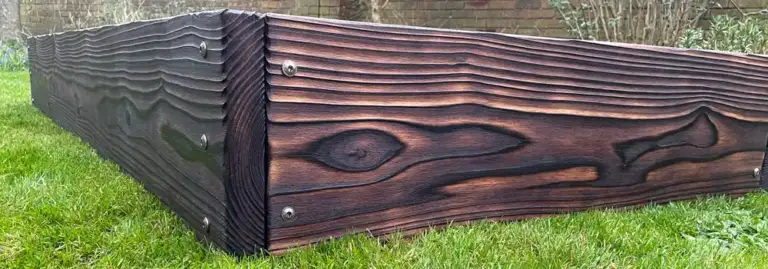
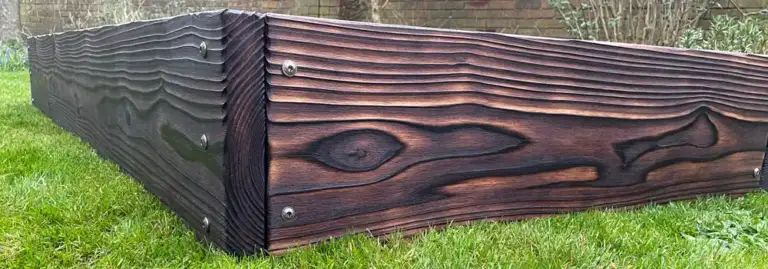
Yakisugi helps wooden raised beds last longer when it is treated as part of a complete timber protection system, not as a decorative black finish. Heating the surface of the wood changes its outer layer, improving its resistance to weathering and making it less vulnerable than untreated timber.
The important detail is what happens next. Loose carbon that would not survive real outdoor use is brushed away by hand using the pika-pika approach. This leaves the stronger, textured grain exposed, creating the distinctive contrast while giving the specialist oil system a better surface to key into.

On our raised beds, this is not only applied to the visible outside boards. Internal faces and structural corner posts are treated with the same care, because wet soil, trapped moisture and hidden joints are often where raised bed decay begins. Yakisugi is not the whole answer, but it is one important layer in a system designed to manage weather, moisture and timber movement over time.
What construction details make a raised bed last longer?
Small construction details often decide how long a raised bed lasts because many failures begin where customers rarely look: internal faces, corner posts, lower joints and fixings.
On our beds, internal timber is treated with the same care as visible boards. That matters because the inside of a raised bed has to cope with damp soil, trapped moisture and reduced airflow. The parts hidden by soil should not be treated as less important than the parts on show.
Corner and fixing details matter too. A small capillary break at the base of the internal post detail helps reduce ground-contact moisture wicking through the exposed end grain when the frame sits on a prepared base. Stainless flange screws are used for joint integrity, not just appearance. They do not magically stop long boards bowing, but the flange head spreads clamping force and helps the corner assembly resist pull-through when wet soil pushes outward over time.
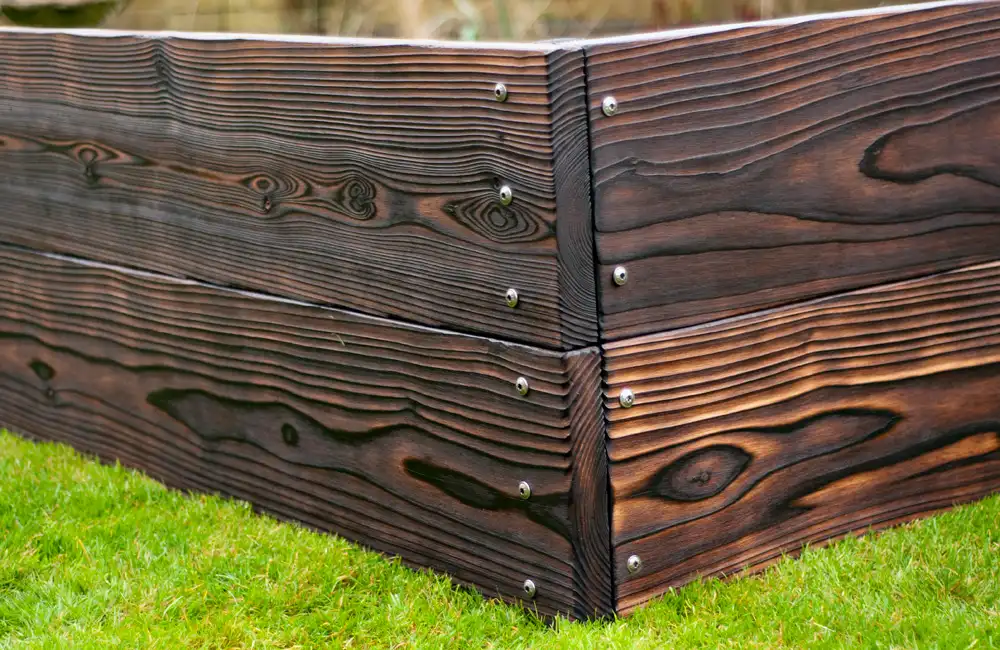
That is the difference between decoration and structural intent. The details look deliberate because they are deliberate.
How climate-resilient raised beds work as a system
The Raised Bed Company does not treat climate-resilient raised beds as a matter of one feature. Western Red Cedar, timber thickness, Yakisugi, brushing, zero VOC oil, stainless flange screws, internal detailing and ground-preparation awareness all have to work together.
That matters because UK weather does not apply one neat pressure at a time. A bed may face wet ground, saturated soil weight, surface weathering, heat, drying and timber movement in the same year. The difference is whether those pressures have been designed for before the bed is built.
| Design question | Typical kit-bed approach | The Raised Bed Company approach | Why it matters in UK weather |
|---|---|---|---|
| Final height and use | Often unknown at the point of sale | Specified around the intended size, height, use and site | Deeper beds create greater soil pressure |
| Saturated soil weight | Rarely calculated by the buyer or maker | Considered as part of the structural design | Wet soil can apply sustained outward pressure |
| Timber thickness | Usually fixed by product range | Chosen around span, height, load and durability | Thickness affects strength, fixing support and thermal buffering |
| Surface protection | Often untreated, or left for the customer to oil after purchase | Finished with Yakisugi, brushing and a specialist zero VOC oil system | Surface moisture, UV and wet-dry cycles are managed from the start |
| Ground contact | Often left entirely to the customer | Designed with base preparation and lower-board drying in mind | Wet ground and splashback are major decay risks |
| Hidden construction | Internal details are often basic or unseen | Internal faces, posts, fixings and lower details are part of the system | Raised beds often fail first where customers do not look |
If you are planning a raised bed for an exposed, wet or long-term garden setting, our premium raised beds are built around the conditions the bed will actually face, not just the size you want on day one.