Raised bed myths: joint and assembly advice that sounds right but fails
A raised bed can look well assembled on the day it is built and still fail once real forces begin to act on it. This is where a lot of joint and assembly advice goes wrong. It focuses on neat corners, tight fits, or how rigid the bed feels when empty, then assumes those early signs tell you how the structure will behave long term.
But a raised bed does not stay in that day-one state. Once filled, it begins retaining weight, resisting outward pressure, absorbing seasonal moisture change, and coping with repeated movement over time. That means assembly quality is not just about whether the parts go together cleanly. It is about whether the structure remains coherent when the bed is loaded, wet, drying, and ageing.
Key takeaway: A raised bed assembly is not proven by how neatly it goes together or how solid it feels when empty. What matters is whether the corners transfer force properly, the walls are restrained where needed, and the whole structure stays stable once soil load, moisture change, and time begin to act on it.
Why raised bed joint and assembly myths spread so easily
Joint and assembly myths spread because they are easy to believe at the exact moment a bed is being built. A tight corner feels reassuring. A clean fit looks competent. Thick boards suggest strength. A bed that does not wobble when empty appears finished and reliable. All of those signals are visible, immediate, and satisfying.
The problem is that none of them, on their own, tells you much about how the bed will behave once it starts acting more like a retaining wall. Real performance depends on load paths, restraint, bearing between members, timber movement, and whether the assembly still makes structural sense after wet and dry cycling. That is why so much assembly advice sounds sensible at first, then fails later when the walls begin to bow, joints open slightly, or the bed starts moving in ways the builder never judged at the start.
| Myth | Why it sounds plausible | Why it fails | Better judgement | Why the better answer works |
|---|---|---|---|---|
| Screwing the boards together at the corner is enough | If the boards are fixed tightly together, the corner can appear complete and solid. | A corner has to transfer retained soil forces, not just hold two boards in contact. | Judge whether the corner has a proper load path and meaningful restraint, not just a connection. | A stronger corner controls force transfer more predictably and resists opening, twisting, and long-term movement better. |
| Tight joints automatically mean strong joints | Good fit is often mistaken for structural quality. | A neat joint can still lack bearing area, restraint, or long-term tolerance for timber movement. | Judge the structural role of the joint, not just how closely the surfaces meet on day one. | Strength comes from how the members work together under load, not from visual neatness alone. |
| Mitred corners are a sign of better construction | Mitres look more refined and are often associated with higher craftsmanship. | They can reduce straightforward bearing, expose vulnerable geometry, and prioritise appearance over restraint. | Judge a corner by force transfer, bearing, and stability under load, not by visual sophistication. | A structurally coherent corner performs better over time than one chosen mainly for appearance. |
| If the corners are strong, the rest of the bed will be fine | Corners are the most obvious structural points, so they get most of the attention. | Long wall spans can still bow between corners if restraint is missing. | Judge the whole bed as a system, including wall span, bracing, and how load is distributed. | Raised beds fail between supports as well as at corners, so system thinking gives a truer picture. |
| Thick boards do not need internal bracing | Thicker timber looks strong enough to cope on its own. | Board thickness does not remove span length, retained soil pressure, or long-term movement. | Judge board depth in relation to span, load, and restraint, not as a standalone guarantee. | Bracing decisions work better when they respond to geometry and loading rather than visual heft. |
| A raised bed behaves like ordinary garden furniture once assembled | It is made of timber, sits outside, and can look like a simple assembled object. | A raised bed retains soil and moisture, so it behaves more like a restrained structure than light furniture. | Judge it as something that must manage pressure, movement, and exposure over time. | This leads to better expectations about restraint, movement, and what assembly quality really means. |
| A bed that goes together cleanly will stay stable long term | Easy assembly is often taken as proof that the design is sound. | Clean assembly says little about what happens after loading, wetting, drying, and seasonal movement. | Judge whether the assembly remains coherent after the environment starts acting on it. | Long-term stability depends on how the structure ages under stress, not how easily it fitted together at first. |
| If it feels rigid when empty, the assembly is strong enough | An empty bed that feels solid seems ready for use. | Empty stiffness is a poor test for behaviour under retained soil load and moisture cycling. | Judge loaded behaviour, restraint, and likely long-term movement rather than empty feel. | This tests the structure in terms closer to real use, where most failures actually develop. |
Myths about what makes a strong corner
Corners attract attention because they are where the bed visibly comes together. They look like the obvious test of quality. If the corner feels tight, looks neat, and seems firmly fixed, it is easy to assume the hard structural work has been done. That is why so much bad advice begins and ends there.
But a corner does more than join two boards. It has to help transfer outward force from retained soil, hold alignment as the timber moves, and stay coherent when the bed is wet, drying, and under repeated stress. A corner that looks convincing on assembly day can still be mechanically weak once the bed starts behaving like a loaded structure.
Screwing the boards together at the corner is enough
This myth sounds sensible because a screwed corner often feels firm during assembly. Two boards meet, the screws pull them tight, and the joint appears complete. On an empty bed, that can look like enough. The problem is that a raised bed corner is not just there to keep two pieces of timber touching. It has to manage force.
Once the bed is filled, the side boards begin resisting lateral soil load. In plain English, that means the weight of the soil starts pushing outwards against the walls. That outward pressure does not disappear when it reaches the corner. It has to be transferred, restrained, and held in alignment by the assembly. A few screws driven through one board into the end grain or edge area of another may hold the parts together at first, but that is not the same as creating a reliable load path.
A load path is simply the route by which force moves through a structure. In a well-resolved corner, that force is passed into members that can resist spreading, rotation, and gradual distortion. In a weak corner, the force concentrates around the fixings, the joint begins to work loose under repeated stress, and the corner starts doing more movement management than it was ever designed to do. That is why a bed can feel secure on day one yet become less coherent once the soil has been in place for a season.
Another problem is bearing. Bearing is the area where one timber member physically bears against another and helps transfer force through contact, not just through metal fixings. If the assembly relies mainly on screws to stop the corner opening, rather than on meaningful bearing and restraint, the joint becomes more dependent on the fixings than many people realise. That may still look tidy, but structurally, it is a weaker way of dealing with retained load.
This also helps explain why corners can be overstressed even when they look tidy. The wall span between corners does not simply sit there under load. As retained soil pushes outward, force builds along the length of the wall and is fed back into the jointed ends. In plain English, the corner is not just joining boards. It is helping control the way the whole wall resists spread, rotation, and gradual distortion over time.
Moisture makes this more demanding because it changes both the load and the material. Wetter soil is usually heavier, which means the retained mass can exert more sustained outward pressure on the bed wall. At the same time, the timber itself responds to seasonal wet and dry cycling by swelling as moisture content rises and shrinking again as it dries. In plain English, the corner is being tested from both directions at once. The soil is pushing harder, while the assembly itself is also moving. A corner that was only ever “held together” can start to lose alignment once moisture increases the retained load and seasonal movement begins working the joint over time.

That is one reason raised beds should be judged less like simple assembled boxes and more like small retaining structures. The joint is not only joining timber. It is helping the whole bed resist spread, bowing, and gradual loss of shape under load. As we explain in our article on why raised beds fail, many failures begin not with dramatic collapse, but with small structural compromises that become more significant as pressure, moisture, and time all start acting together.
Better judgement starts by asking a harder question than “Are the boards screwed together tightly?” Ask whether the corner actually controls force transfer. Does it provide restraint? Does it keep the walls aligned as lateral soil load builds? Does it still make structural sense once the bed is full, wet, and ageing? Those are the questions that separate a merely connected corner from a genuinely competent one.
This is also why our article on durable raised bed design matters here. Durability is not just about timber species or finish. It is also about whether the assembly logic makes sense once the bed is carrying real load. A corner that depends too heavily on fixings alone may remain intact for a time, but it gives the structure less margin for movement, less tolerance for seasonal change, and less control over how force is transferred through the bed as a whole.
Tight joints automatically mean strong joints
A tight joint is easy to trust because it gives immediate visual reassurance. The boards meet cleanly, gaps are minimal, and the assembly looks careful and controlled. In most areas of craft, that kind of fit is associated with quality, so it is understandable that people carry the same assumption into raised bed construction.
The problem is that a tight fit is not the same as a strong structural relationship. It tells you that two surfaces met neatly during assembly, but it does not tell you how force will be transferred once the bed is filled and the walls begin resisting lateral soil load. In plain English, a joint can look excellent on day one and still be doing very little to help the structure cope with outward pressure.
What matters more is bearing, alignment, and restraint. Bearing is the physical contact area that allows one member to support and transfer force into another. Alignment affects whether the members continue working together cleanly under load rather than beginning to twist or spread. Restraint determines whether the joint helps control movement once the wall starts being pushed outward by retained soil. A tight joint may coincide with those things, but it does not guarantee them.
This is one of the easiest places for visual quality to be mistaken for structural quality. A neatly closed joint can still have weak geometry, limited meaningful bearing, or very little tolerance for seasonal timber movement. Once moisture changes the size of the timber slightly and the retained soil continues applying pressure, the joint may begin to open, work, or lose alignment even though it looked excellent when first assembled.
That is why raised bed joints need to be judged by behaviour, not just appearance. The useful question is not “Does this look tight?” but “Will this still transfer force and maintain alignment once the bed is loaded, wet, drying, and ageing?” That is a very different standard, and it often exposes how little a clean visual fit tells you on its own.
A tight joint can look excellent on day one and still do very little to help the bed cope with outward pressure.
This is closely related to the point we explore in raised bed durability: why appearance and condition mislead. Visual cues can be helpful, but they are often poor guides to deeper structural behaviour. A raised bed can look crisp, square, and well finished while still containing assembly logic that is vulnerable once real loading and seasonal movement begin.
Better judgement starts by treating tight fit as a secondary sign rather than the proof itself. A good joint may well be tight, but its real strength comes from whether the members bear properly, stay aligned, and continue working together once the bed starts acting more like a retaining wall than a tidy timber box.
Mitred corners are a sign of better construction
Mitred corners are easy to admire because they look more refined than a simple square junction. The lines are cleaner, the corner appears more deliberate, and the whole bed can take on a more furniture-like finish. That visual neatness makes it easy to assume a mitred corner must also be structurally superior.
The problem is that appearance and structural behaviour are not the same thing. A mitre changes the geometry of the joint, but it does not automatically improve how the corner transfers force once the bed is filled and starts resisting lateral soil load. In plain English, a mitred corner can look more sophisticated while still doing little to improve the way the bed handles outward pressure.
What matters in a raised bed corner is not whether the joint looks elegant but whether it provides dependable bearing, restraint, and alignment under load. Bearing is the physical area through which one member helps support another. Restraint is what stops the corner opening or rotating as pressure builds. Alignment is what helps the members continue working together rather than drifting out of plane over time. A mitred corner may achieve those things, but the mitre itself is not proof of any of them.
This is where category confusion often creeps in. In furniture, a mitre may be judged mainly by appearance and finish. In a raised bed, the corner has to keep working once the walls begin acting more like restrained retaining faces. That means the real test is not whether the joint looks crisp at assembly stage, but whether it stays coherent when the bed is loaded, exposed to moisture change, and gradually stressed over time.
A mitred corner can look more sophisticated while doing little to improve how the bed handles outward pressure.
A corner chosen mainly for visual sophistication can also create a false sense of quality. It may look more advanced than a straightforward square corner, but if the structural logic behind it is weak, the refinement is mostly cosmetic. As we explain in how to judge raised bed durability, visible finish can be helpful, but it is often a poor guide to how a structure will actually behave once real conditions begin acting on it.
Better judgement starts by asking what the corner is being asked to do. Is it helping transfer force cleanly through the assembly? Is it maintaining restraint as outward pressure builds? Is it likely to stay aligned once wet and dry cycling begins? Those questions matter more than whether the corner looks polished or technically impressive at first glance.
A mitred corner is not automatically bad. A mitre only becomes a strong corner when the surrounding assembly gives it real restraint, dependable force transfer, and long-term coherence under load. It is simply not automatically better. In a raised bed, better construction is defined by structural coherence under load, not by whether the corner borrows the visual language of fine joinery.
Myths about how the bed holds its shape
Even when corners are well considered, a raised bed does not succeed or fail at the corners alone. The walls between them still have to resist outward pressure, the spans still have to stay under control, and the whole assembly still has to behave as one restrained system rather than a set of connected parts.
This is where a lot of assembly thinking becomes too local. Builders often judge the obvious junctions and miss the longer structural picture. A bed can have respectable corners and still bow, spread, or gradually lose coherence because the wall restraint, bracing logic, or span behaviour was never properly judged in the first place.
If the corners are strong, the rest of the bed will be fine
This myth sounds plausible because corners are the most obvious structural points in a raised bed. They are where the boards meet, where the assembly feels most deliberate, and where people instinctively look for strength. If those junctions appear solid, it is easy to assume the rest of the bed will simply follow their lead.
The problem is that a raised bed not only fail at its corners. The wall spans between them still have to resist lateral soil load, which is the outward pressure created by retained soil pushing against the sides. In plain English, the long sides of the bed are being pushed outwards along their length, not just at the ends. Strong corners help, but they do not remove the force acting between them.
This is why span matters. A wall can have competent corners and still begin to bow if the unsupported distance between those corners is too great for the board depth, thickness, and restraint strategy being used. Bowing is not just a cosmetic issue. It changes how force is distributed through the wall, increases stress in some parts of the assembly, and can gradually pull the whole bed out of its intended shape over time.
The important structural point is that force is not concentrated neatly where people happen to look. It travels through the whole wall. As soil pressure increases with depth, the lower part of the wall is usually under the greatest load, and the span between corners has to resist that pressure continuously. That is why a raised bed should be judged more like a restrained retaining structure than a frame with four strong meeting points.
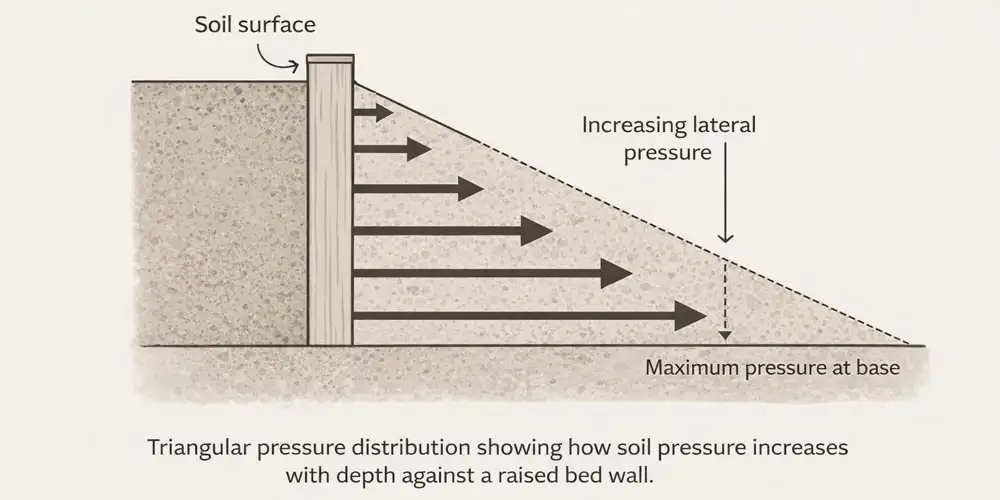
This is also where wall restraint becomes critical. Restraint is what prevents the wall from simply moving outward between supports. If the design relies too heavily on corners alone, the mid-span sections can still flex, creep, or gradually distort under repeated loading and wet/dry cycling. In plain English, a bed can have strong-looking ends and still be weak where it actually has to hold the line.
That is one reason our article on why raised beds fail matters here. Many failures do not begin with a dramatic corner break. They begin with gradual bowing, spreading, or loss of wall control between the obvious structural points people paid attention to at the start.
Better judgement starts by asking whether the whole wall is resolved, not just whether the corners look convincing. How long is the span? How much lateral load is being retained? Where is the restraint coming from between the corners? How will that wall behave once the soil is wet, heavy, and pushing for months rather than minutes? Those are the questions that reveal whether the bed is structurally coherent as a system.
Strong corners are useful, but they are not enough on their own. In a raised bed, the rest of the bed does not become fine just because the ends look secure. The wall between them still has to do real structural work, and if that has not been judged properly, the assembly can still fail in exactly the places the builder stopped looking.
Thick boards do not need internal bracing
This myth sounds plausible because thickness is easy to see and easy to trust. A heavy board looks substantial, feels rigid in the hand, and gives the impression that mass alone will keep the wall stable. That makes it easy to assume internal bracing is only needed for thinner, lighter, or obviously weaker timber.
The problem is that thickness is only one part of the structural picture. A raised bed wall does not resist outward pressure by thickness alone. It resists it through the relationship between board section, unsupported span, retained height, timber stiffness, and whatever restraint exists between the corners. In plain English, a thick board can still bow if the wall is long enough, high enough, wet enough, or poorly restrained enough.
This is where people often confuse visible heft with structural sufficiency. A thicker board does increase resistance to bending, but it does not remove lateral soil load, and it does not shorten the span between supports. If the wall is long and the retained soil is pushing outward continuously, the board is still being asked to act across that whole distance. Thickness helps, but it does not make geometry disappear.
Retained height matters as well. As the bed gets deeper, pressure increases towards the base, so the wall is not being loaded evenly from top to bottom. The lower part of the board is usually doing the hardest work. That means a wall can look very robust from the front and still be structurally stretched in the areas where the demand is greatest. As we explain in how to build a raised bed: why design matters more than instructions, good raised bed design comes from understanding how load, span, and restraint work together, not from assuming one visible feature will solve everything on its own.
Thickness helps, but it does not make geometry disappear.
Internal bracing changes the structural behaviour because it interrupts the span and gives the wall another point of restraint. In plain English, it helps stop the board behaving like one long loaded member between the corners. That does not mean every thick board always needs bracing. It means the decision should be based on span, retained load, and restraint strategy rather than on thickness alone.
Timber movement makes this even more important over time. A wall that seems acceptably stiff when first assembled may begin to creep, bow, or lose alignment after repeated wet and dry cycling. Once that happens, the corners often end up under greater stress as well, because the wall is no longer holding its line cleanly between supports. The issue is not that thick boards are weak. The issue is that thickness can create false confidence when the rest of the structural logic has not been judged properly.
Better judgement starts by asking a more complete question. Not “Are the boards thick?” but “What is the span, what load is being retained, and where is the restraint coming from?” That is the real assembly question. Thick boards may reduce risk, but they do not automatically remove the need for internal bracing when the wall length, soil pressure, or long-term movement still justify it.
In a raised bed, internal bracing is not a sign that the timber has failed. It is often a sign that the builder understands thickness alone does not control the whole system. A strong assembly is one where the wall stays coherent under load, not one where the boards merely look substantial at the start.
A raised bed behaves like ordinary garden furniture once assembled
This myth sounds plausible because a raised bed is made of timber, sits above ground, and often arrives in people’s minds as a finished object rather than an active structure. Once the boards are joined, the shape looks complete. That makes it easy to treat the bed like a bench, planter, or other piece of outdoor furniture that simply needs to hold itself together.
The problem is that a raised bed is doing a very different job. Garden furniture mainly carries its own weight and the occasional temporary load. A raised bed retains a continuous mass of soil that pushes outward against its walls, becomes heavier when wet, and keeps applying pressure day after day. In plain English, once filled, it behaves much more like a small retaining structure than a passive timber object.
That difference matters because it changes how the assembly should be judged. Furniture joints are often assessed by fit, finish, comfort, and general rigidity. A raised bed has to be judged by load path, wall restraint, retained height, and how the structure behaves once soil pressure and moisture cycling begin acting on it over time. The assembly is not just holding a shape. It is resisting spread, bowing, and gradual distortion under sustained load.
This is also why so many apparently sturdy beds disappoint later. People assume that because the bed feels rigid when empty and looks tidy when assembled, it will behave like a static object outdoors. But the real test begins after filling. Soil load builds along the wall, pressure increases towards the base, and seasonal moisture change affects both the retained material and the timber itself. A bed that was judged like furniture can begin to move like a loaded structure.
A raised bed may look like a simple assembled object, but once filled it stops behaving like one.
That wider behavioural shift is one of the reasons we often compare raised beds to retaining walls rather than boxes. The point is not that every bed is a formal engineered wall. It is that the physics are closer to retained-load behaviour than to simple object assembly. As we explore in why raised beds fail, the most common problems usually emerge when beds are treated as simple garden products rather than as structures managing pressure, movement, and exposure.
Better judgement starts by classifying the bed correctly. Ask what it is being asked to resist, not just what it looks like. How much material is it holding back? How long are the wall spans? Where does restraint come from between the corners? How will the structure behave once wet soil and seasonal timber movement begin working on it for months rather than minutes? Those are not furniture questions. They are structural ones.
A raised bed may look like a simple assembled object, but once filled it stops behaving like one. The more clearly that is understood at assembly stage, the less likely the bed is to be judged by the wrong standards from the start.
Myths about assembly quality and long-term movement
Many assembly myths survive because they reward what can be judged immediately. A bed that goes together smoothly feels well-designed. A structure that seems rigid when empty feels reassuring. Those impressions are understandable, but they are based on a very short moment in the life of the bed.
Long-term performance is judged later, when the structure is carrying soil, cycling through wet and dry conditions, and experiencing the slow movement that timber assemblies always face outdoors. At that point, visual neatness and empty-bed rigidity matter far less than whether the assembly still holds alignment, restraint, and structural coherence over time.
A bed that goes together cleanly will stay stable long term
This myth sounds plausible because smooth assembly is reassuring. The boards line up, the corners close neatly, and the whole structure comes together without much resistance. That experience makes it easy to assume the design is fundamentally sound. If the bed went together well, many people feel the hard part must already be over.
The problem is that easy assembly and long-term stability are not the same thing. A raised bed can go together cleanly because the parts were cut accurately, the fixings pulled everything into line, and the unloaded structure looked square at the moment of build. But none of that, on its own, proves how the bed will behave once it is filled, exposed, and repeatedly stressed over time.
This is where assembly-stage judgement can become misleading. On day one, the bed is usually empty, dry, and under very little real structural demand. Once filled, the walls begin resisting lateral soil load, which is the outward pressure created by retained soil pushing against the sides. Once the soil becomes wetter and heavier, that outward pressure becomes more demanding. At the same time, the timber itself begins responding to seasonal moisture change by swelling and shrinking. In plain English, the structure is no longer just sitting there neatly assembled. It is being loaded while also moving slightly as the material changes.
That is why long-term stability depends more on structural coherence than on assembly smoothness. Structural coherence means the members continue working together as a system once pressure, moisture, and movement begin acting on them. A bed that went together beautifully can still lose alignment later if the restraint strategy is weak, the wall spans are under-resolved, or the joints only looked convincing because the structure had not yet started doing real work.
This is also why some raised beds seem excellent at first and then gradually disappoint. Nothing dramatic happens at the start. The bed simply begins to move a little. A wall bows slightly between restraints. A corner works a little harder than expected. Alignment becomes less exact after repeated wet and dry cycling. Over time, those small losses of coherence matter more than the fact that the bed originally assembled without fuss.
A clean assembly can be a good sign of care. It is not proof of long-term structural stability.
As we explain in why identical raised beds age differently, beds that look similar at the start can behave very differently once real conditions begin acting on them. Long-term outcome depends on more than whether the assembly process felt neat and straightforward. It depends on how well the whole structure copes with load, moisture, exposure, and movement over time.
Better judgement starts by asking what happens after assembly, not just during it. Does the structure still make sense once the soil is heavy and pushing outward? Are the wall spans properly restrained? Will the joints and members keep working together as the timber cycles through changing moisture conditions? Those are the questions that reveal whether a bed is likely to stay stable long after the tidy build stage has passed.
A clean assembly can be a good sign of care. It is not proof of long-term structural stability. In a raised bed, that stability is earned later, when the bed is loaded, weathered, and still holding its shape.
If it feels rigid when empty, the assembly is strong enough
This myth sounds plausible because an empty raised bed is easy to test in a simple, physical way. You can push the wall, grab a corner, or try to rock the structure slightly by hand. If it feels solid, that gives immediate reassurance. The bed seems firm, the boards seem well fixed, and the whole assembly appears ready for use.
The problem is that empty-bed rigidity is a very poor stand-in for real structural demand. An empty bed is not yet resisting retained soil load, which is the continuous outward pressure created once the walls are holding back a mass of soil. In plain English, a bed can feel stiff when it is carrying almost nothing and behave very differently once it is filled and the walls begin doing real work.
That difference matters because the loading condition changes completely after filling. The wall is no longer being judged by a quick hand test at the top edge. It is being asked to resist continuous outward force along its length, with pressure usually increasing towards the base. Once the soil becomes wetter and heavier, the demand can increase again. At the same time, the timber itself starts responding to seasonal moisture change, so the assembly is being tested under load while also moving slightly over time.
This is why rigidity and strength are not the same thing. A structure can feel rigid in a light, unloaded state simply because it has not yet been challenged in the way that matters. Real strength in a raised bed is shown by whether the wall spans stay controlled, the corners keep transferring force cleanly, and the whole assembly remains coherent once pressure, moisture, and time all begin acting together.
An empty bed that feels rigid may be well assembled, or it may simply be untested.
It also explains why some beds feel reassuring at the start and then gradually lose shape later. The empty structure gave a good first impression, but the judgement was made before the important forces arrived. Once filled, the wall begins to bow slightly, the corners begin carrying more stress, and the assembly starts revealing whether its restraint strategy was ever strong enough in the first place.
This is closely tied to the wider point we make in how to build a raised bed: why design matters more than instructions. A raised bed should not be judged by whether it feels solid in a moment of unloaded assembly, but by whether its design still makes structural sense once it begins acting more like a restrained retaining structure.
Better judgement starts by testing the right idea mentally, even when the bed is still empty. Ask what happens after filling. Where will the outward pressure build? How long are the unsupported spans? What is restraining the wall between corners? How will the assembly behave once wet soil and seasonal movement begin working on it for months rather than minutes? Those questions reveal far more than whether the empty bed felt rigid by hand.
An empty bed that feels rigid may be well assembled, or it may simply be untested. In a raised bed, structural adequacy is not proven before loading begins. It is proven by how the assembly behaves once the real forces arrive.
What better assembly judgement looks like
Better assembly judgement starts by asking a different question. Not “Did it go together neatly?” but “What happens once this bed is loaded, exposed, and ageing?” That shift changes what you pay attention to. It moves the focus away from tidy corners and reassuring first impressions and towards the structural behaviour that actually decides whether the bed will hold its shape over time.
A better judgement does not look only at the corner. It looks at the whole load path. That means asking how force moves through the wall, where restraint comes from, how the span behaves between supports, and whether the assembly still makes sense once lateral soil load begins pushing outward for months rather than minutes. In plain English, the real question is not whether the bed looked good when empty. It is whether the structure will keep working once the soil, moisture, and seasons begin testing it properly.
That is why better judgement usually pays attention to a small number of structural realities rather than a long list of surface impressions:
- how much retained soil load the wall is actually holding back
- how long the unsupported wall spans are between corners or braces
- where restraint comes from along the wall, not just at the ends
- whether members bear properly and stay aligned under load
- how the bed is likely to behave once wet soil and timber movement begin acting together
- whether the assembly still looks coherent as a loaded structure, not just as a tidy timber object
This is also where raised bed thinking improves once it stops borrowing the wrong standards. Tight fit, smooth assembly, heavy boards, polished corners, and empty-bed rigidity can all be good signs in the right context. But none of them is the real proof. The real proof is whether the assembly logic survives contact with load, movement, and time.
As we explain in durable raised bed design, durability is not created by one feature in isolation. It emerges when the whole structure is resolved properly from the start. That includes the timber, the geometry, the restraint strategy, and the way the bed is expected to behave once it begins acting more like a small retaining structure than a simple assembled box.
Good assembly is not about making a raised bed look convincing on day one. It is about making sure the structure continues to make sense once the easy visual tests no longer matter. That is the difference between something that merely goes together and something that stays coherent under real garden conditions.
The assembly myths that fail under real conditions
Joint and assembly myths survive because they reward what is easy to see. A tight corner, a clean fit, a heavy board, or an empty bed that feels rigid all offer immediate reassurance. But raised beds are not judged by reassurance alone. They are judged by how they behave once they begin holding back weight, absorbing moisture, and moving through seasons of use.
That is why so much assembly advice sounds right at the start and fails later. It mistakes visible neatness for structural competence. It treats corners as if they are the whole structure. It assumes thickness solves span, or that smooth assembly proves long-term stability. In reality, a raised bed succeeds when the whole assembly continues to transfer force, restrain movement, and hold its shape under real load.
The better question is always the harder one: not “Does this look well built?” but “Will this still make structural sense once the bed is full, wet, and ageing?” That is the standard that exposes weak myths and leads to better judgement.
If you want to understand how this same kind of structural thinking applies to the hardware itself, the next article in this series looks at the screw and fastener advice that sounds sensible but fails once real forces begin acting on the bed.
Related reading
- Raised bed myths: structural advice that sounds right but fails
- Raised bed myths: ground preparation that sounds right but fails
- Raised bed myths: soil advice that sounds right but fails
- Raised bed myths: moisture and durability advice that sounds right but fails
- Raised bed myths: planting advice that sounds right but fails
- Raised bed myths: fixing advice that sounds right but fails