Raised bed myths: planting advice that sounds right but fails
Raised bed planting myths usually sound convincing because they offer an appealing shortcut. They suggest that once a bed is raised, ordinary horticultural judgement matters less. Plant choice seems more flexible, richer soil sounds like a universal fix, and depth is often treated as a guarantee of success.
That is rarely how planting in raised beds actually works. A raised bed can improve control, widen planting possibilities, and make management easier in some situations. It can also warm and dry differently from the surrounding ground, change root-zone conditions, and alter how plants respond across the season. But none of that removes the need to match plants to light, exposure, spacing, fertility, moisture demand, and long-term maintenance.
This is where much raised bed advice becomes misleading. It takes one real benefit, then stretches it too far. The result is a set of planting assumptions that sound practical but often lead to overcrowding, poor flowering, weak crop performance, unnecessary depth, or a scheme that becomes harder to manage over time. Good results still come from matching the planting to the bed, and the bed to the site.
Key takeaway: Raised beds widen planting possibilities, but they do not replace plant judgement. Success still depends on matching plant type, root depth, spacing, fertility, moisture demand, and exposure to the real conditions the bed creates.
Why raised bed planting myths spread so easily
Raised bed planting myths spread because raised beds do change some conditions in useful ways. They can make soil easier to manage, improve access, create clearer planting zones, and in some settings help the root zone warm earlier in the season. Those are real advantages. The problem begins when those advantages get translated into claims that are too broad.
That is why planting and growth myths develop so easily around raised beds. A bed that feels more controlled is often mistaken for a bed that can override normal horticultural limits. Rich soil gets confused with balanced soil. Extra depth gets treated as universally beneficial. Better access gets mistaken for lower maintenance. A raised bed can influence how plants grow, but it does not suspend the rules those plants still live by.
The better way to think about planting in raised beds is not as freedom from constraints, but as a more deliberate growing environment. That environment still has to suit the plants you choose, the exposure the site creates, and the way the scheme will behave once it fills out. The myths below sound sensible because each contains a fragment of truth. They fail because they turn that fragment into a universal rule.
| Myth | Why it sounds plausible | Why it fails | Better judgement | Why the better answer works |
|---|---|---|---|---|
| Raised beds are just for vegetables | Raised beds are often shown as kitchen-garden features. | That confuses one common use with the full range of what they can support. | Choose planting by purpose, not by cliché. | Raised beds can support edible, ornamental, sensory, and pollinator-focused schemes. |
| Raised beds are mainly for annual crops, not long-term planting | Seasonal crops make raised beds look temporary. | Many long-term plantings perform well when the bed suits their root and maintenance needs. | Match the bed design and management to the lifespan of the planting. | Perennials, herbs, and long-term mixed schemes can thrive in raised beds. |
| Perennials, herbs, and flowers are a poor use of a raised bed | Raised beds are often judged only by food production. | That ignores structure, season-long interest, pollinator value, and sensory planting. | Judge the planting by what it is meant to do. | Raised beds can be excellent for herbs, flowers, and ornamental planting, not just crops. |
| Any plant will thrive in a raised bed if the soil is rich enough | Better soil sounds like a universal solution. | Rich is not the same as balanced, and excess fertility can distort growth. | Build soil around plant needs, not a vague idea of richness. | Plants respond to the right structure, nutrition, drainage, and moisture balance. |
| Deeper beds always mean better planting | More depth sounds like more root room and better growth. | Many plants succeed perfectly well in moderate depth, and extra depth often serves access more than roots. | Use the depth that suits the plants and the person using the bed. | Appropriate depth works better than maximum depth as a default rule. |
| Raised beds remove the need to think about sun, shade, exposure, and microclimate | Raised beds feel like controlled environments. | They still sit in real light, real weather, and real exposure. | Assess the site as carefully as the bed. | Raised beds can amplify warming and drying, but they do not override placement. |
| You can plant more closely in a raised bed because the soil is better | Healthier soil suggests plants can tolerate tighter spacing. | Closer planting still increases competition and reduces airflow. | Space plants by mature behaviour, not optimism. | Good spacing protects access to light, air, water, and root room. |
| Raised beds make planting easier no matter what you grow | Raised beds often do improve access and organisation. | Ease still depends on crop type, maintenance demands, and growth habit. | Think in terms of plant behaviour, not bed format alone. | Some plants become easier in raised beds, while others simply bring different demands. |
| Once planted well, a raised bed planting scheme mostly looks after itself | A newly planted bed can look finished and self-sustaining. | Density, fertility, drying rate, and seasonal growth keep changing. | Expect stewardship, not autopilot. | Successful raised beds stay good through editing, watering, feeding, and seasonal management. |
Myths about what raised beds are actually for
Much of the confusion around raised bed planting begins with purpose. Raised beds are often treated as vegetable boxes by default, which then narrows how people think about suitable planting, lifespan, and value. Once that assumption takes hold, anything outside annual edible cropping can start to look like a misuse of the space.
That is too narrow. A raised bed is not defined by one crop category, but by the kind of growing environment it creates and the role it plays in the garden. It can support food production, but it can also support herbs, pollinator planting, seasonal colour, sensory schemes, structured perennial planting, and mixed ornamental use. The question is not whether the planting fits a cliché. The question is whether the planting suits the bed, the site, and the purpose.
Myth: Raised beds are just for vegetables
This myth persists because raised beds are so often presented as kitchen-garden features. The visual language is familiar: neat timber rectangles, rows of salad leaves, climbing beans, and seasonal crops being harvested through the year. That association is real, but it is not the same thing as a rule. A common use has gradually been mistaken for the only sensible use.
That is too narrow because a raised bed is not a crop category. It is a defined growing format. What matters is not whether the planting is edible, but whether the bed creates the kind of root zone, access pattern, and maintenance rhythm that the planting actually needs. That is why raised beds can work just as well for long-term herb planting, structured perennial schemes, pollinator planting, sensory compositions, and ornamental combinations designed for colour, texture, or seasonal change.
This becomes especially useful where the wider site is less cooperative. You may not be able to change the soil conditions across the whole garden, but you can create a better-managed planting zone in one defined place. That makes a raised bed useful not just for productive cropping, but for any planting that benefits from clearer soil control, cleaner edges, and easier access. In that sense, the real question is not “should this be vegetables?” but what kind of planting is this bed best placed to support over time?
The myth also fails because it undervalues plant health in non-vegetable schemes. A defined raised bed does more than sharpen presentation. It protects a root zone from routine foot traffic and casual compaction. That can matter as much, or more, for herbs and longer-term ornamental planting than for annual vegetables, because those schemes often depend on a stable, aerated soil structure over time rather than one short productive season. A well-planned raised herb bed is not a decorative compromise. It can be a highly efficient way to combine structure, fragrance, harvest, and accessibility, which is why a link to herb planting for raised beds: structure, spread and harvest would also feel natural here.
A raised bed is not a crop category. It is a defined growing format.
The better judgement is to start with purpose, not tradition. If the aim is food production, vegetables may well be the right answer. But if the aim is scent beside a seating area, year-after-year pollinator return, easier harvesting of culinary herbs, or a more architectural planting feature that holds the garden visually together, a raised bed can support those roles just as convincingly. The success of the bed is measured by whether the planting suits the site and does its job well, not by whether it matches a kitchen-garden cliché.
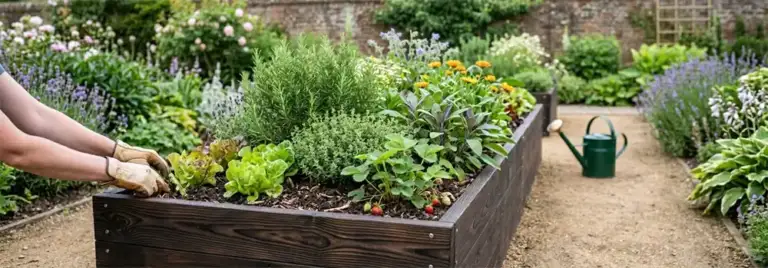
The proof is visible in how many different roles a raised bed can perform when it is designed and planted intentionally. One bed may be used for seasonal edible crops. Another may hold thyme, sage, chives, and lavender near a path. Another may carry a pollinator-rich perennial mix or a sensory planting scheme placed where people actually experience it. Once those uses are seen clearly, the vegetable-only myth starts to look less like a fact and more like an inherited habit.
Myth: Raised beds are mainly for annual crops, not long-term planting
This myth grows naturally out of how raised beds are most often used. Many are planted with salads, beans, cut-and-come-again leaves, or other seasonal crops that are sown, harvested, and cleared within a year. That pattern is so familiar that it can make the whole format seem temporary, as though raised beds are best suited to short-term productivity rather than planting that is expected to settle in and mature over time.
That conclusion does not hold. A raised bed is not temporary just because some people use it for temporary crops. Long-term planting can work extremely well in raised beds when the bed is designed and managed with that lifespan in mind. The key issue is not whether the plants are annuals or perennials. It is whether the root zone, drainage behaviour, depth, exposure, and maintenance pattern suit plants that are expected to remain in place for years rather than months.
This is where the logic shifts. Annual vegetables are often forgiving of regular reworking because the soil is being disturbed, refreshed, and replanted anyway. Long-term planting behaves differently. Herbs, perennials, and mixed ornamental schemes benefit from a more stable root environment, predictable drainage, and soil that is managed through stewardship rather than reset each season. In many cases, that actually makes a raised bed more useful, not less. A defined bed can protect the planting area from compaction, make mulching and top-dressing easier, and allow the whole scheme to be built around how the plants will spread, knit together, and age. You can explore this more in planting for raised beds that are built to last.
The myth also underestimates how many longer-term plants suit the raised-bed format. Culinary herbs are an obvious example, particularly where easy access and repeated harvesting matter. But the same logic can apply to pollinator planting, perennial cut-flower schemes, foliage-led combinations, and structured planting designed to return each year with more continuity than annual bedding ever could. That does not mean every perennial belongs in every raised bed. It means long-term planting is not disqualified by the format itself. Read more on this subject at perennials that thrive in raised beds over decades.
A raised bed is not temporary just because some people use it for temporary crops.
Where the myth does contain a fragment of truth is in maintenance. Long-term planting should not be dropped into a bed designed purely for annual cropping and assumed to sort itself out. A perennial bed still needs appropriate depth, reliable drainage over years rather than one season, and a soil strategy that supports gradual top-dressing rather than repeated wholesale replacement. It also needs realistic spacing from the start. A bed built for quick impact can become crowded, exhausted, or visually confused if long-term spread was never considered. So the correction is not that all raised beds are automatically ideal for permanent planting. It is that long-term planting works well when the bed is treated as a long-term system.
The better judgement is to match the bed to the lifespan of the planting. If you are designing for annual vegetables, you can think in terms of seasonal turnover and repeated intervention. If you are designing for herbs or perennials, you should think more in terms of continuity, spread, access for maintenance, and how the soil will be replenished without constant disruption. Once that shift in thinking happens, the supposed divide between raised beds and long-term planting starts to disappear.
The proof is simple. Some of the most successful raised-bed schemes are not replanted from scratch each year at all. They get better because the planting settles, the structure becomes more coherent, and the gardener begins managing the bed through editing rather than restarting. That is not a misuse of the format. It is one of the clearest signs that the format has been understood properly.
Myth: Perennials, herbs, and flowers are a poor use of a raised bed
This myth usually appears in disguise. It may not always be stated openly, but it sits underneath a great deal of raised-bed thinking: that the “best” use of the space is food production, and that anything more decorative, sensory, or perennial somehow wastes the bed’s potential. Once that assumption takes hold, herbs, flowers, and ornamental planting begin to look indulgent rather than purposeful.
That logic is far too blunt. It assumes that value in a raised bed is measured only in edible yield, when in reality gardens serve many functions at once. A raised bed can be used for harvest, but it can also be used for fragrance, pollinator support, seasonal continuity, visual structure, easier access, and the simple fact that some planting deserves to be brought closer to where it is seen, used, or experienced. Herbs beside a path, pollinator planting near a seating area, or flowers arranged for colour and movement across the season are not lesser uses because they are not vegetables. They are successful uses when they suit the role that part of the garden actually needs to play.
The horticultural case is strong too. Many herbs are especially well suited to raised beds because they benefit from deliberate soil control, defined edges, and repeated but selective harvesting. Perennials can also perform extremely well when the bed gives them stable soil structure, sensible spacing, and conditions that are easier to maintain over time. Flowers are no less valid. In some gardens, a raised bed planted for pollinators or seasonal display may contribute more daily value than another patch of annual cropping.
The myth often survives because people confuse permanence with inefficiency. A bed full of flowers or perennial herbs may not be harvested and cleared in the same rhythm as annual vegetables, so it can appear less “productive” to anyone using crop turnover as the only measure of success. But gardens are not judged only by yield per square metre. A lavender-led planting that brings scent, structure, pollinator activity, and long-season presence to a path edge is doing real work. So is a mixed perennial bed that reduces replanting, holds the garden together visually, and improves with age rather than resetting each season.

The better judgement is to ask what the bed is meant to contribute. If the answer is culinary harvest, vegetables may be right. If the answer is repeated herb cutting, pollinator return, visual rhythm, or a more sensory experience of the garden, then herbs, flowers, and perennials may be the stronger answer. Raised beds are not made worthwhile only by food production. They are made worthwhile by purposeful planting.
The proof is easy to see once the idea of “poor use” is dropped. Some of the most satisfying raised beds are not vegetable beds at all. They are herb beds used every week, pollinator beds that return more strongly each year, or perennial compositions that give the garden structure long after seasonal crops have gone. The format is not being wasted in those cases. It is being used with more imagination and, often, with a clearer understanding of how the garden is actually lived in.
Myths about matching plants to the bed
Once people accept that raised beds can be used for more than vegetables, a second layer of confusion often appears. The mistake is no longer about purpose, but about suitability. The raised bed starts to be treated as a kind of universal upgrade, as though better soil, more visible structure, or extra depth automatically make almost any planting choice work.
That is where a lot of planting advice begins to drift away from horticultural reality. Plants still respond to root depth, light levels, exposure, spacing, fertility balance, and moisture demand. A raised bed can influence those conditions, sometimes very usefully, but it does not cancel them. In some cases, it can even intensify them, especially where warming, drying, and exposure are already strong.
The better question is not whether the bed is “good”, but whether the bed suits the plants you want to grow. That means thinking less in terms of blanket improvements and more in terms of fit. A shallow-rooted herb, a flowering perennial, and a moisture-hungry crop do not read the same bed in the same way. The myths in this section tend to sound persuasive because they take one genuine advantage of raised beds and treat it as universal. That is exactly where they fail.
Myth: Any plant will thrive in a raised bed if the soil is rich enough
This myth sounds sensible because soil improvement is one of the clearest advantages a raised bed can offer. If poor ground can be replaced or amended, it is easy to assume that richer soil solves most planting problems. From there, the logic becomes too simple: more compost, more fertility, more success.
That is not how plants actually behave. “Rich” is not the same as balanced, and it is certainly not the same as suitable for every species. Some plants respond well to fertile, moisture-retentive conditions. Others become overly lush, flower less well, lose structural character, or struggle in soil that stays too damp or nutrient-heavy for their natural preferences. A raised bed filled with heavily enriched compost may sound generous, yet still be the wrong environment for herbs, Mediterranean plants, or species that prefer freer-draining, less indulgent conditions.
One reason is the difference between vegetative growth and reproductive growth. In plain English, vegetative growth means leaves and stems, while reproductive growth means flowers, fruit, or seed. Soil that is too rich in nitrogen can push a plant too far toward leafy growth. The result may look impressive at first, but it is often misleading: more leaf, weaker flowering, softer structure, and growth that is less stable or less useful than it first appears. The plant is active, but not necessarily performing well.
A second issue is nutrient imbalance. Plants do not benefit simply because one nutrient is present in abundance. They need a usable balance. In some cases, an excess of one nutrient can interfere with the uptake of others, which is part of what gardeners and growers mean by nutrient antagonism. The term sounds technical, but the effect is simple enough: more feeding does not automatically mean better nutrition. A soil mix can be “rich” on paper and still push growth in the wrong direction or create imbalance in the root zone.
Lavender is a good example. It may look beautiful in a raised bed, but it does not want the same soil profile as a hungry annual crop. If the mix is too rich and moisture-retentive, you can end up with soft, overfed growth and poorer flowering rather than a healthier plant. The raised bed has not failed there. The matching has failed.

The better judgement is to think in terms of soil character, not just richness. Ask what the plant needs the root zone to do. Should it hold moisture well, or drain more freely? Should it support fast leafy growth, or steadier, more restrained growth with better flowering and stronger form? Should it be topped up regularly with compost, or kept relatively lean so the planting stays in balance? Once those questions are asked, it becomes obvious that one universal “good” soil does not exist, even inside a well-built raised bed. You can read more on soil in our article, Soil mix for raised beds: how to choose the right one.
This myth also confuses visible vigour with real success. A plant can produce lots of soft leafy growth in rich soil and still be performing badly in the ways that matter most. Flowering may be reduced. Habit may become floppy. Roots may sit in conditions that stay wetter than ideal. Crowding can worsen as growth becomes overblown. What looks like success in the first flush of growth can easily become underperformance over time. Richness is only useful when it matches the plant’s biology.
The proof of the corrected answer is that some of the best raised-bed planting depends on restraint, not abundance. Herbs, dry-loving plants, and many structurally important ornamentals often perform better in a medium that is open, stable, and appropriately drained than in one overloaded with compost. A raised bed gives you the chance to build that kind of root environment deliberately. That is its real value. Not that it makes every plant thrive, but that it lets you create a more suitable root zone for the plants you actually want to grow.
Myth: Deeper beds always mean better planting
This myth sounds convincing because depth is easy to see and easy to assume is beneficial. More soil looks like more opportunity: more root room, more moisture reserve, more vigorous growth, and therefore better planting. Once that idea takes hold, a deeper bed starts to feel like an automatic upgrade rather than a design choice. The result is a kind of heroic-depth thinking, where bigger is assumed to mean better before anyone has asked what the planting actually requires.
That is too simplistic. Some plants genuinely benefit from greater depth, especially where a larger root zone improves stability, moisture buffering, or long-term resilience. But many common raised-bed plants do not need extreme depth at all. A large number of herbs, salads, strawberries, and ornamental species grow well in moderate depths, often around 15 to 30 centimetres, provided the soil structure, drainage, and ongoing care are appropriate. In those cases, extra depth is not solving a biological problem. It is simply adding more volume.
This is where the distinction between plant requirement and user requirement matters. More depth is often valuable for the person using the bed even when it is not essential for the plant itself. It can make access easier, reduce bending, improve working height, and support accessibility needs. Those are real benefits, and they matter, but they should not be misrepresented as universal planting needs. A bed may be deeper because it improves comfort and usability, not because the planting would fail without it.
Depth also changes how the bed behaves as a system. More soil volume can buffer moisture and temperature more steadily, which can be useful in exposed or fast-drying positions. In plain English, a larger soil mass usually changes more slowly, so the root zone may dry out less abruptly and swing less sharply between warm and cool conditions. That can be helpful. But it still does not mean deeper is always better. If the planting is relatively shallow-rooted, prefers leaner conditions, or is growing in a site where exposure and drying are already the main pressures, extra depth may offer far less benefit than people expect.
Better planting comes from appropriate depth, not maximum depth.
There is another reason the myth fails. Extra depth is only useful when the whole soil profile is working well. If the lower part of a very deep bed stays too wet, drains poorly, or becomes structurally weak, additional volume is not helping the plants in any meaningful way. Depth is not a magic ingredient. It only improves planting when it supports a healthier and more appropriate root environment from top to bottom.
The better judgement is to ask what the plants actually need from the root zone, and what the person using the bed needs from the build. Are the plants likely to root deeply, or are they relatively shallow and compact? Is the extra soil volume helping with moisture buffering in an exposed position, or is it mainly improving access and presentation? Is the planting long-term and structurally demanding, or short-term and easily managed? Once those questions are asked, the idea that maximum depth is automatically best starts to fall apart. For our full article on this, read How deep should a raised bed be? A practical guide.
The proof of the corrected answer is that successful raised beds are not all built to one heroic depth. They work because the depth suits the planting, the user, and the conditions the bed will actually face. Sometimes moderate depth is entirely enough. Sometimes more depth is valuable, but for accessibility, long-term buffering, or planting stability rather than because every raised bed needs to be as deep as possible. Better planting comes from appropriate depth, not maximum depth.
Myth: Raised beds remove the need to think about sun, shade, exposure, and microclimate
This myth grows out of a real advantage. Raised beds do create a more controlled growing space than open ground in some respects. The soil can be chosen more deliberately, drainage can often be managed more clearly, and the planting area is easier to define and maintain. From there, it is easy to slip into the assumption that site conditions matter less because the bed itself is doing the hard work.
That is where the logic fails. A raised bed changes some conditions, but it does not replace them. It still sits in real weather, real light, and real exposure. Sun still determines how much energy plants receive. Shade still slows drying, flowering, and ripening in many cases. Wind still increases evaporation and physical stress. Cold pockets, reflected heat, shelter, and nearby surfaces still shape how the bed behaves across the day and across the season. A raised bed is not outside the garden. It is part of it.

In some situations, a raised bed can actually intensify microclimate rather than neutralise it. A bed in a hot, exposed position may warm and dry faster than the surrounding ground. A bed placed beside paving, a wall, or a reflective surface may experience greater heat build-up than the gardener expects. Because the root zone is more exposed to surrounding air, heat, and nearby surfaces, raised beds can respond more quickly to drying and local weather patterns than gardeners assume. In colder or more exposed settings, that same responsiveness can also work the other way, with the bed losing warmth faster than expected. The same bed can behave very differently depending on light, shelter, and drying patterns, which is part of the wider reason identical raised beds age differently over time.
This matters because plant failure is often misdiagnosed when microclimate is ignored. A gardener may blame the soil mix, the bed height, or the species itself when the real issue is that the planting never matched the position. Herbs that want sun and freer drying conditions may become weak or sparse in a shaded bed. Moisture-hungry plants may struggle in an exposed raised bed that loses water quickly. Flowers chosen for high summer performance may underdeliver because the bed never receives enough direct light. In those cases, the problem is not that raised beds do not work. It is that raised beds do not cancel placement.
The better judgement is to assess the site and the bed together. How much direct sun does the position actually receive? How exposed is it to drying wind? Does the surrounding environment store heat, block light, or create shelter? Is the bed likely to warm quickly in spring but also dry faster in summer? These are not secondary questions. They are part of the planting decision itself. For a deeper look at how placement affects performance, see our guide to Where to position a raised bed for best growth.
The bed changes the root zone. It does not rewrite the light.
The proof of the corrected answer is visible in how differently the same raised bed can perform in different parts of the same garden. One may be warm, bright, and fast-draining. Another may be cooler, shadier, and slower to dry. The timber format may be identical, yet the planting results can be completely different because the microclimate is different. That is why successful raised-bed planting still begins with exposure, light, and local conditions. The bed can help you respond to them more deliberately. It cannot make them disappear.
Myth: You can plant more closely in a raised bed because the soil is better
This myth sounds plausible because a well-filled raised bed often does support stronger early growth. Plants establish faster, soil can be more workable, and the whole bed can look more vigorous than the surrounding ground. From there, it is easy to assume that healthier soil allows tighter spacing without consequence, as though fertility can compensate for crowding.
That is not how spacing works. Better soil can support healthier plants, but healthier plants still need room to mature. Spacing is not just about getting roots into the ground. It is about how each plant will compete for light, moisture, nutrients, and physical space once it begins to fill out. A raised bed can improve the growing medium, but it does not remove competition. In many cases, it makes the consequences of over-optimism arrive faster, because good early growth can disguise how quickly plants are beginning to crowd one another.
This is where the science becomes clearer. Closer planting usually means reduced airflow through the canopy, greater humidity around leaves, and stronger competition in the root zone. In plain English, plants packed too tightly create a denser, damper, more competitive environment. That can increase the risk of mildew and other stress-related problems, especially once foliage thickens and seasonal growth accelerates. It can also reduce the shape and quality of the planting itself. Herbs lose definition, flowering plants collapse into one another, and crops that looked efficient at planting time can become harder to harvest, prune, or even water properly later on.
The myth also confuses early impact with long-term success. A tightly planted bed often looks better in the first few weeks because the surface fills quickly and the design feels generous. But visual fullness at planting stage is not the same as a planting scheme that will function well over time. Once mature spread, seasonal vigour, and root competition begin asserting themselves, that early “success” can become exactly the problem. Plants may become floppy, stressed, under-aired, or locked in constant competition for the same space.
Better soil does not remove competition. It often makes the consequences of crowding arrive faster.
The better judgement is to space by mature behaviour, not by first impressions. How wide will the plant actually spread? How much airflow does it need to stay healthy? Will it stay compact, or surge once temperatures rise? Does it need repeated access for harvesting, deadheading, or cutting back? These are the real spacing questions. A raised bed may tempt people to plant more densely because the space feels precious and the soil feels improved, but that is precisely why restraint matters. If you want to think more clearly about spread, maturity, and how planting changes over time, our article on planting for raised beds that are built to last explores that longer-term logic in more detail.
The proof of the corrected answer is that the best-planted raised beds rarely feel crowded for long. They feel intentional. The plants have room to show their form, the bed can still breathe, and maintenance stays possible once growth accelerates. Better soil can help plants perform better, but that is exactly why spacing needs to respect what those plants will become, not just what they look like on planting day.
Myths about maintenance and plant behaviour
The final group of planting myths tends to appear once the bed is built, filled, and planted. At that stage, the raised bed can look so ordered and self-contained that people begin assuming it will also be easier in every practical sense. The structure feels more controlled, the edges are clearer, and the soil seems more manageable, so the planting itself starts to look as though it should demand less judgement over time.
That is where expectation drifts away from reality. Raised beds can absolutely make some kinds of planting easier. They can improve access, simplify soil management, and create clearer boundaries for watering, mulching, and editing. But ease still depends on what you grow, how densely you plant, how exposed the bed is, and how the scheme behaves once real seasonal growth begins. A raised bed can improve the format of the work without removing the work itself.
This matters because plant behaviour does not stop once the scheme is in place. Roots keep expanding, foliage thickens, flowering rises and falls, moisture demand shifts with weather, and some plants quickly become more assertive than they looked on planting day. The myths in this section sound attractive because they promise effort without consequence: easier planting regardless of crop, or a scheme that more or less looks after itself once set up. In practice, raised beds still reward observation, adjustment, and restraint.
Myth: Raised beds make planting easier no matter what you grow
This myth begins with something real. Raised beds often do make gardening feel easier at first. The edges are clearer, the soil is more contained, access is often better, and many routine jobs become more deliberate and less messy. That visible order can create a second assumption: if the bed is easier to work with, then the planting inside it must also be easier regardless of what is grown there.
That is where the myth fails. Raised beds can improve the working format, but they do not flatten the differences between plants. A compact herb bed, a thirsty crop, a sprawling flowering scheme, and a tall plant that needs staking do not create the same kind of work simply because they share the same timber frame. Ease still depends on growth habit, watering demand, harvesting pattern, pruning needs, support requirements, and how the planting behaves once it is no longer small and tidy.
This is one of the clearest places where plant behaviour matters more than bed format. Raised beds can reduce bending, improve access, and make soil management more controlled, which is genuinely useful. But if the planting is fast-growing, thirsty, floppy, heavy-cropping, or constantly in need of cutting back, the practical workload remains high. In some cases, a raised bed can even make that workload feel more concentrated, because the root zone may dry faster, the plants may establish more vigorously, and growth can become demanding quite quickly in a well-managed space. Because raised beds contain a finite root volume and are more exposed to air, water can be lost faster through evaporation from the soil and transpiration from the plants themselves, which often means more attentive watering rather than less work.
A raised bed can improve the format of the work without removing the work itself.
The myth also confuses easier access with easier management. They are not the same thing. A bed can be physically easier to reach while still requiring close attention. Tomatoes still need support and feeding. Herbs still need cutting to stay productive and shapely. Flowers still need deadheading or editing if the display is meant to stay clean and repeat well. Moisture-sensitive planting still has to be watched carefully in warm or exposed conditions. The raised bed may improve how you do those jobs, but it does not remove them.
The better judgement is to ask what kind of work the planting creates. Is it a low, steady scheme that asks only for occasional trimming and seasonal top-dressing, or is it a hungry, fast-moving mix that needs regular watering, feeding, staking, harvesting, or cutting back? Is the bed improving genuine ease, or just making the same level of attention feel more organised? That distinction matters. If you want to think more clearly about long-term manageability rather than just planting impact, our article on planting for raised beds that are built to last explores that logic in more detail.
The proof of the corrected answer is simple. Some raised beds are easy because the planting is inherently manageable and well-matched to the site. Others remain demanding because the plants themselves are demanding, even though the bed is beautifully built and easy to access. The frame can improve usability. It cannot make every planting scheme simple. Good results still come from matching plant behaviour to the level of attention the bed is realistically going to receive.
Myth: Once planted well, a raised bed planting scheme mostly looks after itself
This myth is attractive because a newly planted raised bed can look complete very quickly. The edges are clean, the soil is fresh, the spacing feels intentional, and the whole scheme often appears far more orderly than a newly planted border. That visual clarity makes it easy to assume the hard part is over. If the bed was planned carefully at the start, surely it should now settle into a mostly self-sustaining rhythm.
That is not how planting behaves over time. A raised bed is not a sealed system that becomes static once the plants are in place. Roots keep expanding, foliage thickens, flowering rises and falls, soil levels settle, fertility shifts, and moisture demand changes with weather, season, and plant maturity. Even a very well-designed scheme moves continuously. Good planting does not stay good by standing still.
This is where the difference between establishment and stewardship matters. Planting well at the start is important, but it is only the beginning of the bed’s behaviour, not the end of it. A bed that looks balanced in spring may become crowded by midsummer. A scheme that flowers beautifully in its first season may need cutting back, thinning, staking, or deadheading to keep performing well. Mulch breaks down. Compost reserves are used. Some plants become more assertive while others begin to disappear. In plain English, success changes shape as the planting matures.
The science behind that is straightforward enough. Planting schemes do not just consume water from the soil. They also move water through the plants by transpiration, and that demand usually rises as foliage increases and temperatures climb. At the same time, nutrients are being taken up, organic matter is gradually decomposing, and the canopy itself begins to alter airflow, shade, and evaporation across the bed surface. The result is that a raised bed often becomes more dynamic, not less, once the planting starts thriving. A tidy young scheme can therefore become thirsty, crowded, or nutritionally unbalanced faster than the gardener expected.
The myth also tends to confuse lower mess with lower maintenance. A raised bed may be easier to inspect, easier to reach, and easier to edit than an in-ground border, but it still needs editing. Plants need cutting back, lifting, dividing, or replacing. Self-seeders may appear where they are not wanted. Herbs can become woody or lose shape. Flowering can decline if dead growth is not removed or if feeding falls out of balance. In long-term schemes, the real work often shifts from planting to selective correction.
A well-planted raised bed should reduce confusion, not remove responsibility.
The better judgement is to expect stewardship, not autopilot. A well-planted raised bed should reduce confusion, not remove responsibility. Ask how the scheme will be topped up, watered, thinned, and adjusted as it matures. Which plants are likely to dominate? Which will need repeated cutting or harvesting? Which parts of the bed will dry out fastest in warm weather? Which plants are likely to become congested after two or three seasons? If you want to think more clearly about how a scheme matures rather than how it looks on planting day, our article on planting for raised beds that are built to last explores that longer-term thinking in more detail.
The proof of the corrected answer is that the best raised-bed planting usually stays good through observation and intervention, not through neglect. The beds that continue performing well are the ones that are watched, edited, fed appropriately, and adjusted as real growth patterns reveal themselves. Good initial planting matters. But in a successful raised bed, it is the start of the relationship, not the end of the work.
What better planting judgement looks like
The common thread running through these myths is the belief that a raised bed can override plant logic. It cannot. It can give you a more deliberate root zone, clearer soil control, better access, and a more defined place to grow. What it cannot do is make every plant suitable, every position forgiving, or every scheme easy once the timber is in place and the soil is filled.
Better planting judgement starts by treating the raised bed as a growing format, not a guarantee. That means matching the planting to real conditions: depth where it is genuinely needed, fertility that suits the species, spacing based on mature behaviour, and placement that respects light, exposure, and drying patterns. It also means recognising that good results depend on how the bed will behave over time, not just how it looks on planting day.
The strongest raised-bed planting is rarely the most crowded, the richest, or the deepest by default. It is the planting that fits. Sometimes that means vegetables. Sometimes it means herbs, flowers, or long-term perennial structure. Sometimes it means choosing a simpler scheme because the site is exposed or the maintenance window is limited. In every case, the real advantage of a raised bed is not that it replaces horticultural judgement. It is that it gives you a better format in which to apply it.
Related reading
- Raised bed myths: structural advice that sounds right but fails
- Raised bed myths: ground preparation that sounds right but fails
- Raised bed myths: soil advice that sounds right but fails
- Raised bed myths: moisture and durability advice that sounds right but fails
- Raised bed myths: joint and assembly advice that sounds right but fails
- Raised bed myths: fixing advice that sounds right but fails