Best place to put a raised bed: sun, drainage, shelter and access
A raised bed should usually go in the part of the garden with the most reliable light, decent drainage, some shelter from strong wind, and easy access for watering, weeding, and harvesting. Full sun is often the best starting point, but not every bed needs the brightest spot in the garden to work well, especially if you are planning shade-tolerant planting.
The best place is rarely decided by sunlight alone. Wet ground, nearby fences, overhanging trees, awkward access and exposed corners can all turn a promising position into a frustrating one. The right spot is the one that stays practical as well as productive.
Key takeaway: The best place to put a raised bed is usually a spot with reliable light, free-draining ground, some shelter, and easy access. Full sun is often ideal, but a slightly less sunny position can still be the better choice if it drains well, avoids heavy shade, and is easier to reach and maintain.
| Situation | Best judgement |
|---|---|
| Sunny, open, well-drained spot | Usually the best choice |
| Partial shade | Fine for many plants, especially if the bed is otherwise easy to manage |
| Next to a fence or wall | Can work if light, airflow and access are still good |
| Wet or boggy ground | Poor choice unless drainage is improved first |
| Under trees | Usually a weak position because of shade and root competition |
| Exposed windy corner | Often worse than a slightly less sunny but more sheltered spot |
| Small garden with limited options | Prioritise reliable light and easy access over perfection |
What makes one raised bed position better than another?
A good raised bed position is not just the sunniest patch of ground. It is the place where light, drainage, shelter and day-to-day usability work together. If one of those fails badly, the bed can become harder to grow in and harder to live with, even if the light looks excellent on paper.
Light still comes first for most raised beds, especially if you want to grow vegetables, herbs or cut flowers. But light should be judged as a reliable working condition, not as a chase for the single brightest corner. A bed that gets good sun, drains freely, is protected from the worst wind, and can be reached easily for watering and harvesting will usually outperform one in a theoretically perfect but awkward location.
That is why the best place is often a balanced place. A slightly less sunny bed that is sheltered, well-drained and easy to reach can be a better long-term choice than a blazing hot spot on wet ground or in an exposed corner. Good positioning is not about finding the most extreme conditions. It is about choosing the place that will work consistently through the season.
Should a raised bed be in full sun or partial shade?
Full sun is often the best place to start, especially if you want to grow vegetables, herbs, or flowers that perform best with plenty of light. For many gardeners, the ideal position is a bed that gets long, reliable periods of sun through the main growing season rather than a spot that is only bright for a short part of the day.
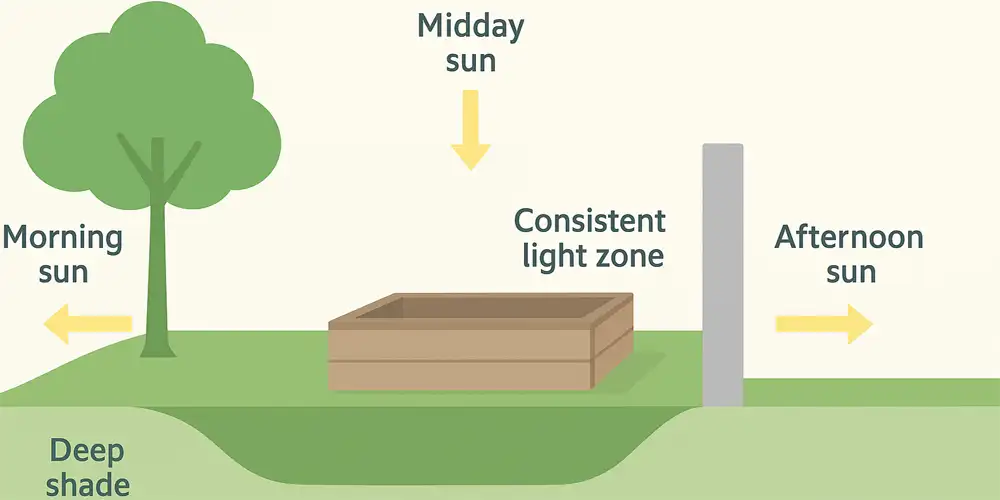
That said, a raised bed does not have to sit in the sunniest part of the garden to be worth having. Partial shade can still work very well, especially for leafy crops, many herbs, and ornamental planting that does not need intense sun all day. In a small garden, a bed with slightly less light but better drainage, easier access, and more shelter is often the smarter choice.
The more difficult condition is not partial shade but deep shade. If a bed sits close to tall fences, dense hedges, neighbouring buildings, overhanging eaves, or mature trees, the growing conditions narrow quickly. Plants dry more slowly after rain, the soil can stay cooler, and the range of things that will grow well becomes more limited.
So the real question is not whether the bed is in full sun or partial shade in theory. It is whether the light is reliable enough for what you want to grow. A raised bed used mainly for tomatoes or cut flowers needs a different position from one intended for herbs, salads, or more shade-tolerant planting. Full sun is often ideal, but workable light is what matters most.
How to check the best place to put a raised bed for sunlight
A quick way to assess the best place to put a raised bed is to check where the sun falls in the morning, at midday, and again in late afternoon. On a clear day, note which parts of the garden stay bright, which slip into shade early, and which areas remain heavily shaded for most of the day.
It is worth repeating this in early spring and again later in the season, because the angle of the sun changes and so do the shadows cast by fences, hedges, trees, and nearby buildings. A spot that looks bright on one day in summer may be much less reliable across the growing season.
This simple check does not take long, but it can prevent one of the most common placement mistakes: choosing a raised bed position by appearance rather than by usable light. If you want reliable performance, map the light before you commit to the bed.
Best place to put a raised bed near a fence, wall or hedge

A raised bed can work well near a fence, wall, or hedge, but only if that position still gives you enough light, airflow, and room to use the bed properly. Boundaries often look convenient because they create a neat edge in the garden, but they can also block sun, reduce air movement, and make routine jobs more awkward than expected.
The biggest mistake is pushing the bed too tightly against the boundary. That can leave the back of the bed difficult to reach for weeding, watering, pruning, or harvesting. If you cannot reach the whole bed comfortably without stepping into it or leaning awkwardly across it, the position is already working against you.
Shade is the next issue. A fence or wall may block light for part of the day, while a hedge can do the same and also compete for moisture. In some gardens, the boundary itself is not the real problem. The issue is what sits beyond it, such as neighbouring trees, dense planting, or a building that quietly casts more shade than you first realise.
Walls and fences can also change how the bed dries out. Some create a sheltered, workable microclimate. Others create a rain shadow or reduce airflow enough that the bed behaves differently from the open garden around it. That is why a boundary position should be judged by how it actually performs through the day, not by how tidy it looks on a plan.

So the best place to put a raised bed near a fence, wall, or hedge is one where the boundary does not create heavy shade, root competition, or awkward access. If the bed still gets reliable light, stays easy to reach from the sides you need, and does not feel cramped, the position can work very well.
Can a raised bed go on wet or poorly drained ground?
A raised bed can go on wet or poorly drained ground, but that does not automatically make the position a good one. A raised bed improves the growing conditions above ground level, but it does not erase the behaviour of the ground underneath. If the site stays waterlogged for long periods, that still affects how the bed performs.
This matters because drainage problems do not stop at the base of the timber. In persistently wet areas, the soil below can stay saturated, surrounding ground can remain soft underfoot, and the bed may become harder to use, maintain, or keep healthy through the wetter parts of the year. Poor drainage can also make a good-looking position much less practical once the seasons change.
That does not mean wet ground is always unusable. In some gardens, improving drainage first or getting the base preparation right can make the position workable. But it is better to treat wet ground as a condition to solve, not as something the raised bed will solve for you on its own.
A raised bed improves the growing conditions above ground, but it does not erase the behaviour of the ground underneath.
If one part of the garden drains freely and another stays boggy after rain, the drier position is usually the better starting point, even if it is not otherwise perfect. A raised bed works best when the site below it is reasonably stable and usable, not when it is constantly fighting the ground beneath it.
So can a raised bed go on wet or poorly drained ground? Yes, sometimes. But the best place to put a raised bed is usually a spot where drainage problems have already been avoided or addressed, not one where they are being ignored.
Does raised bed orientation matter?
Raised bed orientation matters, but usually less than people expect. If you have a choice between a perfectly oriented bed in a poor position and a slightly less ideal orientation in a better overall spot, the better spot usually wins.
In practical terms, orientation affects how light falls across the bed through the day. That can influence how evenly the bed warms and how consistently different parts of it are lit. But those differences are usually secondary compared with the bigger siting questions: how much reliable light the bed gets, whether the ground drains well, how exposed the position is, and how easy the bed is to reach and use.
This is why orientation should be treated as a refinement, not the starting point. It is worth thinking about once you have found a position with good light, drainage, shelter, and access. It is not usually the thing that rescues a weak location.

In a small garden especially, chasing perfect orientation can lead people to ignore more important problems such as deep shade, cramped access, or wet ground. A raised bed that is easy to use and gets dependable light will usually outperform one that is theoretically better aligned but poorly placed.
So, does raised bed orientation matter? Yes, but it matters most after the bigger decisions have already been made. Get the position right first, then use orientation to fine-tune it.
What matters besides sunlight?
Sunlight is usually the first thing people think about, but it is not the only thing that makes a raised bed work well. A good position also needs to be practical to reach, straightforward to water, and sheltered enough that the bed does not dry out too quickly or become awkward to manage.
Access matters more than many gardeners expect. If the bed is hard to reach with a watering can, awkward to move around, or tucked into a part of the garden you naturally avoid, it is less likely to be used well. A raised bed should make growing easier, not create a small obstacle course around itself.
A slightly less ideal orientation in a better overall spot will usually outperform a perfectly aligned bed in the wrong place.
Shelter matters too. A very exposed position may get plenty of light, but strong wind can dry the bed faster, stress plants, and make the growing conditions less stable through the season. In many gardens, a slightly more sheltered position is the better long-term choice, even if it is not the absolute brightest.
It is also worth thinking about how the bed fits into the way you actually use the garden. A spot that looks good on a plan may be less successful if it blocks movement, feels disconnected from the rest of the garden, or sits too far from the places you regularly work. The best place for a raised bed is not just where plants can grow. It is where the bed will be easy to use, easy to maintain, and easy to keep productive.
Where should you not put a raised bed?
Some positions are best avoided from the start. A raised bed should make growing easier, not inherit a new set of problems from the place it sits.
| Position to avoid | Why it usually fails |
|---|---|
| Deep shade | Limits what will grow well and often leaves the bed cooler and slower to dry |
| Wet or boggy ground | The raised bed improves conditions above ground, but does not cancel poor drainage below |
| Under mature trees | Shade and root competition make the bed harder to keep productive |
| Exposed windy corners | Dry out faster, stress plants, and make growing conditions less stable |
| Tight corners or awkward gaps | Make watering, weeding, and harvesting harder than they need to be |
| Hard against fences or walls | Can create blocked light, poor airflow, and difficult rear access |
Deep shade is one of the most limiting positions because it narrows what will grow well and often leaves the bed cooler and slower to dry. Ground under mature trees can be just as difficult, not only because of shade but because roots compete strongly for water and nutrients.
Wet ground is another common trap. A raised bed improves the root zone above ground level, but it does not magically fix a boggy site below. If the surrounding ground stays saturated or awkward underfoot, the position is still working against you.
It is also worth avoiding positions that are technically possible but practically frustrating. Beds squeezed into corners, pushed tightly against boundaries, or exposed to strong drying wind often become harder to water, weed, and harvest than they should be.
Best place to put a raised bed: quick final verdict
The best place to put a raised bed is usually the part of the garden with the most reliable light, decent drainage, some shelter, and easy access. Full sun is often ideal, but the right spot is not always the brightest one.
Choose the position that will work well day after day, not just look good on a plan. If one spot is slightly less sunny but drains better, avoids deep shade, stays sheltered, and is easier to reach, it is often the better long-term choice.
In most gardens, the best place to put a raised bed is the one that gives you:
- reliable light
- reasonably dry, stable ground
- easy access for watering, weeding, and harvesting