How wide should a raised bed be?
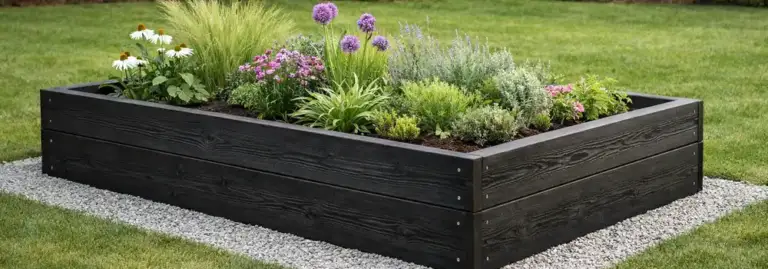
For most gardens, a raised bed should be about 90–120cm wide if you can reach it from both sides. If the bed sits against a wall, fence or boundary and you can only reach it from one side, 60–75cm is usually more practical.
Width is not just about how much growing space you can fit into the garden. It decides whether you can plant, weed, water and harvest comfortably without stepping into the soil. It also needs to work with the height of the bed, because a tall raised bed changes the angle and comfort of your reach. If you are still deciding on height as well as width, our guide to how high a raised bed should be explains that decision in more detail.
Key takeaway: The average width of a raised garden bed is usually 90–120cm when it can be reached from both sides. Against a wall or fence, 60–75cm is often easier to use. The best width is not the widest bed that fits the space, but the width that suits your reach, path layout, bed height and the way you garden.
Let’s look at how these dimensions work in practice, starting with the most common garden setup.
Use this as a practical starting point before adjusting the width around your reach, bed height, path layout and planting style.
| Raised bed situation | Practical width | Why it works |
|---|---|---|
| Reached from both sides | 90–120cm | Keeps the centre within comfortable reach while still giving useful growing space. |
| Reached from one side | 60–75cm | Keeps the far edge usable when the bed sits against a wall, fence or boundary. |
| Taller raised beds | Often narrower than low beds | Allows for the different reach angle created by extra bed height. |
| Children or seated gardening | Usually narrower | Matches the bed width to actual reach, not a standard adult standing position. |
| Bespoke raised beds | Made to suit the garden and gardener | Adjusts width around reach, paths, height, planting style and accessibility needs. |
The best width for a raised bed you can reach from both sides
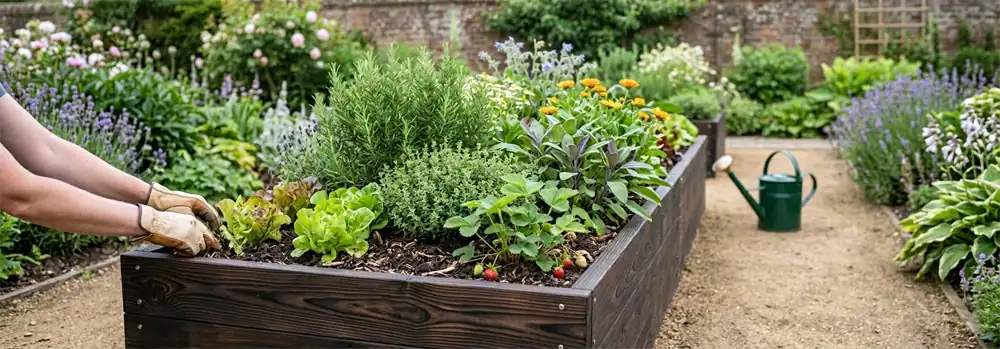
The best width for a raised bed you can reach from both sides is usually 90–120cm. This gives useful growing space while keeping the centre within comfortable reach.
Reach matters more than the number. A 120cm bed can work well with paths on both sides, but only if you can plant, weed, water and harvest the middle without leaning too far. If the bed is too wide, the centre becomes awkward and often gets used less.
This rule applies across raised bed planting styles:
- Vegetables and herbs need regular harvesting, watering and repeat planting.
- Soft fruit needs access for pruning, feeding, netting and picking.
- Flowers and mixed ornamental planting need weeding, cutting back and seasonal care.
In a tighter garden, a slightly narrower bed with better paths will often work better than a wider bed squeezed into the space.
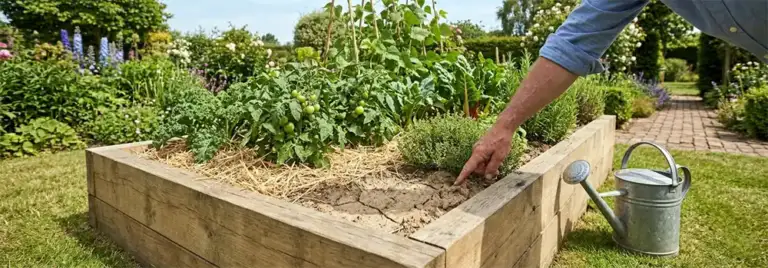
Soil protection matters: If a bed is too wide to reach across, you are more likely to step into it. That compacts the soil, reduces air pockets, slows drainage and makes it harder for roots and soil life to work properly. A raised bed should be narrow enough to manage from the paths, not from inside the growing area.
How wide should a raised bed be against a wall or fence?
A raised bed against a wall, fence or boundary should usually be narrower than a bed you can reach from both sides. In most gardens, 60–75cm is a more practical width for one-sided access.
The reason is simple: you have to manage the whole bed from the front edge. If the bed is too deep, the back becomes difficult to plant, weed, water and harvest. It may look like useful growing space, but it quickly becomes the part of the bed that is hardest to use.
This matters most where the bed sits against a fixed obstruction, such as:
- A house wall
- A fence line
- A garden boundary
- A greenhouse or shed
- A narrow side return
- A tight patio edge
A wall-side raised bed can still be very useful, especially for herbs, flowers, strawberries, salads or compact ornamental planting. The key is to choose a width that lets you reach the back comfortably without leaning your weight onto the bed or stepping into the soil.
For taller wall-side beds, narrower is often better. As height increases, reach becomes more restricted, so a bed that works at ground level may feel awkward once it is raised.
Why wider raised beds are not always better
A wider raised bed can look more generous, but it does not always make the garden easier to use. Once the centre becomes difficult to reach, the extra width stops being useful growing space and becomes awkward space.
The issue is how you have to move around it. If you need to stretch, lean on the frame, balance with one hand, or step into the bed to reach the middle, the bed is too wide for comfortable use.
Over-wide raised beds can create several practical problems:
- Harder maintenance: The centre becomes difficult to plant, weed and tidy properly.
- Uneven watering: The far side or middle can be awkward to reach.
- Uncomfortable harvesting: Low or dense planting becomes harder to pick cleanly.
- Soil compaction: Stepping into the bed damages the loose soil structure raised beds are meant to protect.
- Wasted space: The edges get used heavily while the middle becomes neglected.
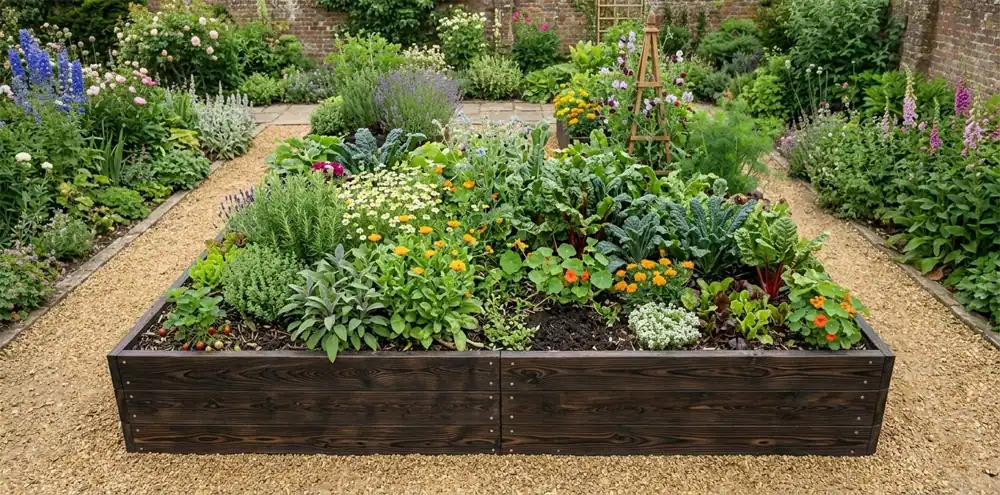
This is why the best raised bed width is not the widest size that fits the garden. It is the width that lets the whole planted area remain usable from the paths.
Does raised bed height affect the ideal width?
Yes. Raised bed height can affect the ideal width because it changes how you reach across the bed.
A low bed allows you to lean from a more natural standing position. A taller bed raises the planting surface, which changes your reach angle. If a high bed is already close to the upper end of the 90–120cm range, reaching the middle can become awkward.
This matters most for:
- Shorter gardeners: A high, wide bed can make comfortable reach much harder.
- Seated gardening: The bed width needs to suit arm reach, not standing reach.
- Children’s beds: Standard adult dimensions rarely make sense.
- One-sided access: Wall-side beds become harder to manage if they are both high and deep.
- Dense planting: Closely planted herbs, flowers, fruit or shrubs can make the centre harder to maintain.
- Tall, narrow planting beds: Some layouts work better when the bed is higher but slimmer, especially where planting, scent or structure matters more than broad growing space.
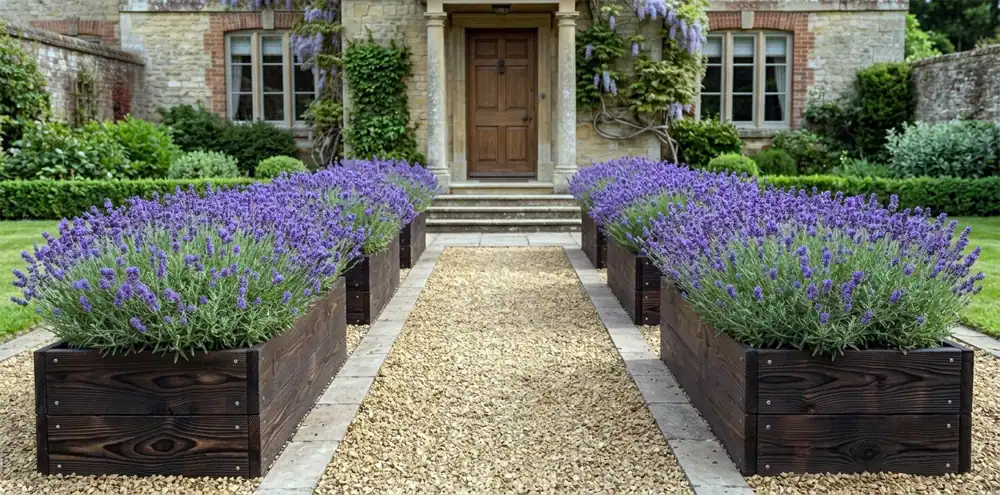
This is why width and height should not be chosen separately. A bed that works well at 30cm high may need to be narrower at 60cm high, depending on who will use it, what it will grow and where it sits in the garden.
Are standard raised bed widths always the best choice?
Standard raised bed widths can be useful starting points, but they are not automatically the best choice for every garden. A standard width may suit manufacturing, packaging or delivery, but that does not mean it suits your reach, path layout or planting style.
This is where width becomes a design decision rather than a catalogue measurement. Before choosing a standard raised bed width, consider:
- The gardener: The bed should suit your actual reach, not an average person on a size chart.
- The location: A bed in open ground can usually be wider than one placed against a wall, fence or boundary.
- The height: Taller beds often need to be narrower to keep the centre comfortable to reach.
- The planting style: Dense planting, soft fruit, herbs, flowers and vegetables all need reliable access.
- The path layout: A standard wide bed can be a poor choice if it leaves cramped paths.
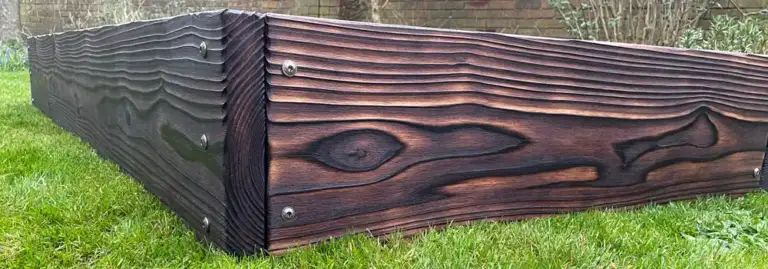
A bespoke raised bed does not have to follow a standard width. It can be designed around the garden and the gardener, so the finished bed works with your space rather than forcing your space to adapt to a pre-made box.
If you choose a standard-size raised bed kit, apply the same filter. Do not buy the widest option because it looks like better value on paper. Choose the width that lets the whole growing area stay useful.
How wide should paths be between raised beds?
Paths between raised beds should be wide enough to let you use the beds comfortably, not just squeeze past them. In most gardens, a narrow access path may work at around 45–60cm, but 75–90cm is usually more comfortable if you need to water, harvest, carry tools or move along the bed regularly.
Path width becomes even more important when beds are placed close together. A well-sized bed can still feel awkward if the path beside it is too narrow. You may be able to reach the planting, but you will not enjoy using the space.
Think about what the path needs to do:
- Foot traffic: Leave enough room to walk naturally without brushing constantly against the bed frame or planting.
- Working space: Allow room to stand, bend, carry a trug or use a watering can.
- Wheelbarrow access: Use a wider path if compost, soil or mulch will be moved through the area.
- Accessible gardening: The path needs to suit the person using it, not just the bed layout.
- Plant spillover: Lavender, herbs, strawberries and flowers can spread beyond the bed edge and reduce usable path width.
This is why bed width and path width should be planned together. A 120cm-wide bed with cramped paths may be less usable than a 90cm bed with generous access around it. The best layout lets you move easily, reach comfortably and maintain the whole planted area without fighting the space.
Choosing a raised bed width made for your garden and gardener
The right raised bed width is the one that keeps the whole bed usable. For most gardens, that means 90–120cm when you can reach from both sides, or 60–75cm when the bed can only be reached from one side.
But those numbers are starting points, not rules. A good raised bed width should respond to the person using it, the height of the bed, the planting style, the available path space and the way the garden is actually laid out.
The best raised bed is not the biggest one that fits. It is the one you can use comfortably, maintain properly and enjoy every time you step into the garden.
That is where a made-to-measure approach can make a real difference. A bespoke raised bed can be designed around your garden and your reach, rather than forcing both into a standard size. If you are planning a layout where width, height, access and planting all need to work together, our premium raised beds are built around that kind of practical design.