Why raised garden beds struggle in year 2: what changes and how to fix it
Raised garden beds often feel easy in their first year, which is why many gardeners are surprised when that same bed begins to struggle in its second season. The soil is fresh, roots move quickly, fertility is high, and the bed seems to do exactly what you hoped. Then the same bed starts behaving differently. Growth is weaker, harvests are less impressive, watering feels less predictable, and a bed that looked full of promise starts to feel strangely tired.
This does not usually mean the raised bed has failed. It usually means the soil system inside it has changed. The fill has settled, the open structure that helped roots and water move easily has started to close up, fertility has been drawn down, organic matter has broken down further, and moisture no longer moves through the bed in quite the same way. If the original fill was never especially stable or balanced, those changes can show up even faster, which is one reason the right starting mix matters so much.
That is why year-2 problems are so often misunderstood. What worked in year one was real, but it was also helped by freshness. A raised bed is not a one-time setup that stays fixed after filling. It is a living, changing system, and if that system is not rebuilt and managed over time, early success can fade much faster than most gardeners expect. The good news is that once you understand what changed, the right fix becomes much clearer.
Key takeaway: Raised garden beds often struggle in year 2 not because they have stopped working, but because the soil inside them has changed. Fresh structure, easy fertility, and more forgiving moisture conditions do not hold themselves in place. Fixing a tired bed usually means rebuilding the soil system, not just expecting year-one performance to continue.
Why raised beds often perform well in their first year
What the gardener is seeing is not just a well-built raised bed, but a newly assembled soil system at its easiest point.
Year one often benefits from conditions that are unusually forgiving. Freshly filled beds tend to have better air spaces, easier root movement, and a larger reserve of readily available fertility than they will later on. Water also tends to infiltrate more easily before the fill has had time to settle and tighten.
That makes the first season a poor guide to long-term performance. Crops establish quickly, growth looks strong, and the bed can feel reliably productive without asking much in return. What the gardener is seeing is not just a well-built raised bed, but a newly assembled soil system at its easiest point.
That is why early success can be slightly misleading. The bed may well be working exactly as it should, but it is also being helped by freshness that will not hold itself in place.
What changes inside a raised bed by year two
By year two, the bed is no longer running on freshness. The soil has started to settle, organic matter has broken down further, and the balance between air, water, and fertility is usually less forgiving than it was in the first season. The timber frame may look much the same, but the growing conditions inside it have already begun to shift.
| What changes by year two | What that usually means | Why it matters |
|---|---|---|
| The soil settles and loses structure | The fill becomes denser and less open | Roots, drainage, and oxygen become less reliable |
| Fresh fertility drops | The bed is no longer running on its original nutrient reserve | Growth becomes less vigorous and crops ask more of the soil |
| Moisture behaves differently | Water movement becomes less forgiving | The same watering routine may no longer work well |
The soil settles and loses its original structure
Fresh fill rarely stays as open as it was on day one. Gravity, watering, root activity, and decomposition all help the soil settle into a denser state. The surface level often drops, the air spaces become smaller, and roots no longer move through the bed as easily as they did in the first year.
That matters because structure affects almost everything else. Once the fill tightens, water infiltration, drainage, root development, and oxygen availability all become less reliable. A bed can still look perfectly tidy from above while performing very differently below the surface.
The bed is no longer running on fresh fertility
The first season often draws on a rich starting reserve. Compost, organic matter, and freshly blended soil can provide nutrients generously at the beginning, especially when the bed has not yet been cropped heavily. By year two, that easy fertility is usually lower.
That does not mean the bed is suddenly barren. It means it has started behaving more like a worked growing system than a newly filled one. Nutrients have been used, organic matter has continued to break down, and the bed is no longer being carried by the initial richness that made year one feel so easy.
Moisture starts behaving differently
Water rarely behaves the same way in year two as it did in year one. As the fill settles and structure changes, some beds dry out faster near the top while others become slower to absorb water cleanly. The same watering routine can suddenly feel less effective, even though the gardener has changed nothing.
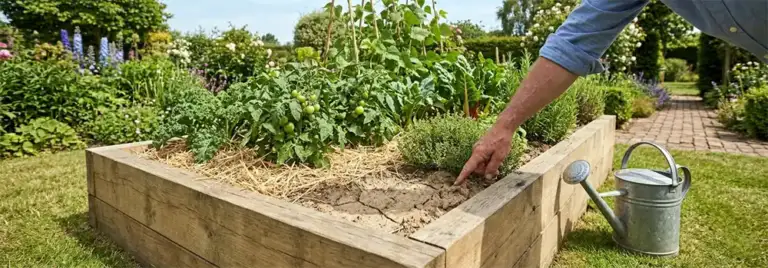
One common sign is that the surface begins to cake or crust. Instead of soaking in evenly, water may sit briefly on top, run off more quickly, or disappear unevenly across the bed. That is often a sign that the mix has tightened, the surface has changed, or the soil is no longer handling moisture as freely as it did when the bed was first filled.
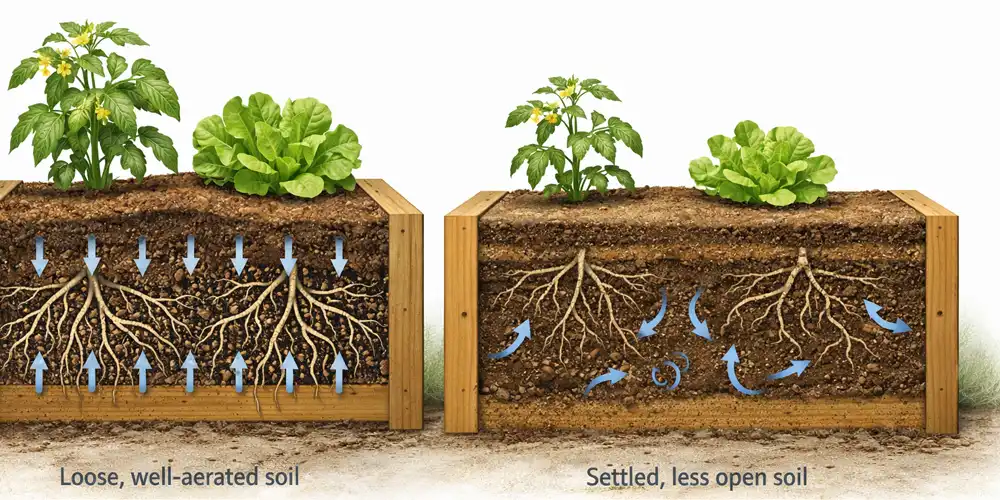
This is one reason the year-two decline can be so confusing. A bed that once felt easy to manage may now swing more quickly between too dry and too wet. When structure, fertility, and moisture all shift together, performance usually drops before the gardener fully sees why.
How those changes show up in plant performance
The difficulty with year-two decline is that it rarely announces itself as one neat problem. More often, the bed still looks respectable, but the plants stop responding as they did before. Growth slows, harvests shrink, and crops that once felt straightforward become harder to keep moving well.
That happens because structure, fertility, and moisture do not fail separately in real beds. They shift together. Roots may meet denser soil, nutrients may be less freely available, and water may move through the bed less evenly. The result is not always dramatic collapse. It is often a quieter loss of vigour.
This is why year-two underperformance is so easy to misread. A gardener may see yellowing leaves and think only about feeding, or see dry soil at the surface and think only about watering. But the visible symptom is often just the surface expression of a deeper change in how the bed is functioning.
Why a bed can still look tidy while performing worse
A neat bed is not always a healthy one. The timber may still be straight, the soil may still fill most of the frame, and the planting may still look organised from a distance. What has changed is not always obvious at a glance.
A neat bed is not always a healthy one.
That is what makes the second year so frustrating. The bed still looks like it should work, so the gardener naturally expects the same results. But once the fill has settled, fertility has dropped, and moisture movement has become less forgiving, appearance stops being a reliable guide to performance. Even where nutrients are still physically present, roots may no longer be reaching or using them as freely as they did before.
How to tell what is actually going wrong
Once a raised bed has moved past its easy first season, the visible signs can be misleading. Yellowing leaves, weaker growth, poor harvests, or awkward watering do not each point to one neat cause. They are often different surface signs of the same deeper shift in structure, fertility, and moisture behaviour.
Use the diagnostic table below to identify why your second-year raised bed is underperforming and what may be changing beneath the surface.
| What you notice in year two | What may have changed underneath | Better judgement |
|---|---|---|
| Soil level has dropped | The fill has settled and organic matter has broken down further | The bed usually needs rebuilding, not just more watering |
| Plants start well, then stall | Early root growth is meeting denser soil and lower easy fertility | Year-one momentum has gone, so the bed now needs active replenishment |
| Leaves yellow or growth looks pale | Nutrients may be lower or less available to roots than before | Feeding may help, but check structure and moisture as well |
| Water sits on the surface, runs off, or soaks in unevenly | The surface has tightened or the soil structure is no longer as open | The issue may be infiltration and soil condition, not simply lack of water |
| One part of the bed performs worse than the rest | Moisture, settling, compaction, or fill quality may now be uneven | Treat the bed as a variable system, not a uniform box of soil |
How to fix a raised bed that has lost year-one performance
Once a raised bed stops running on freshness, the answer is not to chase each symptom separately. Watering more, adding a feed, or blaming one crop may help briefly, but they rarely solve the deeper problem on their own. The better approach is to rebuild the growing system the bed is now asking for: structure, fertility, moisture handling, and cropping pressure all need to be brought back into balance.
Rebuild the soil, not just the surface
If the fill level has dropped and performance has weakened, the bed usually needs more than a light cosmetic top-up. Settling, decomposition, and repeated cropping all change the soil profile over time, so rebuilding means restoring depth, openness, and growing capacity, not just making the bed look fuller again.
The aim is to rebuild a better root environment, not just cover the surface.
In practice, that usually means adding enough material to make a real difference rather than scattering a thin layer across the top. A bed that has become denser and less forgiving needs fresh structure as well as fresh nutrients. The aim is to rebuild a better root environment, not just cover the surface.
That often means thinking in three parts:
- enough material to restore lost depth
- compost to replace organic matter and fertility
- extra soil or mineral-rich material where the bed needs more body and structure
Why compost can help, but not always on its own
Compost is often part of the answer because it helps replace organic matter, restore fertility, and lift the level of a bed that has sunk. For many second-year beds, that alone will improve performance noticeably. It is one reason topping up with home-made compost or a good compost blend is such a common and sensible response.
But compost is not always the whole solution. A bed can also suffer from a tighter soil body, uneven moisture movement, or a mix that has become too soft, too depleted, or too unbalanced for long-term stability. In those cases, compost works best as part of a broader rebuild, often alongside additional soil or mineral material that helps restore body and structure rather than just feeding the bed.
Match watering to the new soil reality
A watering routine that worked perfectly in year one may be wrong in year two without the gardener doing anything careless. Once the fill has settled and the surface has changed, some beds begin to crust, cake, or shed water unevenly. Others dry quickly at the top while staying heavier lower down. The result is that the bed can look dry, act wet, and respond badly to both under-watering and over-watering.
That is why the fix is not simply “water more”. First look at how the bed is actually taking water. If it is slow to absorb, watering more heavily may make runoff worse. If the surface dries fast but the lower soil stays heavy, frequent shallow watering may only reinforce the problem.
Before changing your watering routine, check below the surface with your finger or a hand trowel. A dry-looking top layer does not always mean the whole bed is dry. Year-two watering usually works better when it responds to how the rebuilt soil is behaving, not how the original fill behaved.
Stop repeating the same demand without replenishment
A raised bed that carried hungry crops well in year one may struggle if the same demand is placed on it again without rebuilding what those crops removed. Tomatoes, courgettes, squash, brassicas, and other heavy feeders can strip a fresh bed of its easy year-one fertility surprisingly quickly if that demand is repeated without renewal.
This does not mean every bed needs a complicated rotation plan. It means repeated extraction needs repeated replacement. If the same kinds of crops keep asking for the same things, the bed has to be given those things back in a form that also supports structure and moisture balance. Otherwise, the system becomes steadily less generous, even if it still looks fine from above.
No dig does not mean no maintenance
No dig is often misunderstood as a promise that the soil will look after itself. In reality, it means reducing disturbance, not avoiding responsibility. A no-dig raised bed can be an excellent way to protect soil structure and biology over time, but it still needs organic matter, fertility, and depth to be renewed as the seasons pass.
That matters here because year-two decline often begins when “leave it alone” quietly turns into “do nothing to rebuild it”. A bed can remain no dig while still being actively maintained. In practice, that usually means topping up from above rather than disturbing the whole profile below, often with compost or other suitable organic material used as a renewing surface layer.
No dig can reduce disturbance, but it does not freeze a bed in its first-year condition.
This is one reason raised beds can disappoint gardeners who expected them to stay easy indefinitely. No dig can reduce disruption, but it does not freeze a bed in its first-year condition. Organic matter continues to break down, crops continue to take, moisture continues to behave differently, and the soil still needs managing as a living system rather than being left to coast on old inputs.
How to stop the same decline happening again
The best time to correct year-two decline is before it becomes obvious. Once a bed has already lost vigour, the rebuild is usually larger. When you watch for smaller signs early, maintenance becomes simpler and the bed stays more consistent.
One of the clearest clues is a gradual drop in soil level. That usually means the bed is no longer holding the same depth, structure, and organic matter it started with. If you top up before that loss becomes significant, you are maintaining the system rather than rescuing it.
Other signs are often easy to miss at first:
- the soil level is slowly sinking
- water is soaking in less freely
- the surface is more prone to crusting
- heavy feeders are giving weaker returns
- the bed feels less generous than it did in year one
It also helps to think in cycles rather than seasons. A raised bed is always being changed by roots, watering, weather, decomposition, and harvest. Beds tend to stay productive for longer when fertility, structure, and moisture behaviour are treated as linked, not as separate problems dealt with one at a time.
That does not require an elaborate routine. It usually means noticing when the bed is becoming less open, less full, or less generous, then responding before crops begin to struggle. Small, timely rebuilding is easier than waiting for a clear slump and trying to reverse it all at once.
Soil maintenance: why a raised bed is a living system
A raised bed can look permanent from the outside while changing constantly within. The timber may hold the soil in place, but the growing system inside it is never finished. Roots move through it, water reshapes it, organic matter breaks down, crops draw from it, and biology keeps transforming it whether the gardener notices or not.
That is why soil maintenance matters so much. It is not a sign that the bed has failed. It is the normal work of keeping a living system productive. A raised bed does not stay good because it was once filled well. It stays good when depth, structure, fertility, and moisture behaviour are renewed as they change.
Seen that way, year two is often the moment a gardener stops treating the bed as a one-time setup and starts treating it as something that needs stewardship. That shift matters more than any single product or quick fix. Once you understand that a raised bed is a living system, its changes become easier to read and its maintenance becomes much easier to judge.
Conclusion: year two reveals what year one can hide
A raised garden bed that struggles in year 2 has not necessarily gone wrong. More often, it has simply moved beyond the easy advantages of fresh fill, loose structure, and ready fertility. What looked effortless in year one now needs a little more understanding and a little more care.
That is the real lesson of year-two decline. The bed is not just a frame full of soil. It is a changing growing system, and its performance depends on how well depth, structure, fertility, and moisture behaviour are maintained over time.
Once you see that clearly, the problem becomes easier to solve. Instead of chasing one symptom at a time, you can start rebuilding what changed and judging the bed as a living system. That is usually the point at which a raised bed stops being disappointing and starts becoming reliable again.