Best soil mix for raised beds in 2026: 3 simple mixes that work
If you want the best soil mix for raised beds, start with this: most beds do best with a balanced mix of topsoil, compost, and a smaller amount of drainage or structure-improving material. The exact balance then changes depending on whether the bed is for vegetables, mixed planting, or long-term flowers and herbs.
That matters because a raised bed is a contained growing system. If you fill it with compost alone, it can slump, dry out, or lose structure over time. If you rely too heavily on dense topsoil, drainage and root airflow can suffer. The best soil mix for raised beds is not the richest-looking one on day one. It is the one that stays stable, drains well, and supports healthy growth over time.
In 2026, gardeners are still being sold one-size-fits-all shortcuts, from compost-heavy and peat-free bagged mixes to vague “raised bed” blends that sound helpful but do not always behave well in practice.
This guide gives you three simple soil mixes that work, explains when to use each one, and shows how to avoid the fill mistakes that lead to settling, poor drainage, and weak growth.
Key takeaway: The best soil mix for raised beds is usually not a single product. It is a balanced mix of topsoil, compost, and a smaller structural component, adjusted to suit how the bed will be planted and how stable you need it to remain.
- Standard mix: best for most raised beds where you want a balanced, reliable starting point.
- Vegetable mix: best for hungry crops that need more feeding and moisture retention.
- Stable mix: best for flowers, herbs, and long-term planting where structure matters more over time.
- Avoid this shortcut: compost on its own often looks rich at first, but it is rarely the best long-term fill for a raised bed.
The table below shows the three best starting mixes and when to use each one. The rest of the article explains why they work and how to avoid the fill mistakes that cause settling, poor drainage, and weak growth.
| Mix | Best for | Core balance | Why it works | Watch-out |
|---|---|---|---|---|
| Standard mix | Most raised beds | 50% topsoil, 40% compost, 10% drainage or structure material | Gives a strong balance of fertility, moisture retention, drainage, and long-term stability | Still settles if the compost is too fine or the topsoil is heavy |
| Vegetable mix | Annual crops and hungrier planting | 40% topsoil, 50% compost, 10% drainage or structure material | Holds more moisture and nutrients for fast-growing crops while keeping enough structure for roots and drainage | More likely to slump over time, so it suits beds that are actively topped up and managed |
| Stable mix | Flowers, herbs, and long-term planting | 60% topsoil, 30% compost, 10% drainage or structure material | Gives the bed more mineral body and better long-term structure, with enough organic matter to support healthy growth | Feels less rich at first, but usually behaves more predictably over time |
These are starting points, not rigid formulas. Material quality matters as much as ratio, whether you are using conventional ingredients or peat-free alternatives.
3 simple soil mixes for raised beds
Most raised beds do not need a miracle formula. They need a sensible balance of mineral soil, organic matter, and enough structure to hold moisture without turning dense or unstable. These three mixes are strong starting points, then the rest of the article explains when to adjust them.
1. The standard mix for most raised beds
The standard mix is the best place to start for most gardens because it balances fertility, drainage, moisture retention, and long-term structure without leaning too hard in any one direction.
Suggested balance: 50% topsoil, 40% compost, 10% drainage or structure material.
This mix suits most general raised beds, especially where you want reliable performance across a mix of planting rather than a bed built around one demanding crop. The topsoil gives the bed mineral body and stability, the compost improves fertility and moisture retention, and the final 10% helps keep the mix open enough for roots and excess water to move properly.
It is also the most forgiving of the three mixes. If your compost is slightly richer than expected or your topsoil is a little heavier, the balance is usually still sound. That makes it the strongest default option for gardeners who want a raised bed that behaves predictably from the start.
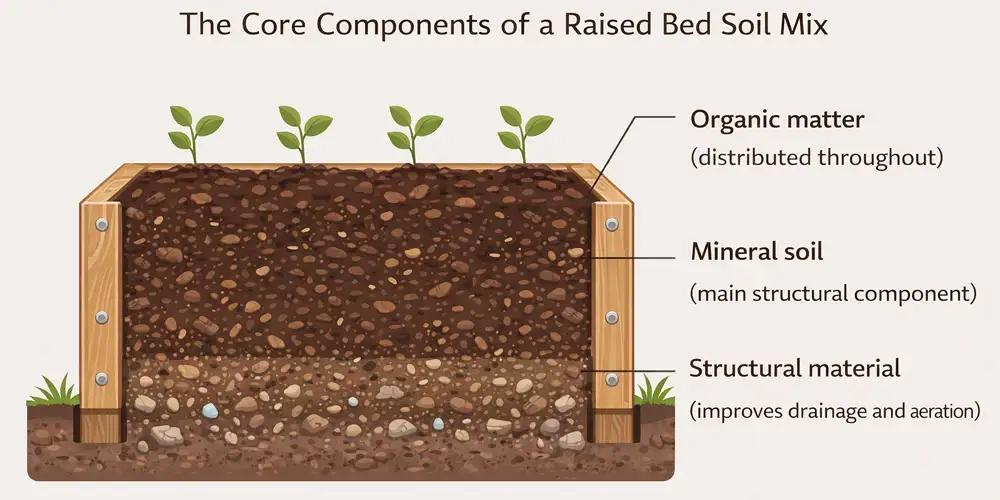
For that final 10%, use a material that helps keep the mix open rather than dense. In most raised beds, that means horticultural grit, coarse sharp sand, or perlite. The best choice depends on how heavy the topsoil is and how free-draining you need the bed to be.
2. The vegetable mix for beds that need more feeding
Vegetable beds usually need a slightly richer mix because fast-growing annual crops draw more heavily on nutrients and often need steadier access to moisture through the growing season.
Suggested balance: 40% topsoil, 50% compost, 10% drainage or structure material.
This mix increases the compost content without turning the whole bed into loose organic matter. That gives hungry crops a more fertile rooting environment while the topsoil still provides enough weight and structure to stop the bed becoming unstable or overly quick to dry out.
It works best in raised beds that are actively managed. Vegetable beds are usually topped up, mulched, replanted, and refreshed more often than ornamental or long-term planting beds, so a slightly softer, richer fill is less of a problem here than it would be in a bed intended to sit undisturbed for years.
The trade-off is that this mix is more likely to settle over time. That is not a flaw if you expect it and manage the bed accordingly, but it is one reason vegetable mixes should not automatically be treated as the best answer for every raised bed.
3. The stable mix for flowers, herbs, and long-term planting
Raised beds planted for longer-term structure usually need a more stable soil body than a vegetable bed. Flowers, herbs, and perennial planting benefit from fertility, but they also benefit from a mix that holds shape well and changes more slowly over time.
Suggested balance: 60% topsoil, 30% compost, 10% drainage or structure material.
This mix gives the bed more mineral weight and long-term structure while still keeping enough organic matter to support healthy growth. It is particularly useful where the planting is meant to remain in place and the bed is not going to be emptied, rebuilt, or heavily refreshed every season.
It may look slightly less rich at first than a compost-heavier fill, but that can be misleading. In practice, this kind of mix often behaves more predictably across wet and dry periods and is less prone to the slumping that can disrupt long-term planting.
For many non-vegetable raised beds, this is the most durable starting point of the three.
Once you know which mix suits your bed, the next question is not just volume but load. Our raised bed soil volume, weight and load calculator uses 5 simple inputs to estimate soil volume, saturated soil weight, and whether your bed may be approaching structural limits before you start ordering materials.
Which soil mix should you choose?
The best soil mix is not the richest one. It is the one that matches how the bed will actually be used, how often it will be refreshed, and how stable you need it to remain over time.
| Mix | Choose it if… | Best suited to | Main trade-off |
|---|---|---|---|
| Standard mix | You want the safest all-round starting point | Most raised beds, mixed planting, and general garden use | Less specialised than the other two, so it will not push either fertility or long-term stability as far |
| Vegetable mix | You want stronger feeding and are happy to manage the bed actively | Annual crops, productive kitchen beds, and regularly refreshed planting | More likely to settle over time, so it suits beds that are topped up and reworked |
| Stable mix | You want the bed to hold its shape and behave predictably over longer periods | Flowers, herbs, lavender, and long-term ornamental planting | Can feel less rich at first, even though it often performs more steadily over time |
The table gives a fast decision. The sections below explain where each mix makes the most sense and what you are trading off.
Choose the standard mix if…
Choose the standard mix if you want the safest all-round starting point. It suits most raised beds because it balances fertility, drainage, moisture retention, and structure without pushing too hard in any one direction.
This is usually the best choice for mixed planting, general garden use, and beds where you want reliable performance without constantly adjusting the fill. If you are not building the bed around one specific crop or one very particular soil condition, this is the strongest default.
It is also the easiest mix to live with if your materials are not perfect. Slight variation in the topsoil or compost usually matters less here than it does in the richer vegetable mix or the more mineral-heavy stable mix.
Choose the vegetable mix if…
Choose the vegetable mix if the bed is mainly for annual crops, fast growth, and active seasonal management. Vegetables usually demand more feeding and more consistent moisture than long-term ornamental planting, so a slightly richer mix makes sense here.
This suits beds that are regularly mulched, topped up, replanted, and refreshed. In other words, it works best where you already expect to intervene. That is why the higher compost content is not automatically a weakness in this context.
The trade-off is that this mix is more likely to settle over time. If you want a fill-once-and-leave-it bed, it is usually not the best option. If you want productivity and are happy to manage the bed actively, it is often the right one.
Choose the stable mix if…
Choose the stable mix if the planting is meant to stay in place and the bed needs to behave predictably over a longer period. This is often the best fit for flowers, herbs, lavender, mixed ornamental planting, and other beds where long-term structure matters more than pushing fast early growth.
The extra topsoil gives the bed more body and reduces the tendency to slump as the organic matter breaks down. That helps the soil surface stay more consistent, which is useful where roots are settling in for the long term and you do not want the bed changing shape too quickly.
It can look slightly less rich at first than a compost-heavier fill, but that can be misleading. For many long-term raised beds, this is the mix that performs more calmly and more reliably after the first season has passed.
Structural note: The stable mix usually carries the most mineral weight of the three, which is one reason it behaves more predictably over time. It also means larger or deeper beds can end up carrying more saturated load than many gardeners expect. Our raised bed soil volume, weight and load calculator helps you estimate not just soil volume, but wet weight and whether your bed may be approaching structural limits.
How to fill a raised bed for better drainage and stability
Choosing the right mix is only part of the job. How the bed is filled affects how that mix behaves, especially once it gets wet and starts to settle.
| Question | Short answer | Why it matters | Watch-out |
|---|---|---|---|
| Should you mix materials or layer them? | Mix the main growing medium rather than building sharp internal layers. | A more even mix gives roots, moisture, and air a more consistent environment. | Distinct layers can create uneven drainage and less predictable root conditions. |
| How full should a raised bed be? | Usually fill to around 2 to 5 cm below the top edge. | This leaves room for settling, mulching, and easier watering. | Filling right to the rim often leaves the bed looking underfilled once the mix settles. |
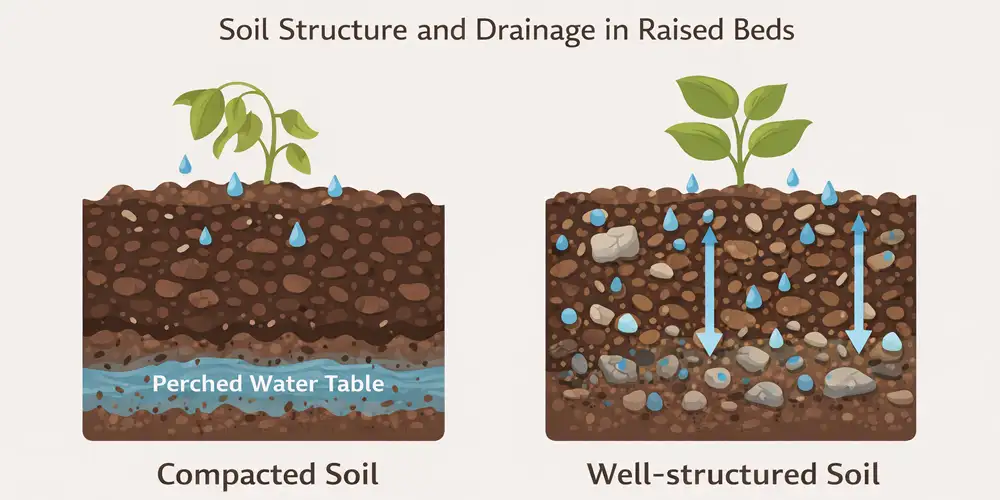
| What if the ground below is heavy clay? | Loosen the surface below the bed and avoid impermeable barriers. | Excess water needs a path downward, even in a raised system. | Dense clay and trapped layers can keep the base wetter than expected. |
Should you mix materials or layer them?
In most raised beds, the main fill should be mixed rather than built in distinct layers. Roots do better when they can move through a consistent growing medium, and water also behaves more predictably when the mix is reasonably even from top to bottom.
A sharply layered bed can create sudden changes in texture and drainage behaviour. That does not always cause failure, but it does make the bed less consistent. A blended fill is usually the safer default because it gives roots, moisture, and air a more stable environment.
This does not mean every part of the bed has to be mechanically perfect. It means the main growing zone should behave as one mix rather than as separate bands of compost, soil, and drainage material.
How full should a raised bed be?
A raised bed should not usually be filled right to the rim. Most mixes settle over time, especially if they contain a healthy proportion of compost, so leaving a little space at the top gives the bed room to relax without immediately looking underfilled or spilling mulch over the edge.
As a practical rule, fill the bed to around 2 to 5 cm below the top edge. Shallower beds can sit a little nearer the top, while deeper beds or compost-richer mixes are usually better with a slightly larger settling gap.
This upper space also makes the bed easier to water, mulch, and maintain. If the soil starts level with the top board, you lose that working margin straight away.
This matters more as beds get larger, deeper, or more heavily filled, because the question is not just how much soil fits inside but how much saturated load the bed must actually carry.
What if the ground below is heavy clay?
Heavy clay does not stop a raised bed from working, but it does change how important the base conditions become. If the ground below drains slowly and stays dense, water can struggle to move away from the bottom of the bed, especially in wetter months.
The answer is usually not to create a hard barrier or build elaborate layers inside the bed. It is to make sure the bed sits on ground that has at least been loosened and cleared of obvious compaction, so excess water has a better chance of moving downward.
In practical terms, that means breaking up the surface of the clay with a fork before filling the bed and avoiding anything impermeable at the base that could trap water. A good soil mix will still do much of the work, but the ground below should not be treated as irrelevant just because the bed is raised.
If you’re also deciding what should sit beneath the main soil mix, our article on raised bed soil myths covers the common shortcuts that sound helpful but often create new problems.
What makes a good raised bed soil mix?
A good raised bed soil mix does four things at once. It gives plants access to nutrients, holds enough moisture to stay usable between watering, drains excess water before roots sit in it too long, and keeps enough structure for air and root growth. Most weak mixes fail because they do one or two of those jobs well, but not all four.
| Principle | What it adds | What goes wrong | Better judgement |
|---|---|---|---|
| Compost | Fertility, biology, and moisture retention | Used too heavily, it keeps breaking down, which can lead to settling and weaker long-term structure | Use compost as part of the mix, not as the whole answer |
| Drainage and moisture retention | A good raised bed holds enough water for roots while still letting excess move away | If the mix stays too wet it becomes airless; if it drains too quickly it can swing between wet and dry | Aim for balance, not maximum drainage or maximum water-holding in isolation |
| Long-term stability | Keeps the bed behaving more predictably as organic matter breaks down and roots settle in | A mix that is too soft or too rich can slump and change shape faster than long-term planting wants | Use more mineral body where the bed is meant to hold structure over time |
Why you need more than just compost
Compost is valuable, but it is not a complete raised bed fill on its own. It improves fertility, supports soil life, and helps hold moisture, which is why it appears in all three mixes. The problem starts when compost is treated as the whole answer rather than one component in a wider system.
In a raised bed, compost-heavy fills often look excellent at first because they are dark, rich, and easy to work. Over time, though, they continue to break down, which means the bed can settle, lose structure, and change how it handles moisture. That is manageable in actively maintained vegetable beds, but much less desirable in beds meant to stay stable for years.
The answer is not to avoid compost. It is to give compost the right role. In a good raised bed mix, compost feeds the system and supports moisture balance, but mineral soil and structural material stop the bed behaving like a bag of decomposing organic matter.
How drainage and moisture retention work together
Many gardeners treat drainage and moisture retention as opposites, but a good raised bed needs both. A mix that drains too slowly can become dense and airless after rain. A mix that drains too fast can dry out quickly and leave roots swinging between wet and dry extremes.
What matters is not simply whether water leaves the bed, but how the mix behaves between rain or watering events. A well-balanced raised bed soil mix keeps enough moisture in reserve for plants to use while still leaving enough air space for roots to breathe and excess water to move away.
That is why the structure of the mix matters so much. Topsoil, compost, and the final drainage or structure component all influence the size and distribution of the spaces between particles. Those spaces control whether the bed behaves as a stable growing medium or an inconsistent one.
Why long-term planting needs more stability
A raised bed planted with annual vegetables can be refreshed regularly. A raised bed planted with herbs, flowers, or longer-term ornamental structure often cannot. That changes what the soil mix needs to do.
In a long-term bed, the mix has to hold shape more reliably as organic matter breaks down and roots settle in. If the fill is too soft or too compost-heavy, the surface can slump, mulch lines can shift, and root zones can change more quickly than the planting wants. None of that usually causes instant failure, but it does make the bed less predictable over time.
That is why the stable mix carries more mineral soil. The extra body is not there to make the bed poorer. It is there to make it calmer. For long-term planting, steadiness is often more valuable than a richer-looking fill that changes too quickly after the first season.
Compost vs topsoil in raised beds
Compost and topsoil are often treated as substitutes, but they do different jobs in a raised bed. Most poor fills happen when one is expected to do the work of both.
| Material | What it adds | What goes wrong on its own | Better judgement |
|---|---|---|---|
| Compost | Fertility, biology, and moisture retention | It keeps breaking down, which can lead to settling and weaker long-term structure | Use compost to feed and condition the mix, not to replace the whole soil body |
| Topsoil | Mineral weight, structure, and root support | Used too heavily on its own, it can become dense, less forgiving, and slower to drain | Use topsoil to give the bed body, then balance it with compost and a structural component |
| Compost + topsoil together | Fertility, stability, moisture balance, and better long-term behaviour | If the proportions are poor, the bed can still be too soft, too dense, or too variable | Build the mix around both, then adjust the balance to suit the type of planting |
The table gives the fast answer. The sections below explain why each material matters and why most raised beds perform better when both are working together.
What compost adds
Compost brings fertility, biological activity, and moisture retention into the mix. It is the part that helps a raised bed feel alive rather than inert, which is why every good mix in this article includes it.
It also makes the soil easier to work and helps buffer moisture between rain or watering. That is especially useful in raised beds, which tend to drain more freely than open ground and can dry out faster if the mix is too mineral-heavy.
The problem is not compost itself. The problem is expecting compost to provide the whole structure of the bed. It is there to improve the system, not replace it.
What topsoil adds
Topsoil gives the bed mineral body, physical stability, and a more durable rooting environment. It is the part that helps the mix hold shape and behave more predictably over time.
That matters more than many gardeners realise. A raised bed is not just a nutrient container. It is a physical soil body that has to carry water, air, roots, and load without changing too quickly as the season goes on. Topsoil helps provide that steadiness.
Without enough mineral soil, a raised bed can feel rich at first but become softer, lower, and less consistent as the organic matter continues to break down.
Why most raised beds need both
Most raised beds perform best when compost and topsoil are working together rather than competing for the same role. Compost brings feeding power and moisture buffering. Topsoil brings body, root support, and longer-term structure. One is not the “good” material and the other the boring one. They solve different parts of the same problem.
That is why the best soil mix for raised beds is rarely a single bagged product and rarely a single ingredient. It is usually a balance of compost, topsoil, and a smaller structural component, adjusted to suit how the bed will be planted and how stable you need it to remain.
The question, then, is not whether compost or topsoil matters more. The better question is how much of each the bed needs for the kind of planting you want to grow.
Do peat-free and sustainable soil choices change the answer in 2026?
Not as much as the marketing suggests. Peat-free and more sustainable ingredients can work very well in raised beds, but they do not remove the need for balance. A good raised bed mix still needs enough mineral body, enough organic matter, and enough structure to manage moisture, drainage, and long-term stability.
| Concern | What matters in practice | Better judgement |
|---|---|---|
| Peat-free compost | It can work well, but different products vary more in texture, water-holding, and breakdown rate than many gardeners expect. | Treat peat-free compost as one ingredient in a wider mix, not as a complete raised bed fill. |
| Sustainable ingredients | Coco coir, wood fibre, and similar alternatives can be useful, but they still need balancing with topsoil and structural material. | Judge ingredients by how the final mix behaves, not by whether one component sounds eco-friendly on its own. |
| 2026 advice trends | Many current mixes are marketed around peat-free or all-in-one convenience, but raised beds still respond to the same physical rules. | Choose a mix for stability, drainage, moisture balance, and planting type first, then make the ingredients as sustainable as you reasonably can. |
The shift toward peat-free gardening is real, but the underlying soil physics have not changed. Raised beds still perform best when the fill holds together as a stable growing medium rather than a loose pile of organic material.
That means peat-free compost can be part of a very good mix, especially when paired with decent topsoil and the right structural component. What matters is not whether the bag says peat-free, but whether the final blend drains well, holds enough moisture, and keeps enough body to stay usable over time.
The same applies to other sustainable ingredients. Materials such as coco coir or wood-based composts can help with moisture retention or organic content, but they are not magic replacements for the whole job that mineral soil and structure still need to do.
The better approach is not to chase a fashionable ingredient in isolation, but to make sure the final mix still behaves as a stable growing medium over time.
New materials may change the ingredients you use, but they do not change what a raised bed soil mix has to do.
Common soil advice that sounds right but fails
Some raised bed advice sounds sensible because it focuses on one benefit in isolation. More compost sounds richer. More drainage material sounds safer. Filling to the top looks generous. In practice, raised beds behave as systems, so advice that overcorrects one part of the mix often creates a new problem somewhere else.
The most common example is compost-only filling. It can look rich and promising at first, but in most raised beds it settles more quickly, changes structure faster, and becomes less predictable over time than a balanced mix with enough mineral soil to give the bed body.
If you want the fuller version of those shortcuts and why they fail, our article on raised bed soil myths breaks down the common advice that sounds helpful but often leads to weaker results.
Final answer: what is the best soil mix for raised beds?
The best soil mix for raised beds is usually not a single product or a one-size-fits-all bagged blend. It is a balanced mix of topsoil, compost, and a smaller structural component, adjusted to suit what the bed is for and how stable you need it to remain over time.
For most raised beds, the standard mix is the strongest starting point because it balances fertility, moisture retention, drainage, and structure without leaning too hard in any one direction. The vegetable mix is better where the bed will be actively managed and fed through the season. The stable mix is usually the better choice for flowers, herbs, and long-term planting where calm, predictable behaviour matters more than looking rich on day one.
The better question is not which ingredient sounds best on its own, but which mix will behave best once it is wet, settled, planted, and left to perform in a real garden.
- Choose the standard mix for the safest all-round starting point.
- Choose the vegetable mix for annual crops and higher feeding demand.
- Choose the stable mix for long-term planting and better structural steadiness.
- Avoid treating compost, topsoil, or peat-free products as complete answers on their own.
- Judge the mix by how it behaves over time, not how rich it looks when first filled.