Where to put a raised bed so it lasts longer
Most people choose where to put a raised bed based on sunlight, convenience or how the garden looks. Those things matter, but they do not tell the whole story. If you want the bed itself to last longer, you also need to think about how the site affects ground moisture, airflow, spacing and nearby boundaries.
The best place to put a raised bed is an open, level, free-draining position where air can move around the structure and water does not sit against the base. A bed placed in a damp hollow, tight corner or narrow gap between boundaries may stay wetter for longer, even if it is well made.
This is why two identical raised beds can age differently in the same garden. The build may be the same, but the drying conditions around each bed are not. For a wider view of timber, joints, drainage and structure, see our guide to how to make raised beds last longer.
Key takeaway: Where you put a raised bed affects how long it lasts. Choose a level, free-draining spot with good airflow, enough clearance around the sides, and no nearby boundary that traps damp air or debris against the timber.
Where to put a raised bed: the 4 placement checks
The best place to put a raised bed is somewhere level, open and free-draining, with enough space around the sides for air movement and maintenance. It should receive enough light for the plants you want to grow, but the bed itself also needs a position that lets timber dry after rain.
A sunny spot is not automatically a durable spot. A bed can receive good light and still sit in a damp hollow, tight corner or poorly ventilated gap. Over time, those local conditions can keep the lower boards wetter for longer and shorten the useful life of the structure.
Use these checks when deciding where to put a raised bed, especially if the position looks neat but may stay damp.
| Placement factor | Best condition | Why it affects lifespan |
|---|---|---|
| Ground moisture | Level, free-draining ground rather than a wet hollow | Reduces how long water sits around the base after rain. |
| Airflow | Open enough for air to move around the sides | Helps the timber dry instead of staying damp in still air. |
| Spacing | Enough room between beds to walk, inspect, clear debris and let air move | Prevents narrow gaps from trapping damp air, leaves and debris. |
| Nearby boundaries | Clearance from fences, walls, hedges and dense planting | Reduces sheltered damp zones where one side of the bed dries slowly. |
A few extra steps to reach the bed may be a small price to pay for a position that drains better, dries faster and gives the timber more room to recover after rain.
Does raised bed placement affect how long it lasts?
Yes, raised bed placement can affect how long it lasts because position changes how often the timber gets wet, how quickly it dries, and how much repeated dampness builds up around the base.
Two beds can be made from the same timber and built to the same standard, yet age differently because they are not living in the same conditions. One may sit in open air on free-draining ground. Another may sit beside a hedge, wall, damp lawn edge, piled-up leaves or tall weeds where moisture lingers for longer after rain.
The difference is usually not dramatic at first. It builds through repetition. Each slow drying cycle keeps the timber damp for longer. Each trapped corner or shaded boundary gives the bed less chance to recover before the next wet spell. The bed does not only need a useful position for plants. It also needs a position that allows the structure to dry, breathe and recover.
Placement is part of durability, not just garden layout.
Should a raised bed go on wet or free-draining ground?
A raised bed should ideally go on free-draining ground rather than a wet hollow. The bed can cope with rain, but it should not sit in a position where water repeatedly gathers around the base.
Wet ground affects the bed in two ways. It keeps the lower timber damp for longer after rain, and it slows the drying cycle between wet periods. That matters because timber durability is not just about whether wood gets wet. It is about how long it stays wet before it can dry again.
A dry-looking area in summer can still be a poor position in winter. Clay soil, compacted lawn, low spots and areas near hard surfaces can all hold water when rainfall increases. Patios, paths and driveways can also shed water towards nearby soil, so the edge beside a hard surface may be wetter than it looks.
Use these checks before choosing the position:
- Does water sit there after heavy rain?
- Is the ground lower than the surrounding garden?
- Does the lawn stay soft, muddy or mossy in that area?
- Will nearby paving, paths or slopes send water towards the bed?
- Can water move away from the base, or will it linger underneath?
The best ground for a raised bed is not bone dry. It is ground with an exit route for excess water, so moisture can leave instead of sitting against the timber.
How much airflow does a raised bed need?
A raised bed needs enough airflow for damp air to move away from the timber after rain. It does not need to sit in an exposed, windy position, but it should not be trapped in a still, enclosed space where moisture lingers around the sides and base.
Airflow matters because drying is part of protection. When air can move around the bed, moisture leaves the timber more evenly. When air is blocked by walls, fences, hedges, dense planting or closely spaced beds, evaporation slows and some faces may stay damp for longer than others.
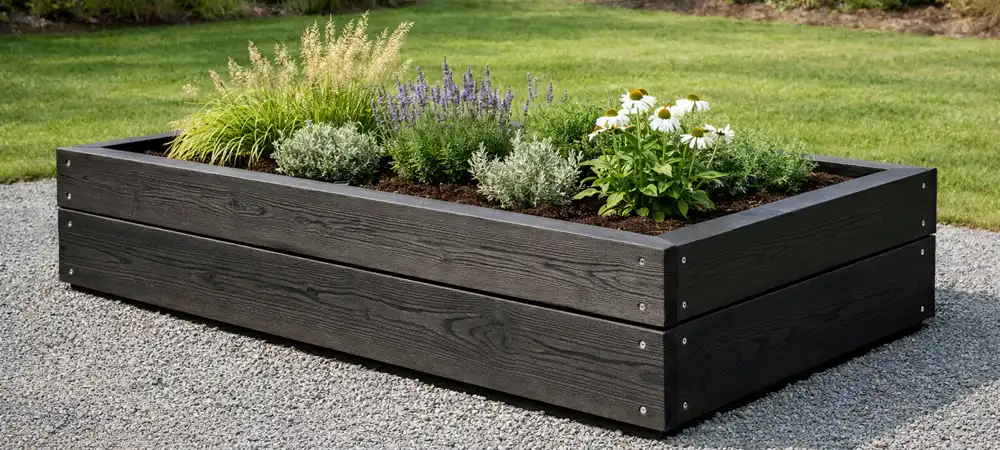
The risk is usually highest low down, where timber is closest to wet ground, splashback, fallen leaves and shaded corners. This is where still air can turn a small damp patch into a repeated drying problem.
A good position allows air to pass around the bed without creating an awkward or exposed growing space. In practice, that means avoiding tight corners, clearing dense vegetation away from the sides, and leaving enough room for the lower boards to dry after wet weather.
How much space should you leave around a raised bed?
You should leave enough space around a raised bed to walk, inspect the sides, clear debris and let air move. The exact gap depends on the garden, but the principle is simple: if you cannot easily reach the side of the bed, it is more likely to trap damp leaves, still air and unnoticed moisture. As a practical starting point, aim for enough clearance to stand, reach the side, and remove debris easily. In many gardens, that means thinking in terms of a usable path rather than a narrow visual gap.
Spacing matters because narrow gaps behave differently from open garden space. A tight gap between two beds, or between a bed and a boundary, can hold damp air after rain and slow drying along the lower boards. It can also make maintenance harder, which means leaves, soil splashback and weeds are more likely to sit against the timber.
For practical planning, think in terms of access as well as appearance. A bed that looks neatly tucked into a corner may be harder to clean, inspect and keep dry. A slightly wider path or clearer margin gives the structure more room to recover after wet weather.
| Spacing benefit | What it helps you do | Why it affects lifespan |
|---|---|---|
| Airflow | Allows air to move around the lower boards | Helps damp timber dry after rain instead of sitting in still air. |
| Maintenance access | Makes watering, planting and harvesting easier | Reduces the chance that one side becomes neglected, overgrown or constantly damp. |
| Debris clearance | Lets you remove leaves, weeds and soil splashback | Stops damp organic material acting like a sponge against the timber. |
| Inspection | Lets you check corners, fixings and lower edges | Makes early signs of movement, rot or trapped moisture easier to spot. |
| Separation between beds | Prevents beds from forming a narrow damp channel | Reduces shared pockets of trapped air and moisture between structures. |
The best gap is not just the one that fits the layout. It is the one that lets the bed work as part of the garden without being trapped by it.
Can you put a raised bed next to a fence or wall?
Yes, you can put a raised bed next to a fence or wall, but you should not press it tightly against the boundary. The bed needs enough clearance for air movement, drying, inspection and maintenance.
A fence or wall changes the local conditions around a raised bed. It can reduce airflow, cast shade, trap damp air and collect leaves or soil splashback at the back of the bed. That hidden side often dries more slowly than the open side, especially after rain.
The main risk is not the boundary itself. It is the dead space created when timber sits too close to it. If you cannot see, clean or reach the back edge, damp material can build up unnoticed and keep moisture against the bed for longer.
Hedges and dense planting need even more care than hard boundaries. They can hold moisture, drop leaves, reduce airflow and make the back of the bed harder to maintain. A bed beside living growth should never be treated as “open” just because there is no wall.
Use this as the practical rule: leave enough space behind the bed to inspect the timber, clear debris and let the back face dry. If the bed must sit near a fence, wall or hedge, treat that rear gap as a working space, not wasted space.
A raised bed near a boundary can still work well. It just needs enough room to breathe, dry and be maintained from the side most likely to be forgotten.
Where should you not put a raised bed?
You should not put a raised bed anywhere that keeps the structure wet, trapped, twisted or hard to maintain. The bed may still work for plants at first, but poor placement can shorten its lifespan by slowing drying and hiding early problems.
The biggest mistake is choosing a position only because it looks neat. A tight corner, damp lawn edge or narrow gap beside a fence may seem tidy on day one, but those same places often collect moisture, leaves and still air after rain.
Avoid placing a raised bed:
- in a low spot where water gathers after heavy rain
- directly against a fence, wall, hedge or dense planting
- between other beds with no room for airflow or access
- on uneven ground that twists the frame
- where paving or slopes direct water and silt towards the base
- under overhanging plants that keep the area shaded and damp
- beside young shrubs or planting that may grow into the bed over time
- where you cannot inspect or clean the lower boards
A poor position does not always cause immediate failure. It usually creates a pattern: slower drying, more trapped dampness, less inspection and more repeated stress. That pattern is what makes placement matter over the long term.
What should you read next?
Where you put a raised bed affects how it dries, breathes and ages. The next step is to look more closely at the part of the decision that matters most for your garden, whether that is ground preparation, drainage, structure, lifespan or soil load.
| Question you still have | Best next page | Why it helps |
|---|---|---|
| How should I prepare the ground before placing the bed? | How to Prepare the Ground for a Raised Bed | Shows how levelling, drainage and base conditions affect the bed from below. |
| How do timber, joints and drainage work together? | How to Make Raised Beds Last Longer: 6 Key Factors | Explains the wider durability system beyond placement alone. |
| How long should a raised bed actually last? | How Long Do Raised Beds Last? The 5–20+ Year Truth | Gives realistic lifespan ranges and explains why conditions change the outcome. |
| What causes raised beds to bow, rot or fail? | Why Raised Beds Fail: Causes and Fixes for Bowing or Rot | Helps identify the structural and moisture problems poor placement can make worse. |
| How much soil weight will the site and bed need to handle? | Raised bed soil volume, weight and load calculator | Calculates soil volume, saturated weight and structural load before you commit to a layout. |
| Is my raised bed actually a planter? | Raised Bed vs Planter: Why the Bottom Changes Everything | Explains why an open-bottom raised bed behaves differently from a contained planter. |