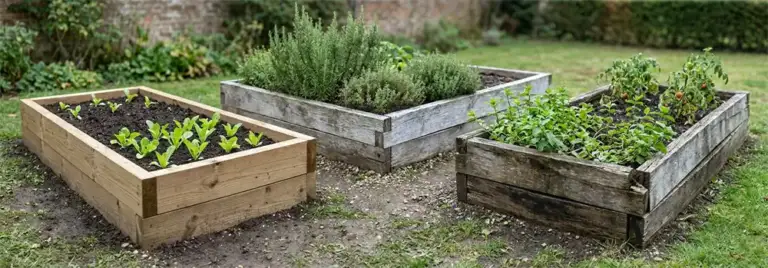
How deep should a raised bed be for different plants?
For most gardens, a raised bed with 30 to 45 cm of usable soil depth is a strong all-round choice. Shallower beds can still work well for quick crops and intensively managed planting, but herbs, bulbs, flowers, vegetables, and longer-term planting usually perform better when there is enough depth for the soil to stay more stable.
That is because raised bed depth is not only about giving roots somewhere to go. It also affects how much soil the bed can hold, how quickly it dries out, how sharply temperatures change, and how often you need to water, feed, or correct problems. Depth changes how forgiving the whole system is. If you are also deciding what to fill it with, our guide to the best soil mix for raised beds explains how depth and soil structure work together.
This guide breaks raised bed depth down by plant type, so you can see when a shallower bed is enough, when more depth is worth it, and how to choose a depth that suits the way you actually want to garden.
Key takeaway: For most gardeners, around 30 to 45 cm of usable soil depth is a strong all-round choice.
- Shallow raised beds can work well for quick crops and closely managed planting.
- Deeper beds hold moisture more evenly and buffer temperature swings better.
- Herbs, bulbs, flowers, vegetables, and longer-term planting usually perform better when the soil volume is more stable.
- The best depth depends not just on roots, but on how forgiving you want the whole growing system to be.
Raised bed depth at a glance for different plants
There is no single perfect depth for every raised bed. The right choice depends on what you want to grow, how permanent the planting will be, and how much day-to-day watering, feeding, and correction you are happy to do. The table below gives a practical overview of the depth ranges that usually work well for different types of planting.
| Planting type | Depth that works well | Can shallower still work? | Why more depth helps |
|---|---|---|---|
| Salad crops and quick annuals | 20 to 30 cm | Yes, often | More depth gives steadier moisture and reduces how quickly the bed dries out between watering. |
| General vegetables | 30 to 45 cm | Sometimes | Extra depth gives roots more room, improves moisture buffering, and makes growth more consistent in warm weather. |
| Herbs | 25 to 40 cm | Often, depending on the herb | More depth improves overall soil stability and helps avoid sharp swings between very dry and very wet conditions. |
| Bulbs and tubers | 25 to 40 cm | Sometimes | Extra depth leaves more usable soil beneath the planting zone, helping with moisture balance and longer-term performance. |
| Flowers and pollinator planting | 30 to 45 cm | Sometimes | More soil volume supports longer flowering, steadier moisture, and less stress during dry spells. |
| Perennials and shrubs | 40 cm or more | Rarely ideal | Long-term planting benefits from more root room, better anchorage, and a more stable growing environment over time. |
| Low-maintenance mixed planting | 40 to 45 cm or more | Possible, but less forgiving | Deeper beds change more slowly, so they need less intervention and cope better with weather extremes. |
These are working depths, not rigid rules. A shallower bed can still grow many things well if it is actively managed, but the shallower the bed, the faster the soil tends to dry out, heat up, cool down, and run short of nutrients. Deeper beds are not automatically necessary, but they are usually easier to keep performing well over time.
When is a shallow raised bed enough?
A shallow raised bed can work well when the planting is fast and the bed is actively managed. With less soil volume, it buffers moisture, temperature, and nutrients less effectively, so it is usually less forgiving.
Shallow beds suit quick crops such as salads, cut-and-come-again leaves, radishes, and other fast annuals. They can also make sense where height is being kept low, where cost or materials need to be controlled, or where open ground below gives roots some freedom beneath the visible structure.
A shallow raised bed is not wrong. It is usually just less forgiving.
The drawback shows over time. Shallow beds dry out faster, heat up and cool down more quickly, and run through nutrients sooner. That is why they can work very well for quick crops, but often less well for herbs, flowers, bulbs, or longer-term mixed planting.
A shallow raised bed is usually enough when the planting is short-term, the gardener is hands-on, and the bed is not being asked to behave like a stable, lower-maintenance system.
A shallow raised bed usually works best when you are happy to provide more active support, such as:
- more frequent watering in warm weather
- regular feeding through the growing season
- mulching to slow moisture loss
- closer attention to temperature swings in exposed positions
Best shallow raised bed depth for salads and quick crops
For salads and quick crops, around 20 to 30 cm of usable soil depth is often enough. That usually suits leaves, small annuals, and other crops harvested before they place long-term demands on the bed.
This is why shallow raised beds can look excellent at first. Fast crops respond quickly, the planting cycle is short, and active watering and feeding can easily keep pace.
The important point is why that works. A shallow bed growing leaves and quick annuals is usually succeeding because the crop is short-term and the system is being actively supported. It is not proof that the same depth will suit everything else.
Why shallow beds need more watering, feeding and temperature control
The shallower the raised bed, the faster it responds to changing conditions. That can help in spring, when shallow soil warms quickly. But it also means the bed loses moisture faster, runs through nutrients sooner, and is more exposed to temperature swings.
Shallow beds can be highly productive, but they usually succeed because they are being actively managed, not because depth no longer matters.
In summer, shallow beds heat up and dry out far sooner than deeper ones, especially in sunny or windy positions. Feeding matters more for the same reason. With less soil volume, the nutrient reserve is smaller and repeated cropping depletes it more quickly.
So shallow raised beds are usually best seen as responsive systems rather than stable ones. They can work very well, but they depend more on timing, attention, and active management.
How deep should a raised bed be for different plants?
Extra depth matters more when planting is expected to stay in place, cope with wider swings in weather, or perform well with less day-to-day correction. That is why the best raised bed depth is rarely about root length alone. It is about how much stable, usable soil the planting will rely on over time.
Vegetables, herbs, bulbs, flowers, and longer-term mixed planting all use soil differently. Some are fast and forgiving. Others depend more on steady moisture, lower stress, and enough room for roots to establish properly. The deeper the bed, the more slowly those conditions usually change.
This is where raised bed depth stops being a simple measurement and becomes a gardening decision. A quick crop in a closely managed bed can do well with less. A longer-term bed that is meant to settle, fill out, and stay healthy through changing seasons usually benefits from more.
More depth does not just give plants more room. It gives the whole bed more stability.
Raised bed depth for vegetables
Vegetables are often used as the benchmark for raised bed depth, but they do not all ask the same thing from the bed. Some are shallow and fast. Others need more room below them or benefit from a deeper, more stable soil profile during active growth.
That is why it helps to think in groups rather than look for one universal vegetable depth. Leafy crops, root crops, and larger fruiting vegetables all place different demands on the bed. The table below shows practical working depths for the most common types.
| Vegetable group | Common examples | Depth that works well | Why this depth helps |
|---|---|---|---|
| Leafy greens and quick crops | Lettuce, rocket, spinach, radish | 20 to 30 cm | These crops are fast, relatively shallow-rooted, and usually harvested before long-term soil demands build up. |
| General vegetables | Beetroot, peas, beans, chard | 25 to 40 cm | More depth gives steadier moisture and a larger soil reserve, which helps maintain more even growth. |
| Root crops | Carrots, parsnips, longer-rooted beet varieties | 30 to 45 cm | These crops benefit from enough depth for root development and from loose, stable soil that does not tighten too quickly, which helps reduce stunting and misshapen roots. |
| Fruiting vegetables | Tomatoes, peppers, courgettes, cucumbers | 30 to 45 cm | More depth helps buffer moisture swings and supports heavier top growth during the most demanding part of the season. |
Vegetables often succeed in shallower beds because they are usually grown as annuals, watered regularly, and fed actively. That makes them one of the more forgiving plant groups overall. But that should not be confused with depth being irrelevant. A shallow vegetable bed can be productive, but it usually stays productive because the gardener is helping it more often.
A shallow vegetable bed can be productive, but it usually stays productive because someone is helping it more often.
Raised bed depth for herbs
Herbs do not all want the same kind of raised bed. Some are quick and shallow-rooted. Others become woody, stay in place for years, and rely much more on stable soil conditions.
A shallower bed can work well for soft, short-term herbs such as basil, coriander, and parsley, especially if it is watered and fed regularly. But once herbs are expected to stay in place or return year after year, extra depth becomes more useful because it helps the soil stay more even through wet periods, dry spells, and seasonal change.
Herbs often struggle in shallow beds not because they need extreme depth, but because the soil changes too quickly around them.
Mediterranean herbs show this especially clearly. Rosemary, thyme, sage, and lavender may be drought-tolerant, but they still do better when the root zone is better drained and more stable overall.
The table below shows practical working depths for some of the most common herbs.
| Herb | Growth habit | Depth that works well | Why this depth helps |
|---|---|---|---|
| Basil | Soft annual | 20 to 30 cm | Usually grown for one season, so it can do well in a shallower bed if moisture and feeding are kept consistent. |
| Parsley | Short-lived leafy herb | 20 to 30 cm | Needs steady moisture more than extreme depth, but benefits from enough soil to avoid rapid drying in warm weather. |
| Chives | Clump-forming perennial | 20 to 30 cm | Can cope with moderate depth, but performs better when the soil stays evenly moist and less stressed through summer. |
| Thyme | Woody perennial | 25 to 35 cm | Benefits from stable drainage and enough soil beneath it to avoid sharp wet-dry swings, especially in winter. |
| Sage | Woody perennial | 30 to 40 cm | Extra depth helps create a more stable, better-drained root zone and supports a healthier long-term structure. |
| Rosemary | Larger woody perennial | 30 to 45 cm | Usually performs better with a deeper, better-drained root zone and more stable soil conditions, especially where it is expected to stay in place for years. |
| Mint | Spreading perennial | 25 to 35 cm | Does not need extreme depth, but benefits from enough soil volume to support vigorous growth without drying too quickly. |
The main mistake is assuming that small herbs are all shallow-bed plants. In practice, the more permanent the herb, the more useful stable soil conditions become.
Raised bed depth for bulbs and tubers
Bulbs and tubers raise a slightly different depth question. Part of it is about how deep the bulb or tuber itself is planted, but the raised bed also needs enough soil beneath that planting zone to support drainage, moisture balance, and healthy growth.
This is where people often confuse planting depth with bed depth. A crocus bulb may only need to sit a few centimetres below the surface, but that does not mean the whole bed only needs to be that deep. The bed still benefits from enough usable soil below the bulb to stop conditions changing too sharply after rain, heat, or drying winds.
Planting depth and bed depth are not the same thing. A bulb can be planted shallowly and still benefit from a deeper raised bed.
That matters even more with larger bulbs and tubers. Tulips, daffodils, alliums, and dahlias all benefit from a bed that feels stable around them rather than one that swings quickly between very wet and very dry.
The table below separates the two, so the difference is clear.
| Bulb or tuber | Typical planting depth | Raised bed depth that works well | Why more bed depth helps |
|---|---|---|---|
| Crocus | 8 to 10 cm | 20 to 30 cm | Small bulbs can be planted quite shallowly, but still benefit from enough soil beneath them to buffer drying and support even spring growth. |
| Tulips | 10 to 15 cm | 25 to 35 cm | More bed depth helps keep moisture and temperature changes steadier around the bulb zone, especially through winter and spring. |
| Daffodils | 10 to 15 cm | 25 to 35 cm | These bulbs often stay in place for years, so enough soil below them helps support drainage, root development, and more stable performance over repeated seasons. |
| Alliums | 10 to 15 cm | 25 to 40 cm | Larger ornamental bulbs benefit from a more stable rooting zone and enough soil beneath them to avoid sharp wet-dry swings. |
| Dahlias | 10 to 15 cm | 30 to 45 cm | Tubers benefit from a deeper, more stable soil profile that supports stronger summer growth and reduces rapid drying in warm weather. |

The key point is that bulbs and tubers do not usually need extreme depth, but they do benefit from enough total soil volume to keep conditions steadier around them. A shallow bed may still produce flowers, but a deeper bed usually gives a more stable growing environment and a wider margin for error.
Raised bed depth for perennials, shrubs and long-term planting
This is where extra depth usually matters most. Perennials and shrubs are expected to establish, return, spread, and stay healthy over time. That changes the job the raised bed has to do.
A shallow bed can sometimes support young perennial planting at first. But as the planting settles in, the limits tend to show. Soil dries more quickly, roots reach the boundaries sooner, and the bed becomes more dependent on regular correction. What works in year one may not work as well in year three.
Long-term planting benefits from more than simple root clearance. It benefits from a soil volume that changes more slowly and gives roots more room to establish without constant competition.
The longer planting is meant to stay, the more useful stable soil becomes.
Why long-term planting needs a more stable root zone
Shrubs make this especially clear. A small shrub may not look demanding when first planted, but it is being asked to build a lasting root system, support woody top growth, and remain resilient through repeated seasons. In a shallower raised bed, that usually means more watering, more feeding, and less margin for error as the plant matures.

This is why deeper raised beds tend to suit lower-maintenance, long-term planting better. They are not automatically more productive at first, but they usually create a steadier growing environment over time. A good working depth for perennials, shrubs, and long-term mixed planting is usually around 40 cm or more.
Raised bed depth vs height
Depth and height are not always the same thing. Height is the visible size of the raised bed above ground. Depth is the amount of usable soil the planting can actually rely on.
That matters because a bed can look tall and still offer limited effective depth if it sits on compacted ground, poor drainage, or a base that restricts root movement. A lower bed on open soil may sometimes give roots access to more usable depth overall, even if the timber sides are shorter. A true raised bed that remains open to the ground behaves very differently from a contained planter, which is why it helps to understand why raised beds and planters are not the same.
A simple rule of thumb helps:
- On open soil, visible bed height plus workable ground below can create the total effective depth.
- On hard or restrictive bases, the visible bed height is usually much closer to the total effective depth.
So fixed-depth advice can be misleading. What matters most is not just how high the bed looks, but how much usable soil the planting can actually use.
Ground conditions and bed width can change how much depth you really need
The ground below the bed matters because it affects how much of the soil profile plants can actually use. On open, workable soil, roots may move below the visible bed, so a lower structure can still offer good effective depth. On compacted ground, heavy clay, hard surfaces, or poorly drained bases, the bed has to provide more of that usable depth itself.
Width matters for a different reason. Roots do not only grow down. They also spread outward in search of water, nutrients, and stability. A narrower bed limits that lateral space more quickly, so it can behave like a smaller soil system even when the depth looks reasonable.
So when choosing raised bed depth, it helps to think about the whole soil space rather than one measurement in isolation.
What depth should you choose?
For most gardens, 30 to 45 cm of usable soil depth is a strong all-round choice. That is deep enough for a wide range of vegetables, herbs, bulbs, flowers, and mixed planting without making the bed unnecessarily tall or expensive.
Go shallower only when the planting is quick, the bed is actively managed, or the open ground below adds usable depth. Go deeper when the planting is long-term, the base is restrictive, or you want a more stable, lower-maintenance growing system.
The best raised bed depth is not just about root space. It is about how much stable soil the planting can actually rely on over time.