Raised bed myths: ground preparation that sounds right but fails
Raised bed myths do not begin at the surface. Many of the most persistent ones begin underneath the bed, in the ground it sits on and the materials people place below it. Gravel sounds like drainage. Weed fabric sounds like prevention. A level-looking bed sounds properly prepared. The problem is that ground-preparation advice often becomes unreliable when a partial truth is repeated as a universal rule.
This article focuses on the myths behind ground preparation for a raised bed. Instead of repeating familiar setup habits, it tests them against what actually shapes performance below and around the bed: drainage behaviour, base contact, level support, moisture separation, and the way the frame meets the site. The aim is not just to dismiss bad advice, but to replace it with better judgement and show why that judgement holds up.
Key takeaway: Raised bed ground-preparation myths survive because they usually begin with something that sounds practical, then get copied too far. Raised beds do not automatically fix drainage. Gravel at the bottom does not solve every wet site. A level-looking bed is not always properly supported. Liners and weed fabric do not help by default. Better preparation comes from understanding support, moisture, drainage, separation, and site contact as one working system, not from stacking familiar add-ons underneath the frame.
Why raised bed ground-preparation myths spread so easily
Most raised bed ground-preparation myths do not begin as nonsense. They begin as practical-sounding habits that seem to solve a visible problem. Gravel sounds like drainage. Weed fabric sounds like protection. A level-looking bed sounds properly prepared. A raised bed itself sounds like something that should automatically correct whatever sits underneath it.
That is why these myths spread so easily. They usually contain a fragment of truth, but they strip away the conditions that make that truth valid. Once support, drainage path, moisture behaviour, base contact, separation, and the condition of the site are removed from the conversation, advice becomes easier to repeat and much less reliable to build from.
The table below shows each myth, why people repeat it, where it breaks down, and what better ground preparation should replace it.
| Myth | Why it sounds plausible | Why it fails | Better judgement | Why the better answer works |
|---|---|---|---|---|
| Raised beds always improve drainage | Lifting the soil above ground level sounds like a built-in drainage fix. | Drainage still depends on what sits underneath, how water moves, and whether it can escape. | Treat drainage as a site and sub-base question, not an automatic benefit. | A raised bed only drains well when the whole ground system beneath it works properly. |
| You do not need to think about the ground underneath if the bed is raised | The frame appears to separate the growing area from the original ground. | The bed still depends on the ground below for support, drainage, moisture behaviour, and contact conditions. | Treat the bed and the ground beneath it as one working system. | Performance depends on how the frame, base, and surrounding ground behave together. |
| Adding gravel or stones at the bottom improves drainage | A coarse layer sounds like an easy way to help water move away. | It can create a perched wet layer instead of improving drainage through the whole profile. | Use a properly prepared base, not a token drainage layer. | Water movement depends on the full profile and exit path, not on adding rubble at the bottom. |
| You can fix a bad site with enough imported soil | Fresh soil sounds like it should override whatever is wrong below. | Imported soil does not correct poor support, trapped moisture, or bad drainage beneath the bed. | Fix the site conditions as well as the fill above them. | The bed performs best when the base and the fill work together rather than against each other. |
| Levelling is just cosmetic | A slight lean can look harmless if the bed still feels stable. | Poor level affects support, load-sharing, water behaviour, and long-term pressure distribution. | Treat levelling as structural preparation, not visual tidying. | A properly level bed shares load more evenly and starts from a cleaner structural footing. |
| Levelling the soil levels the bed | If the ground surface looks flatter, it is easy to assume the bed will sit properly. | Loose scraping or moving soil does not guarantee true support across the whole footprint. | Level the prepared base, not just the visible surface. | Proper support comes from consistent contact beneath the frame, not from surface appearance alone. |
| You must dig up the grass or sod before placing the bed | Removing turf sounds like the obvious way to prepare clean ground. | It is not always necessary and can disturb a site more than the bed detail requires. | Decide based on support, organic matter, contact, and the base detail you are creating. | Good preparation depends on how the bed meets the site, not on one universal stripping rule. |
| Ground preparation only matters on sloping sites | Slopes make preparation problems obvious, while flat sites look easier. | Flat sites can still hide compaction, poor drainage, buried organic matter, and weak support. | Prepare the ground properly on flat sites as well as sloping ones. | Ground condition matters even when the site looks visually straightforward. |
| You should always line the bottom of a raised bed | A liner sounds like automatic protection against weeds, moisture, or contamination. | Used carelessly, it can interrupt drainage or create conditions the bed does not need. | Only use a bottom lining where the site condition or purpose genuinely calls for it. | The right underlayer depends on what problem is actually being solved. |
| Weed fabric underneath is always a good idea | It sounds like a simple way to block weeds before problems begin. | It does not help every site and can become an unnecessary or poorly matched layer. | Use weed fabric selectively, not by default. | Preparation works best when each layer has a clear purpose in the ground system. |
Myths about drainage and what happens underneath the bed
Many of the most persistent raised bed myths begin below the frame. That is partly because drainage problems are easy to feel but harder to see clearly. Waterlogging, slow drying, poor growth, and damp lower boards all encourage quick fixes. Gravel sounds sensible. Fresh imported soil sounds like a reset. Raising the bed itself sounds like it should solve whatever the original ground was doing wrong.
That is why these myths spread so easily. They reduce drainage and ground behaviour to a simple add-on problem, when in reality, water movement depends on the whole system beneath and around the bed. The ground below, the layers added, the way the frame meets the site, and whether water can actually move away all matter together.
Myth: Raised beds always improve drainage
This myth sounds plausible because lifting soil above ground level often improves conditions compared with planting directly into poorly managed ground. Extra height can help the root zone sit above some of the wettest conditions, and that makes it easy to assume that a raised bed automatically fixes drainage wherever it is placed.
That is where the myth goes wrong. A raised bed does not operate in isolation from what sits underneath it. Water still has to move somewhere. If the ground below drains badly, remains compacted, or traps moisture, simply raising the growing medium does not remove those conditions. In some cases, it can leave the bed behaving more like a large container sitting above a poorly functioning base than a properly integrated growing system.
This is the weakness in the “raised beds improve drainage” rule. It treats height as if it automatically creates a drainage path. But drainage is not created by height alone. It depends on whether water can move through the full vertical soil profile and away from the bed, whether the base conditions allow it to disperse, and whether there is a real exit path into the surrounding ground. If water movement is slowed beneath the bed, wet conditions can still persist in the lower zone. Capillary action can also keep drawing moisture upward from damp ground below, leaving the base of the bed and the lower part of the soil profile wetter for longer than people expect.
In the worst cases, a raised bed can even develop a kind of bathtub effect. The growing medium above may look elevated and free-draining, but if water is still being held around or beneath the footprint, the system does not recover properly between wet periods. What appears to be a drainage upgrade can still sit over a wet, slow-drying base.
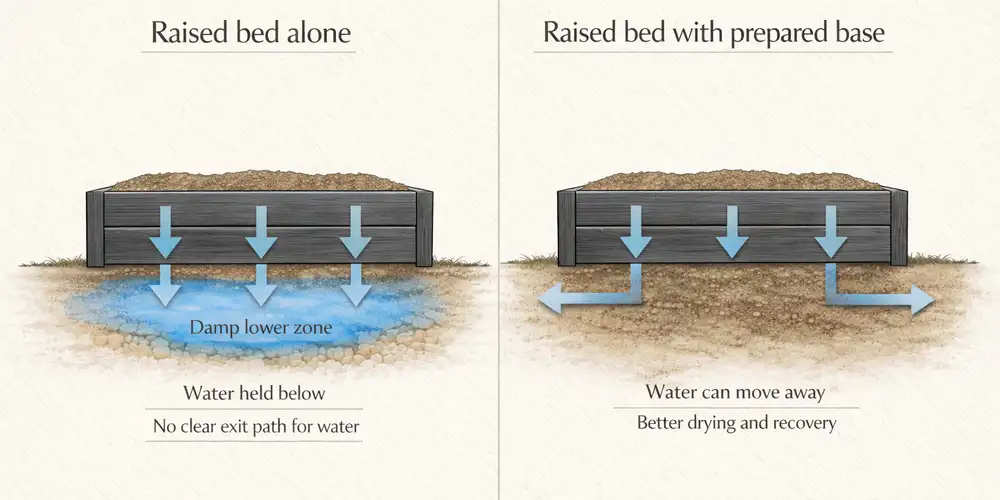
Better judgement starts by treating drainage as a site question as well as a bed question. A raised bed can absolutely improve growing conditions, but only when the ground beneath it and around it is understood properly. The real issue is not whether the bed is raised. It is whether the whole ground system allows excess water to move away and the lower part of the structure to dry and recover between wet periods.
Good drainage comes from how the bed, the ground below, and the wider site handle water together. Raising the soil helps only when the system beneath it can actually let water move away.
Myth: You do not need to think about the ground underneath if the bed is raised
This myth sounds plausible because a raised bed creates a visible frame above the original ground. Once fresh soil is added inside it, it is easy to assume the growing area has been separated from whatever was happening below. The bed appears to create its own environment, so the ground underneath can start to feel like background rather than part of the working system.
That is where the myth fails. A raised bed still depends on the ground below for support, drainage, moisture behaviour, and contact conditions. The lower part of the frame sits in direct relationship with the site it is placed on. If that ground is uneven, compacted, persistently wet, unstable, or badly separated from the base detail, the bed does not escape those conditions simply by being raised above them.
This is the deeper problem with treating the original ground as irrelevant. It encourages people to focus only on what goes into the bed while ignoring what the bed is actually sitting on. But the structure still transfers load into the ground, the lower boards still dry in relation to the surrounding conditions, and water still moves through and around the footprint in response to the site below. Capillary action can also keep drawing moisture upward from damp ground, which means the lower zone of the bed and the timber near the base may remain wetter for longer than expected, even when the soil above looks improved.
Support behaves in the same joined-up way. A bed only performs properly when its footprint bears cleanly and consistently on the prepared base. If the underlying ground is uneven, soft, or poorly prepared, the frame can settle differently from one point to another. That kind of uneven movement, known as differential settlement, creates localised pressure and poorer load-sharing across the bed. Fresh growing medium above does not remove that problem. It simply places the structure on top of it.
Better judgement starts by treating the bed and the ground beneath it as one working system. The question is not only what mix goes inside the frame, but what kind of support, drainage path, contact condition, and moisture environment exist underneath and around it. The frame needs a reliable, even bearing where it meets the site, while the footprint beneath the bed still needs to remain part of a permeable, working ground system.
A raised bed performs best when the frame, the ground below, and the surrounding site are working with each other rather than behaving as disconnected layers. Good preparation begins beneath the bed, not just inside it.
Myth: Adding gravel or stones at the bottom improves drainage
This myth sounds plausible because a coarse layer feels like an obvious drainage aid. Gravel and stones look open, free-draining, and different from soil, so it is easy to assume that placing them at the bottom of a raised bed will help water move away more effectively.
That is where the myth goes wrong. Water does not move through a bed simply because one layer looks more open than another. If a coarse layer is placed beneath finer material, water can hesitate at the boundary rather than passing neatly through it. Instead of solving drainage, the added gravel can create a perched water table, or perched wet layer, above it, leaving the bed holding moisture higher in the profile than people expect.
This is the weakness in the “gravel equals drainage” logic. It treats drainage like a matter of adding a loose material at the bottom, when the real issue is how water moves through the whole profile and where it can actually go next. If the ground beneath still drains poorly, or if the layered transition interrupts movement rather than supporting it, the gravel does not fix the system. It simply adds another layer that sounds reassuring while making the moisture behaviour more complicated.
This is also why the gravel shortcut can feed a small-scale bathtub effect. Water is not being given a better exit route. It is being held above a layer boundary that sounds draining but does not solve the underlying site condition. The result can be a bed that looks upgraded in section while still staying wetter where it matters.
Better judgement starts by thinking about drainage as a profile and exit-path problem, not a token material problem. The real question is whether water can move through the bed, into the prepared base, and away through the surrounding ground conditions without being trapped or slowed by an unnecessary layer.
A drainage layer that traps water above it is not solving the problem. It is changing where the problem sits.
Good drainage comes from how the full system is prepared, not from dropping rubble into the bottom and assuming the problem is solved. A properly considered base detail does more useful work than a familiar drainage shortcut ever can.
Myth: You can fix a bad site with enough imported soil
This myth sounds plausible because fresh imported soil feels like a reset. If the original ground is compacted, wet, poor, or awkward, it is easy to imagine that adding enough new material above it will override those conditions and create a clean start inside the bed.
That is where the myth fails. Imported soil changes what is inside the frame, but it does not correct what the frame is sitting on. Poor support, trapped moisture, bad drainage beneath the footprint, and weak site preparation do not disappear just because a better growing medium has been added above them. The fill may improve part of the system, but it does not automatically repair the base.
This is the deeper weakness in the logic. It treats the bed as if the soil inside it can be separated completely from the conditions below. But the structure still bears on the original ground, the lower zone still interacts with moisture rising or lingering around the base, and water still has to move through and away from the site as a whole. Capillary action can continue drawing moisture upward from wet ground beneath, while poor subsoil drainage can keep the lower part of the system wetter for longer than the fresh fill above would suggest.
A change in soil above does not remove the soil interface below. If the imported layer is looser and freer-draining while the ground underneath remains compacted, wet, or slow to absorb water, moisture can still hesitate or collect at that transition. What looks like a clean, new growing medium can end up sitting over the same badly functioning base, only now hidden from view. In some cases, the fresh soil masks the site problem rather than curing it.
Better judgement starts by fixing the site conditions as well as choosing the right fill. Imported soil can absolutely play an important role, but only as one part of a larger preparation strategy that also considers drainage, support, contact, and the way the bed meets the ground.
A raised bed performs best when the base conditions and the fill above them support each other. Good soil helps, but it does not replace good ground preparation.
Myths about level, contact, and how the bed meets the site
Some of the most damaging raised bed myths are not really about soil mix or drainage layers at all. They are about how the frame meets the site. A bed can look level, feel settled, and still be poorly supported underneath. It can sit on ground that appears flat while the actual bearing is inconsistent, soft, compacted, or interrupted by turf, buried organic matter, or loose surface preparation.
That is why these myths are so persistent. They reduce the meeting point between bed and ground to something visual or cosmetic, when it is actually structural as well as environmental. Level affects load-sharing. Contact affects support and drying. The prepared footprint influences how the frame bears, how moisture behaves at the base, and whether the bed starts life on a clean, stable footing or on a hidden weakness.
Myth: Levelling is just cosmetic
This myth sounds plausible because a slight lean can look harmless if the bed still appears stable. People naturally read level as an aesthetic issue first. If the frame looks roughly right and the soil will still sit inside it, it is easy to assume levelling is mostly about neatness rather than performance.
That is where the myth fails. Levelling is not just visual tidying. It affects how the frame bears on the ground, how load is shared through the structure, and how water behaves within the bed. Once a raised bed is filled, especially in wet conditions, it carries substantial weight. If one part of the footprint bears more heavily than another, the structure does not start from a neutral condition. It starts with uneven support across its bearing surface.
This is where the science matters. A bed that is out of level can concentrate load into one area of the base instead of distributing it cleanly across the footprint. That creates localised pressure and increases the risk of differential settlement, where one part of the bed sinks or bears differently from another. The result is not just a visual lean. It can alter structural behaviour through the whole frame and place extra stress on joints and corners over time.
Level also matters environmentally. Water does not ignore geometry. If the bed starts from a poor level condition, moisture can behave unevenly across the growing area, and the lower boards may spend longer under damp pressure on one side than the other. What looks like a small setup issue can become part of the reason one edge stays wetter, strains more, or dries more slowly over time.
Better judgement starts by treating levelling as structural preparation, not cosmetic finishing. The point is not to make the bed look tidy in a photograph. The point is to give the frame a clean, even bearing condition so that weight, moisture, and load can be handled predictably from the start.
A properly level bed shares load more evenly, begins with better support across its footprint, and gives the whole structure a more stable starting condition. That is not cosmetic. It is part of how the bed works.
Myth: Levelling the soil levels the bed
This myth sounds plausible because surface preparation is easy to judge visually. If the ground looks flatter after scraping, raking, or moving a little soil around, it is natural to assume the bed will sit level once it is placed on top. A smoother surface feels like a prepared surface.
That is where the myth fails. Levelling the visible soil surface is not the same as creating a level, stable bearing condition for the frame. Loose scraping or shifting soil can make the site look tidier without improving how the bed actually bears across its footprint. In some cases, it can even create a surface that appears flatter while remaining soft, inconsistent, or prone to settlement once the bed is filled.
This is where the mechanics matter. A raised bed does not sit on appearance. It sits on contact and bearing. If the base is made level only by moving loose material around, the frame may still bear unevenly when loaded, because the support beneath it is not consistent. Once wet soil is added and the weight increases, those weak spots can compress differently from one another, creating uneven bearing and setting up the risk of differential settlement. What looked level before filling may not remain level once the structure begins doing real work.

This is also why the myth can be misleading environmentally as well as structurally. A base that is visually even but poorly prepared can still allow moisture to linger differently across the footprint, especially where contact is inconsistent or where soft spots hold water longer. The result is a bed that may start life looking correct while already carrying the conditions for uneven support and uneven drying.
Better judgement starts by levelling the prepared base, not just the visible surface. The question is whether the frame will bear cleanly and consistently once the bed is loaded, not whether the top layer of soil has been made to look flatter for a moment. Proper preparation means creating a stable, level contact condition across the footprint rather than relying on cosmetic surface adjustment.
A bed performs best when level comes from genuine support beneath the frame, not from the illusion of flatness on the soil surface. What matters is not how the site looks just before installation, but how it bears once the bed is filled and under load.
Myth: You must dig up the grass or sod before placing the bed
This myth sounds plausible because stripping turf feels like the obvious way to begin cleanly. If grass is visible beneath the bed footprint, removing it can seem like the only proper way to prepare the site. It looks decisive, tidy, and thorough.
That is where the myth fails. Digging up the grass or sod is not automatically the same thing as preparing the ground well. In some cases it may be appropriate, but in others it can disturb the site more than the bed detail actually requires. Removing turf does not guarantee good support, good drainage, or a better contact condition beneath the frame. It simply changes the starting surface.
This is where the real issue becomes clearer. The question is not whether grass exists. The question is what kind of ground condition the frame will actually bear on once the bed is in place. If turf is stripped away and the bed is then set onto softer, more disturbed ground or onto denser subsoil that drains badly, the site can end up less stable rather than more. What looked like proper preparation may simply have replaced a knitted surface layer with a weaker or wetter bearing condition.
That is why unnecessary stripping can be counterproductive. Turf often sits over a shallow surface layer that is more structured and better drained than the compacted material beneath it. Remove it without improving the finished base detail, and you may expose a denser layer that holds water more readily or supports the frame less consistently. In other cases, disturbing the surface leaves the footprint looser and more prone to settlement once the bed is filled and loaded.
Better judgement starts by deciding what the bed needs from the footprint rather than following one ritual step for every site. If turf removal helps create the right bearing condition, contact detail, or perimeter behaviour, it may be justified. If the same goals can be achieved more cleanly through the actual base preparation, then stripping the whole area is not automatically the best answer.
A raised bed performs best when the site is prepared according to how the frame will bear, drain, and dry in use. Good preparation is defined by the finished ground condition beneath the bed, not by whether the process began with digging out the grass.
Myth: Ground preparation only matters on sloping sites
This myth sounds plausible because sloping ground makes preparation problems obvious. A bed placed on a visible incline clearly needs attention if it is to sit level and bear properly. By contrast, a flat site looks straightforward. That makes it easy to assume that real ground preparation only matters when the ground is visibly uneven.
That is where the myth fails. Flat ground can still hide poor support, compaction, buried organic matter, old disturbance, weak drainage, and inconsistent moisture behaviour across the footprint. A site does not need to slope visibly to create structural or environmental problems. It only needs to bear unevenly, hold water badly, or recover slowly after rain.
This is where the mechanics matter. A raised bed performs according to the condition of the ground it bears on, not according to how level the site looks from a standing position. A visually flat area can still contain softer patches, denser zones, slight hollows, or old disturbed ground that causes the frame to bear differently from one point to another. Once the bed is filled and the load increases, those hidden variations can lead to uneven support and differential settlement even though the site never looked problematic at the start.
That risk often becomes more obvious after rain. A bed may seem stable when dry, then reveal hidden weakness once the soil mass becomes heavier and wetter. What looked like a simple static load becomes a more demanding wet load, and the ground beneath starts to show whether it can actually support the footprint consistently. In that sense, some flat sites do not fail because they are sloping. They fail because they were never properly understood beneath the surface.
The same is true environmentally. Flat ground can still drain poorly, trap moisture near the base, or keep parts of the footprint wetter for longer than others. A site may look easy simply because its problems are less visible. But hidden wetness, slow drying, and inconsistent contact with the bed can still shape how the frame performs and how the lower boards behave over time.
Better judgement starts by treating ground preparation as a condition issue, not just a slope issue. The real question is not whether the site looks level at a glance. It is whether the footprint beneath the bed is stable, well-draining, properly prepared, and able to support the frame consistently once it is loaded.
Flat does not automatically mean ready. A site can look simple and still hide weak support, poor drainage, and uneven bearing below the surface.
A raised bed performs best when the site has been understood below the surface as well as above it. Good preparation matters on flat sites too, because flat does not automatically mean ready.
Myths about liners and underlayers
Some of the most repeated raised bed advice appears in the layers people add underneath the bed. Liners, membranes, and weed fabrics sound protective because they promise control. They seem to separate the bed from weeds, moisture, contamination, or uncertainty below. That makes them very easy to recommend as default extras.
That is why these myths spread so easily. An underlayer feels like a precaution, but precautions only help when they match the actual problem. A layer that solves one site condition can create a different one somewhere else. Under a raised bed, the question is not whether another material can be added. It is whether that material helps support drainage, separation, and long-term site behaviour rather than interrupting them.
Myth: You should always line the bottom of a raised bed
This myth sounds plausible because a liner feels like automatic protection. If a raised bed sits over uncertain ground, a physical layer at the bottom can seem like the safest possible detail. It sounds as though it should protect the bed from weeds, moisture, contamination, or contact with whatever lies below.
That is where the myth fails. A bottom lining is not automatically protective just because it creates separation. The real question is what kind of separation it creates and whether the site actually needs it. If the layer interrupts drainage, slows water movement, or creates a trapped wet zone beneath the bed, it may solve less than people imagine. In some cases, it can create the very moisture problems it was meant to prevent.
This is where the mechanism matters. Water moving through a raised bed still needs a path downward and away. If a bottom layer behaves as an impermeable or poorly matched barrier, the bed can begin to hold moisture above it rather than passing it through cleanly into the working ground below. That can create a perched wet zone or small-scale bathtub effect, especially where the surrounding site already drains slowly. Even a permeable fabric can become part of the problem if it creates a textural interruption between layers or slows movement at the boundary.
There is also a longer-term issue. Fine particles can migrate downward and begin to clog the fabric over time, a process sometimes called blinding. A layer that originally sounded breathable can gradually become less permeable in use, turning a precaution into a drainage bottleneck.
The same is true structurally and environmentally. A bottom liner does not improve bearing, level, or site preparation on its own. It also does nothing useful unless the problem it is trying to solve is real and clearly understood. A layer added by default can easily become a token precaution: present in the build, but not actually helping the bed perform better.
Better judgement starts by asking what the underlayer is for. Is it separating a gravel base from fine soil? Reducing siltation into a sub-base? Managing a very specific contamination or pest issue? If there is no clear reason, then a bottom lining is not a default requirement. It is simply another material introduced into a system that may have worked better without it.
A raised bed performs best when each layer beneath it has a defined job. Bottom linings can be useful in the right context, but they are not automatically good practice. The right underlayer depends on the real site condition, not on a general habit of putting something under every bed.
Myth: Weed fabric underneath is always a good idea
This myth sounds plausible because weed fabric feels like a clean preventative step. If weeds are expected to be a problem, placing a barrier underneath the bed can seem like an obvious way to stop trouble before it starts. It looks neat, intentional, and protective, which makes it easy to treat as standard practice.
That is where the myth fails. Weed fabric does not automatically improve what happens underneath a raised bed. It only helps if the site has a specific weed-pressure problem that the fabric is genuinely suited to manage. Used by default, it can become just another layer in the ground system without solving the underlying issue or improving how the bed bears, drains, or dries.
This is where the mechanism matters. A fabric layer still interrupts the contact between the bed and the ground below it. Even when it is permeable, it can alter how water moves at the boundary, slow downward movement, and create a textural break that was not needed in the first place. Over time, fine particles can also begin to clog the fabric, reducing permeability and turning what sounded like a breathable barrier into a less effective drainage layer.
The weakness in the “always use weed fabric” rule is that it treats every site as if weeds are the main problem and a barrier is the obvious cure. That same habit also explains why cardboard is so often discussed beneath raised beds. But neither fabric nor cardboard should be treated as a default layer. The real question is what problem the underlayer is solving, how long it needs to perform, and whether it helps or interrupts the wider ground system beneath the bed.
Better judgement starts by asking what the layer is actually there to do. If the site has a clear weed-pressure issue and the underlayer supports the wider ground detail without interrupting drainage or support, it may be justified. If not, then the fabric is simply another default precaution that may do little useful work beneath the bed.
An underlayer is only useful when it has a defined job. Added by default, it becomes a precaution without a purpose.
A raised bed performs best when every layer below it has a clear purpose and works with the whole site system. Weed fabric can be useful in some situations, but neither fabric nor cardboard should go underneath a raised bed by default.
What better ground preparation looks like
Better ground preparation does not begin with default layers, familiar rituals, or materials that merely sound protective. It begins with understanding what the bed is actually sitting on and how that ground will behave once the frame is loaded, the soil is wet, and time has exposed whatever the site was doing all along.
That is the common thread behind every myth in this article. Drainage is not automatic just because the bed is raised. Gravel does not fix a bad exit path. Imported soil does not repair a weak or wet base. A level-looking surface is not the same as a properly prepared bearing condition. Liners, weed fabric, and cardboard only make sense when they solve a specific problem without disrupting the wider system beneath the bed.
Good preparation comes from treating the bed, the footprint, and the surrounding site as one working system. Support, drainage, contact, separation, drying, and recovery all interact. Once that is understood, the ground beneath a raised bed stops being an afterthought and becomes part of the design itself.
The best ground preparation is not about what you add underneath the bed by default. It is about how well you understand the ground the bed is actually being asked to work with.
If you want the deeper system explanation behind these myths, our article on how to prepare the ground for a raised bed explores the sub-base, moisture behaviour, and perimeter detail in more depth, while premium raised beds shows how those decisions shape the finished structure above ground.
Related reading
- Raised bed myths: structural advice that sounds right but fails
- Raised bed myths: soil advice that sounds right but fails
- Raised bed myths: moisture and durability advice that sounds right but fails
- Raised bed myths: planting advice that sounds right but fails
- Raised bed myths: joint and assembly advice that sounds right but fails
- Raised bed myths: fixing advice that sounds right but fails